


Property through super in a SMSF – Part 1: Background


PropertyFrom the media hype you should already know that self-managed superannuation funds (SMSFs) can borrow funds to purchase assets, provided the borrowing satisfies certain requirements outlined in the Superannuation Industry (Supervision) Act 1993. This can be a very attractive option for SMSF trustees for a number of reasons.

This is Part 1 of a 3 part series. In this first article, we will look at the background to the limited recourse borrowing arrangements that can be used by SMSFs to invest in an asset, specifically a residential or commercial property.

Limited recourse borrowing arrangements

While the Superannuation Industry (Supervision) Act contains a general prohibition against borrowing, SMSF trustees have been able to borrow to acquire assets since September 2007. The Act was further amended in July 2010 with the introduction of new legislation that clarified the intended operation of the borrowing exemption. The rules around the use of borrowed funds for repair and improvement and what is an acquirable asset were further clarified in 2012.

SMSFs may borrow funds to acquire an asset provided the following conditions are satisfied:

1) Single acquirable asset: The borrowed funds must be used to acquire a single asset or a collection of identical assets that have the same market value (which are together treated as a single asset), which the fund would otherwise be permitted to acquire. A single asset could be a parcel of, for example, 1000 ANZ Bank shares, but a parcel of 500 ANZ Bank shares and 500 Woolworth’s shares would not meet the definition of a single asset.

2) Restriction on improvements: The borrowed funds are not to be used to improve the acquirable asset. The ATO recently confirmed its position in relation to repairs vs. improvements of an asset acquired through a limited recourse borrowing arrangement in Self Managed Superannuation Funds Ruling SMSFR 2012/1. For example, if a fire damages part of a kitchen (e.g. the cooktop, benches, walls and the ceiling), the SMSF trustee could use the borrowed funds to restore or replace the damaged part of the kitchen with modern equivalent materials or appliances, but it could not use the borrowed funds to extend the size of the kitchen (as this would be considered an improvement).

3) Beneficial ownership: The acquired asset must be held on a trust where the super fund holds the beneficial interest in the acquired asset. This requires what is known commonly as a ‘bare trust’ or a ‘custodian trust’ to be registered as on the title as the legal owner. This is one of the reasons why the process can get complicated and is the main mistake made in implementing this strategy without doing the groundwork first.

4) Legal ownership: the documentation makes it very clear that the actual beneficial owner is the trustee of the self-managed super fund. After acquiring this beneficial interest, the SMSF has the right to acquire the legal ownership of the asset once it has repaid in full the lending for the property purchase.

5) Limited recourse rights of lender on default: If the fund defaults on the borrowing, the rights of the lender under the arrangement are limited to rights relating to the acquired asset. In other words, the lender’s rights are limited to repossessing and disposing of the asset to recover funds. The lender cannot recover funds from the superannuation fund’s other assets or undertakings. However it can become common practice for the lenders to seek personal guarantees from the trustees in their private capacity to add a layer of protection for the lender

6) Restriction on replacement assets: The acquired asset can be replaced by another acquirable asset (but only in very limited circumstances). For example, the proceeds of a claim after a fire destroys a four-bedroom home could be used to rebuild a four-bedroom home in a newer style but you could not build three town-houses on the same site using the funds.

Types of property that can be acquired

An SMSF can only borrow money to acquire an asset if it would not be prohibited from investing in that asset directly under the Act. This includes residential units, houses, commercial property like office units, industrial warehouses and a current flavour of the day: 7/11 stores! A SMSF is prohibited from intentionally acquiring an asset from a related party of the fund.

The exception, business real property, must be acquired for market value but there are Stamp duty exemptions in some States liked Section 62A of the NSW Stamp Duties act. Business real property is an interest in real property where the property is used wholly and exclusively in one or more businesses. It does not have to be in your own business but it can be and this is why the strategy has been so popular with business people.

The borrowing structure

This diagram shows a typical limited recourse borrowing structure:
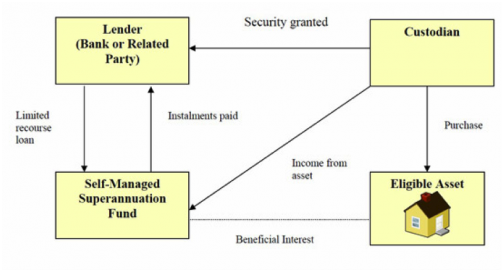
Borrowing through SMSF

Funding Options

There are two main funding options available:

1) Related party lending: There is no restriction on you, your family, a related trust, or similar entity lending the money to the SMSF. The benefits of this are that you can avoid costly bank legal adviser fees and other incidental costs of borrowing from a bank. You must follow the suggested ‘Safe Harbour Provisions’ outlined in ATO guidance on related party SMSF loans (LRBAs) . You cannot put in place a loan that is worse in commercial terms for the SMSF.

In any self -funding scenario you have to expect greater scrutiny by the auditor and regulators so as to avoid any compliance issues, SMSF members choosing self-funding should ensure their loan to the fund is properly documented and meets the requirements of the SIS Act. For example, the trustee of the SMSF must ensure that all investments are conducted on an arm’s length basis. This means that a proper lease agreement must be in place, repayments must be scheduled and met and as mentioned above the terms of the loan cannot disadvantage the SMSF in comparison to what’s available in the market.

2) Third party lending: Nearly all the major banks, and some specialised non-bank lenders, have developed SMSF loan packages specifically tailored to meet the requirements of the Act. I really do recommend that you seek advice from a broker who has experience in this area as the terms and conditions offered by the various lenders differ dramatically as some deal with them through their residential lending division and others through their commercial divisions.

The bottom line:  Placing real estate assets into your self-managed superannuation fund can be both straightforward and financially sensible, but there are certain rules you need to follow carefully, In the next instalment of our SMSF session we will guide you through the steps involved in the process from start to finish. Please seek independent professional advice to ensure that any proposed strategy complies with the law, because there are severe penalties that can apply if the trustee gets it wrong.

NEXT STEP : THE PROCESS OF BUYING PROPERTY IN AN SMSF (all states are slightly different but follow these steps to ensure you don’t fall foul of the rules)

As always please contact me if you want to look at your own options. You can make an appointment by clicking here. We have offices in Castle Hill and Windsor but can meet clients anywhere in Sydney or via Teams or Zoom or FaceTime .

Liam Shorte B.Bus FSSA™ AFP

Financial Planner & Fellow SMSF Specialist Advisor™

     

Tel: 02 98993693, Mobile: 0413 936 299

PO Box 6002, Norwest NSW 2153

40/8 Victoria Ave Castle Hill NSW 2154

Corporate Authorised Representative of Viridian Advisory Pty Ltd ABN 34 605 438 042, AFSL 476223

This information has been prepared without taking account of your objectives, financial situation or needs. Because of this you should, before acting on this information, consider its appropriateness, having regard to your objectives, financial situation and needs. This website provides an overview or summary only and it should not be considered a comprehensive statement on any matter or relied upon as such.

7 Common SMSF Pension Errors


Having set up over 120 pensions and taken over many other clients we know that having the right documentation and following the guidelines set down for accessing pensions is essential to remain compliant and access tax exempt status. Here are some of the common mistakes we see on documentation of pensions that clients bring to us from other sources.

1.  Pension entitlement – don’t bend the rules

You must be over the preservation age to commence a pension. This means that you must have reached the preservation age at the time the pension documents say the pension starts.  A common mistake is to assume this means at the time the first pension payment is made, which is wrong. For example, you may be turning  which is your preservation age on the 1st of October and think that you can start the pension on the 1st of July but not pay any pension payments until after the 1st of October and get the full year of tax exempt  income. This is not possible; in order to start the pension you must have reached the preservation age at the 1st of October. the income for that year will be split pro-rata across the period in accumulation phase pre- 1st of October and in pension phase after that date.

2. Market valuation of assets funding the pension

SMSF Advisors, Accountants and trustees must make sure the assets of the fund are valued at market rates before the pension is calculated. Further they should ensure the assets are revalued at the end of financial year. This is important in determining the level of pension in the coming year is correct and reflects the true value of the assets in the fund. There used to be some leeway especially with property but auditors now seem to be implementing a more rigorous checking system to ensure property values are updated annually.

3. Use a Comprehensive Pension Kit

Timely documentation is essential to ensure that the pension actually commences when you want it to commence. Typically, a pension may start well before an actual pension payment is made as often the financials for the SMSF are not completed yet. Often the pension start date will be 1st July and the actual pension payment may be made quarterly or half-yearly later in the year. The pension kit should reflect this and include at a bare minimum such things as a pension request form from the member to the trustee(s), minutes of the trustee acknowledging and agreeing to the request, notification from the trustee to the member with a draft pension agreement stating the type of pension, start date, frequency of payments and if a reversionary pension is to be applied.  Importantly, it should also include a Product Disclosure Statement which is a legal requirement. The initial pension documentation does not have to have the exact figure of the pension amount but should refer to the fact that this figure will be clarified once the financials are completed. We update the initial kit with a set of minutes after the financials are provided which shows the exact amount in the pension and the relevant minimum and maximums or selected pension payment for that year and the Tax free component of the pension.

Your SMSF advisor of accountant should be able to help with this documentation.

4. Minimum Pension Payments (don’t ignore letters from your advisor!)

Pension payments are only tax-free if you met the conditions required to take advantage of the Tax Exempt Pension Income within the fund (0% tax on the income from the assets supporting the pension). The minimum pension amount must be paid within the financial year. This means that the pension payment must physically leave the SMSF bank account by the 30th June. That is a benefit is paid when the member accepts the money, banks the cheque which is subsequently honoured or receives a credit by way of electronic transfer from the SMSF. As an example, if at the 30th June you have made $6,000 worth of pension payments but your minimum pension payment for the year is $10,000, the $4,000 cannot be carried over and paid at a later date.  In this instance the fund has failed to meet its pension requirements and the pension would be invalid and the entire pension account subject to tax for the full year.

During the financial year all pensions paid must be paid in “cash”;. That is a benefit is cashed when the member accepts the money, banks the cheque which is subsequently honoured or receives a credit by way of electronic transfer from the SMSF. Therefore if a member receives a cheque dated 30/6 and banks it after 30/6, this amount cannot be classed as “cash” for the year ending 30/6 on the cheque. Also a member cannot receive a pension via an in-species transfer from the SMSF to the member.

Our process is to remind clients in April/May each year by advising them in writing the minimum amount payable by the 30th June. We ask clients to confirm they have taken these payments by ticking a questionnaire and returning it to us. If you are receiving a Transition to Retirement Pension the advice also indicates the maximum amount of pension and requests confirmation that this has not been exceeded.

Some strategies are in place for correcting errors before the 30th of June but once that clock ticks over to 1st of July there is little that can be done to amend strategies.

5. Tax and Estate Planning -Tracking the Tax Free Component Amount/Percentage

On commencing a pension the Tax Free and Taxable Components need to be calculated. This percentage split remains the same for the life of the pension. The tax free percentage is calculated by dividing the Tax Free Components by the total starting balance of the pension. The Tax free component should be shown in your Pension Kit (once financials completed) and then reaffirmed in your members account statement annually.

Why is this important if Pension payments are tax free?

The tax free component does not refer to the annual pension payments. The Tax Free Component percentage becomes relevant upon death of the last member without a reversionary beneficiary and can make significant difference to the tax paid by your dependents (particular adult children). Good pension planning may see more than one pension being set up for a member with each Pension allocated towards the most tax efficient recipient beneficiary. i.e. spouse may receive pension with low tax free % while adult children receive the pension with a higher Tax free %.

Some smaller accountants or those who do not have the relevant software may not be tracking your Tax Free component and this may cause a problem later when your remainder pension needs to be distributed.  Check your last statement and If in any doubt you should discuss with your accountant or SMSF Advisor.

6. Ongoing Contributions

A member’s pension account cannot receive new contributions during the year. You can make contributions but these contributions must be credited to a separate accumulation account. A SMSF a member may have more than one pension account but cannot have more than one accumulation account. As an aside this is necessary for a Transition to Retirement Strategy combined with Salary Sacrifice to work properly.

You can rollback (stop) a pension and add the accumulation account balance and then start a new pension.  We term this as RCR (Rollback, Consolidation and Recommencement). Before stopping a pension you must ensure that you first pay the minimum pension to keep the fund tax exempt for the year to that date. For this reason we often rollback the pension at the end of the financial year and recommence on 01st July.

7. Actuarial Certificate

If you have a pension account and accumulation account during the year (i.e you have made contributions) and the fund’s assets have not been segregated you will need to obtain an actuarial certificate to identify the tax exempt percentage of the investment income. The Actuarial Certificates are normally outsourced by the Accountant to an Actuary but you should ensure that they do take responsibility for arranging it for you annually.

As you can see these pension rules can be a minefield to negotiate and advice from a SMSF Specialist Advisor is highly recommended. Through Verante’s SMSF Coaching Service we remind our clients that when it comes to “their money” that there is no such thing as a silly question. With pensions it is essential to get it right up front and double-check before June 30th!

I hope these thoughts  have been helpful and please take the time to comment if you know of other common mistakes as I know this is not an exhaustive list. Would love some feedback as well.

Liam Shorte B.Bus SSA™ AFP

Financial Planner & SMSF Specialist Advisor™

SMSF Specialist Adviser 

 Follow SMSFCoach on Twitter Liam Shorte on Linkedin NextGen Wealth on Facebook   

Verante Financial Planning

Tel: 02 98941844, Mobile: 0413 936 299

PO Box 6002 BHBC, Baulkham Hills NSW 2153

5/15 Terminus St. Castle Hill NSW 2154

Corporate Authorised Representative of  Viridian Advisory Pty Ltd (ABN 34 605 438 042) (AFSL 476223)

This information has been prepared without taking account of your objectives, financial situation or needs. Because of this you should, before acting on this information, consider its appropriateness, having regard to your objectives, financial situation and needs. This website provides an overview or summary only and it should not be considered a comprehensive statement on any matter or relied upon as such.

10 common mistakes made by many SMSF Trustees


I run regular sessions educating Trustees in small groups on how to utilise their SMSF and to avoid common mistakes so I thought I should share the more common ones. Self managed superannuation funds can be kept simple or they can involve very complex strategies. The superannuation system has many rules and regulations that members need to adhere to.  To ensure that you avoid the traps when it comes to self managed superannuation read on! Errors happen

1.    Jumping in too early with a low balance.

Unless you expect to make regular large contributions in the coming years or expect to put a large lump sum (e.g. inheritance) in soon, the administration fees of maintaining a Self Managed Superannuation Fund will erode away any profits and may also eat into your contributions.  The general agreed rule of thumb among honest SMSF professionals for a minimum balance for a Self Managed Superannuation Fund would be $200k. This would only be on the proviso you would be making contributions at or near your concessional cap depending on your age and that you may also be adding some non-concessional funds on a regular basis so that your fund has $400-$500K within 3-5 years.

If there are 2-4 members that are contributing to the fund with frequently largely sized contributions this can justify the use of a self managed superannuation fund earlier.  Just remember that generally it costs around $2,200.00 per annum in auditing, accounting, tax agents fees and ASIC fees for the fund as well as a general 1% investment fee.

2.    Failing to educate yourself first, before you open your fund so you know the basic SMSF rules.

Self managed superannuation funds can be very complex, if you do not know the basic rules of a fund and you are not using a fund administrator like an Accountant or a specialised service, you are asking for trouble! As the number of self managed superannuation funds increase rapidly the ATO as regulators will begin to take a stronger position.  Currently non compliant funds can lose up to 46.5% of the funds assets to tax plus fines for the Trustees!

There is jargon like concessional and non=concessional contributions and tax free and taxable components so take the time to understand them.

The main reasons of funds losing their compliance status is due to providing loans members. Anyone who has just started a self managed superannuation fund whether they have a manager or not that controls the funds should know the basic rules.

Here are some places to start:

ATO central access point for information on SMSFs  http://www.ato.gov.au/super/self-managed-super-funds/

The SMSF Association is pleased to provide you with this ATO SMSF Trustee online resource. ATO approved SMSF Trustee Education Program

By the end of this course, you will have learnt;

  • The basic facts about Superannuation and Self-Managed Superannuation Funds
  • How an SMSF works
  • The investment rules for SMSFs
  • The administration process to keep your SMSF healthy.

http://www.smsftrustee.com/ The Self Managed Superannuation Fund Trustee Education Program has been released by the Joint Accounting Bodies

We run regular seminars on educational topics for SMSF Trustees in groups of 6-10 people. Contact us for more details liam@verante.com.au 

 3.    Drawing on your SMSF for business or personal needs – Read and learn to stick by the Sole Purpose Test

Always remember it is your money but not yet! You are receiving generous tax concessions for providing for your retirement. Break the rules and you will lose those concessions! Self managed superannuation funds are not to be used to fund personal or business needs of the members of the fund or their relatives.  While many may be able to justify a small loan for a short period of time there is a total restriction on lending to members of the fund or related parties which may be extended family members or entities such as Family Trusts, Companies or partnerships.

Another example would be if you invested in a holiday resort unit managed independently by a management company and as part of the arrangement, you are entitled to private use of the apartment, 2 weeks per year. This arrangement would breach of the sole purpose test if used by your or any related party.

4.    Arranging for your SMSF to own your business premises without thinking the strategy through to the end

I actually love this strategy but there are positives and negatives to this situation and you will need guidance from your legal, accounting and SMSF Specialist Advisor. Many owners of small to medium enterprises use this as an effective strategy but others do a half-baked job and leave themselves exposed.

Pros:

  • Direct control of your super investments and a real understanding of where your money is invested.
  • The fund will pay only 15% tax on commercial rent paid
  • If the premises is sold no capital gains tax may be applicable once you are in pension phase and 15% or less if earlier.
  • You can be your own landlord with secured tenancy which allows you greater certainty when fitting out or installing equipment.
  • Keeps liquidity in the business to fund other costs.

Cons:

  • There are thousands of dollars in set-up costs and there are sometimes higher fees involved in getting a loan through your SMSF.
  • If a member of the fund dies without the proper insurance in place the fund may have to pay out death benefits leading to a rushed sale of the commercial premises.
  • If sold to a third-party then there is a possible loss of tenancy to the business which could destroy it.
  • There are strategies that can be built to avoid the cons, it is best to speak to an advisor so that they can see what is best for your personal situation.

5.    Choosing the wrong type of Trustee for the job

 76% of funds in this country still have Individual Trustees or a Trading company as trustee when a Sole Purpose Corporate Trustee would be much more suitable for long-term planning.

With individuals as trustees you need to change the name on all investments if one person leaves (divorce, death, Incapacity to act) or you add a new member (bring in a child, business partner or second spouse!). The paperwork involved is time-consuming and expensive just when it usually most inconvenient.

Please see my previous blog on this subject for more detailed discussion on this topic https://smsfcoach.com.au/2012/08/09/trading-company-as-smsf-trustee-or-sole-purpose-smsf-trustee-company/


6.    Failing to plan for death or serious illness of a member

If the fund is run by a husband and wife or run predominantly by one member, if that member passes it could have devastating impact on the remaining member and the self managed superannuation fund.  Strategies should be put in place so that all members involved in the fund understand the rules and regulations as well as the funds investment strategy.

Effort should be made to ensure the “silent” member is aware of and has met the Accountant, Auditor, and Financial Advisor and is comfortable that they could deal with them in the event of needing them. What’s the use in having a city based advisor if your spouse does not feel comfortable driving into the CBD. Choose a local Advisor for your later years.

All shares should be properly Chess sponsored and all members should have access to account numbers and passwords.

Binding Death Nominations and Reversionary Pensions should be reviewed regularly to ensure they still meet your wishes. The idea of leaving 20% to a son or daughter may have been fine when the fund was doing well but is it still a good idea in 2017? Make sure you do not leave your spouse short!

7.     Rolling to a SMSF without maintaining or transferring Insurance First.

One of the most important factors is to undergo a review of current insurances and to have life insurance integrated into your self managed superannuation fund.  When transferring from retail, employer or industry superannuation fund look to get “Transfer Terms” from insurers to open a new policy in the name of the SMSF without extensive underwriting. DO NOT LEAVE THIS UNTIL AFTER YOU HAVE ROLLED OVER! Despite your own perception of your health and vigour, you may find it hard to find new cover on the same terms or any terms so preserve what you have. Often we keep a small balance in a retail or industry fund just to continue the insurances in there at the group or discounted rates available.

8.    Getting behind on paperwork

More than just filing statements, trustees are required to document every decision that is made whether this is to make an investment, take out insurance, or change bank accounts. This should come in the form of minutes with details regarding who made the decision, on what day and where the decision was made.

The record keeping requirements of an SMSF can be quite onerous and failing to meet them is an easy way to fall foul of the ATO. Business owners usually have enough paperwork as it is, so paying professionals who can look after your record keeping may make sense for you.

9.    Exceeding the contributions cap

The cap on concessional contributions has changed so often in the last decade that confusion reigns each year.

The cap on concessional contributions for 2018/19  is $25,000. The after tax contributions (non-concessional) is capped at $100,000 per annum

There are a number of ways members can get caught out and exceed the cap. For example,

  • if you are paying for life insurance held in another super fund, the insurance premium can be deemed as a contribution. This premium would then be levied at penalty tax rates.
  • If your employer made last year’s June Super contribution in July of this year.

We can show you strategies for a couple to get up to $800,000 to $1,200,000 into super in one year by using a mix of contributions and a holding account strategy.

10.  Not having a proper Cash Hub and losing interest and paying unnecessary fees

If you go to your normal bank to set up a bank account for your SMSF, they will most likely suggest that you use a business bank account. These accounts generally have high monthly fees, transaction fees and provide little to no interest.

We estimated the average cash balance of SMSFs to be between $50,000 and $80,000. Based on these figures, by using business bank accounts, trustees may be costing themselves approximately $3,000 per annum in fees and lost interest.

There are better options out there. Look at Macquarie’s Cash Management Account almost matching the RBA cash rate (noting for first $5K). Link these to an ING Direct Savings Maximiser for the Fund or a RaboDirect Notice Saver Account paying up to 1.8 to 2.35% higher for cash. Use 6, 9 and 12 month Term Deposits where funds are not needed short-term.

Make sure all accounts are opened correctly in the name of all trustees. Get it wrong and it can cost a lot to rectify.

I hope these thoughts  have been helpful and please take the time to comment if you know of others common mistakes as I know this is not an exhaustive list.

Liam Shorte B.Bus SSA™ AFP

Financial Planner & SMSF Specialist Advisor™

SMSF Specialist Adviser 

 Follow SMSFCoach on Twitter Liam Shorte on Linkedin NextGen Wealth on Facebook   

Verante Financial Planning

Tel: 02 98941844, Mobile: 0413 936 299

PO Box 6002 BHBC, Baulkham Hills NSW 2153

5/15 Terminus St. Castle Hill NSW 2154

Corporate Authorised Representative of  Viridian Advisory Pty Ltd (ABN 34 605 438 042) (AFSL 476223)

This information has been prepared without taking account of your objectives, financial situation or needs. Because of this you should, before acting on this information, consider its appropriateness, having regard to your objectives, financial situation and needs. This website provides an overview or summary only and it should not be considered a comprehensive statement on any matter or relied upon as such.

Managing the Government Guarantee on Term Deposits as an SMSF Trustee


ID-100264824

SMSF trustees are able to take advantage of cash accounts backed by the Federal Government’s Financial Claims Scheme (FCS), commonly known as the government guarantee, to improve the security of their capital and achieve good levels of interest.

In 2012 the Government announced the guarantee on deposits was to be reduced to a $250,000 cap, down from $1m cap in place since 2008. The lower limit is a concern to many SMSF Trustees given that it reduces competitiveness between the Big 4 banks and smaller the regional banks and the building societies.

The initial reaction especially for the risk averse was for Term Deposits larger than the cap to drift back to the CBA, ANZ, Westpac and NAB, given their much higher credit ratings. They have capitalised on the move and as a consequence we see lower term deposit rates from the Big 4 for amounts more than $250,000 since February 2012.

So what strategies are available to retain the government guarantee and to secure the higher interest rates.  Here are some ideas for the SMSF Trustees and Self funded Retirees to consider:

  1. Do your research on your target providers and consider if the guarantee is really needed. If you are willing to take the risk on the solid backing of many of Australia’s financial institutions. If you are happy with them then you may just opt for the highest interest rate paying one and don’t be afraid to ask them to get you a better deal than advertised as you can get 0.05 to 0.2% by asking! It all adds to your bottom line so don’t be shy.
  2. If you have more than $250,000 to invest, you could split your investment between a number of providers. At www.ratecity.com.au and www.mozo.com.au  they give you details of a number of different institutions such as ING DIRECT, ME Bank, Greater Building Society and Rabobank. Don’t be afraid of these names not being too familiar, they have the guarantee! You could split deposits across 3-4 institutions as well as your current Big 4 favourite and maintain the guarantee on your portfolio.  It does involve a bit of work to set up initially but if you’re wanting a government guarantee, then it’s worth the initial effort, think of it as an Insurance policy application!
  3. The added benefit is that should you need access to some funds urgently then you may only have to break one of the Term Deposits instead of previously breaking the one large one and incurring Break Fee, which we all hate. You may stagger the terms to ensure even more flexibility.
  4. Now you may not be comfortable with this one as the level of knowledge about this sector is not great among individual trustees but you might consider buying some bonds for a higher return. By investing lower in the capital structure in those well-known banks where you are confident that they will continue to trade, you can pick up a higher return. While senior bonds are higher risk than term deposits, the main benefit they have is that they are liquid and can be sold very quickly.
  5. Yields on Australian dollar bonds are not great at the moment as market expectations for a low growth world economy spreads with the IMF this week reducing forecasts even further. Your adviser or fixed interest broker can guide you towards the better risk and decent yielding bonds and you can expect 2.5 to 5.5% for what I would consider suitable risk for a moderately conservative investor if well diversified.
  6. Don’t chase a guarantee or safety to far and limit exposure to underpaying securities like the 10-year government bond, 2.58 per cent. For $50,000, some of the best-paying, three-year term deposits with the deposit guarantee are paying in excess of 3.2 per cent.
  7. If you want diversity without the extra paperwork think about outsourcing this sector to a professional fund manager like Macquarie Income Opportunities Fund. Schroders or Henderson also have decent offerings in this conservative end of the sector. Look for a mindset in a Fund Manager that sees Capital Preservation as a core to their strategy.
  8. Instead of lending to the bank, buy the bank or at least blue chip shares that provide decent dividends. Buy no more than a handful of reliable blue-chip stocks that pay a regular dividend and are forecast to continue to do so through thick and thin. These should be “bottom drawer” stocks. If you have only got a small part of your wealth invested in them then you can afford to let them ride the volatility but you still need to watch their sector for any major changes (think Blockbuster video demise after online streaming). I am talking about the 1 or 2 banks, the consumer staples like Wesfarmers and inflation linked income companies like APA Group which owns Australia’s largest natural gas distribution and storage infrastructure network, constituting mainly gas transmission and distribution, mostly servicing power generation, industrial, and commercial customers.

All to0 hard? Well at Verante Financial Planning we have access to a facility that can access over 20 Term Deposit providers in one place with a one-off application form and easy transfer from institution to institution at maturity for the best rates.Have a look at Australian Money Market

In summary it appears most people are unsure about the future and want guarantees on their investments while on the other side younger people don’t want to take on additional debt at this time. This means we’re likely to see rates remain low for some time. By doing some research and comparing what’s available in the market and maybe seeking advice for a second opinion you can find the Term Deposit that suits your needs.

Are you looking for an advisor that will keep you up to date and provide guidance and tips like in this blog? Then why now contact me at our Castle Hill or Windsor office in Northwest Sydney to arrange a one on one consultation. Just click the Schedule Now button up on the left to find the appointment options.

Liam Shorte B.Bus SSA™ AFP

Financial Planner & SMSF Specialist Advisor™

SMSF Specialist Adviser 

 Follow SMSFCoach on Twitter Liam Shorte on Linkedin NextGen Wealth on Facebook   

Verante Financial Planning

Tel: 02 98941844, Mobile: 0413 936 299

PO Box 6002 BHBC, Baulkham Hills NSW 2153

5/15 Terminus St. Castle Hill NSW 2154

Corporate Authorised Representative of Viridian Select Pty Ltd ABN 41 621 447 345, AFSL 51572

This information has been prepared without taking account of your objectives, financial situation or needs. Because of this you should, before acting on this information, consider its appropriateness, having regard to your objectives, financial situation and needs. This website provides an overview or summary only and it should not be considered a comprehensive statement on any matter or relied upon as such.

Image courtesy of Stuart Miles at FreeDigitalPhotos.net

Five pointers to consider when looking at dividend investing


Ok so you are looking to get back in to the market or use the current dip to add to your portfolio and everyone in every article is saying look for Yield! Well how do you do that or how  do you explain it to a client? I found this article on Morning Star and it was very easy to read and understand so I thought it would be appropriate to pass it on. It discuss 5 points to consider when looking a Dividend Investing:

  1. Look at the past and future – where have dividends come from in the past and can the company sustain them into the future.
  2. Look behind the yield – why is the yield high. Is it because the capital value has fallen or because dividends increasing over time. Capacity to grow its dividends is essential.
  3. Look closer at cyclical stocks – Cyclical companies like Newcrest Mining (NCM) may also have a tendency to pay sporadic dividends and you do not want to be buying into a story that will change in the short-medium term. Again consistency and future capacity are the core.
  4. Look beyond banks – don’t get overexposed to one sector . Look at consumer staples (MTS, WOW, WES), Healthcare, Infrastructure all defensive high yielding sectors. Because the Global financial Crisis revolved around banking, this sector has been more volatile in the recent past and looks to continue in this vein for years to come.
  5. Look for tax implications – what is useful for one type of investor is not for another. Franking Credits are the “CREAM” for a SMSF Pension Investor but of little or no use to someone on a higher Tax Bracket. Look at the after tax implications of an investment for your particular circumstances

So as I said some good points to consider and if you want to read the article in full please go to Click here

Liam Shorte B.Bus SSA™ AFP

Financial Planner & SMSF Specialist Advisor™

SMSF Specialist Adviser 

 Follow SMSFCoach on Twitter Liam Shorte on Linkedin NextGen Wealth on Facebook   

Verante Financial Planning

Tel: 02 98941844, Mobile: 0413 936 299

PO Box 6002 BHBC, Baulkham Hills NSW 2153

5/15 Terminus St. Castle Hill NSW 2154

Corporate Authorised Representative of Viridian Select Pty Ltd ABN 41 621 447 345, AFSL 51572

This information has been prepared without taking account of your objectives, financial situation or needs. Because of this you should, before acting on this information, consider its appropriateness, having regard to your objectives, financial situation and needs. This website provides an overview or summary only and it should not be considered a comprehensive statement on any matter or relied upon as such.

How to react to this volatility as a SMSF Trustee / Investor.


The volatility over the last 6 months has been staggering but it is not unusual in historical terms as it has happened many times before. The difference now is that we are bombarded through all the forms of media with the daily movements of our investments and you just cannot ignore that weight of news. Also many people are now able to take more control of their investments via their own Self Managed Super fund or retail Master Trust / Wrap account.

It’s enough to make an anxious investor abandon shares entirely. But if you jettison equities from your portfolio in favour of cash, bonds and term deposits, it will take you much longer to reach your savings goals, and you may not get there at all.

When you look at current interest rates as being a pretty good predictor of what bonds/fixed interest will return in the future, the outlook isn’t particularly good with the 3yr bond yield hovering around 3.87% and inflation tickling the 3% band.

Likewise, interest rates from term deposits and high interest cash accounts have been dropping sharply in the last 2 weeks with 4s and 5s now in front of 6 month rates where 6s were common last month and forecasters now looking at rate cuts in October.

While short-term fluctuations in the market can be unnerving, they rarely affect long-term returns, for example investors who moved their savings into cash at the end of 2008 and stopped contributing to their superannuation accounts now have an account balance worth 20% less than investors who remained in the market.

With no end to volatility in sight, how do you keep your head while all around you are losing theirs? Here are some coping strategies:

Rebalance, Rebalance, Rebalance. Volatile markets can distort your portfolio. For example, if your goal is to have 35% of your savings in Australian equities, 20% in International Equities, 10% in property, 25% in Fixed Interest and 10% in cash, a big market meltdown could increase the amount you have in Fixed Interest and lower your allocation in equities and property.

To rebalance, you should sell some of your best-performing funds (fixed Interest, bond and cash funds) and put the money in your worst performers, something many investors lack the fortitude or commitment to do. We all know in theory what we’re supposed to do, but in reality do the opposite and flee to the best performer or cash. I know it hurts but you have to understand market cycles as opposed to “herd mentaility”. Look at Warren Buffet this week investing $5 Billion in Bank of America when most were fleeing the stock. He has a strong track record of buying when stocks are out of favour with the mainstream.

Don’t be blind to significant changes in markets like the rise of Asia or the risk of sovereign debt. Look out for changing trends like the move towards income orientated stocks. Your adviser should be pointing these matters out to you and identifying strategic asset allocations to allow for them.

How often should you rebalance? We recommend conducting regular portfolio reviews every six months, but only rebalancing when your allocation is at least 5 percentage points way from your benchmark.

Revisit you long term strategy and stick to it.  If the thought of rebalancing makes your palms sweat, consider investing your savings a “life cycle” strategy. This name for the common strategy, which has become much more popular in the last decade, invests in a mix of shares, bonds and cash and gradually become more conservative as you approach retirement. It is nothing new and most advisers will adjust your portfolio this way as part of your overall strategy but maybe you have not discussed this with them for awhile and the volatility may have led to inaction. Well now is the time to consider your future strategy and get that down in writing so you and your adviser are clear on your objectives, timelines and changing strategy over time.

Resist chasing this year’s ‘winner’ is just as likely to be next year’s ‘loser’. Even during the darkest days, some investments will shine. Lately, the flavour of the day has been gold, which is up considerably this year vs. a decline of almost 9% for the All Ordinaries.

The rise of exchange traded funds and similar products in the past few years has made it easier for small investors to invest in “hard” assets, such as gold and other commodities. In small doses, such investments can diversify your portfolio, but they’re easily abused. For example, while gold has been a winner this year, it’s not for the fainthearted. Factoring in inflation, it would have to reach $2,113 an ounce to reach its 1981 high of $850. That was a long time in the doldrums in between its peaks!

Have a look at the Russell Long Term Investment Returns report for more insight in to this subject. http://www.russell.com/AU/_pdfs/market-reports/asx/ASX_Report_2011.pdf

Save more. In this uncertain world, the amount you save is one of the few things you can control. If your employer matches super contributions or you take advantage of the Government co-contribution fro you or your spouse, you’re guaranteed an investment return — something even gold can’t deliver.

If you look back at just how complicated and volatile the last 10 years have been, people who diversified and rebalanced and kept contributing are well ahead of where they were a decade ago.

Liam Shorte B.Bus SSA™ AFP

Financial Planner & SMSF Specialist Advisor™

SMSF Specialist Adviser 

 Follow SMSFCoach on Twitter Liam Shorte on Linkedin NextGen Wealth on Facebook   

Verante Financial Planning

Tel: 02 98941844, Mobile: 0413 936 299

PO Box 6002 BHBC, Baulkham Hills NSW 2153

5/15 Terminus St. Castle Hill NSW 2154

Corporate Authorised Representative of Viridian Select Pty Ltd ABN 41 621 447 345, AFSL 51572

This information has been prepared without taking account of your objectives, financial situation or needs. Because of this you should, before acting on this information, consider its appropriateness, having regard to your objectives, financial situation and needs. This website provides an overview or summary only and it should not be considered a comprehensive statement on any matter or relied upon as such.

Are we crazy to invest overseas?


Unless you have been in limbo for the last 10 years, you would have noticed that the Australian share market has outperformed international markets over the past decade. Australian shares have outperformed while the US and Europe have been like a quagmire slowly sucking up and depleting our investment funds. SMSF funds have traditionally had a low exposure to this sector and that has paid off in the last 10 years but prior to 2000 it meant they were underperfoming. Has the time come to look at this sector again with potential for another significant drop in the Aussie dollar over the next few years and stellar returns on international funds  as well as improved outlook for the US and Europe as our economy slows? International Investing

The  question for investors is “why should we invest our savings anywhere else other than Australia?  Time to look deeper into an explanation of why Australia has done so well and can it continue or do we need to be looking ahead of the pack for likely changes.

I read recently on the Motley Fool website a warning about false statements like “Diversification is the monster that needs stabbing, because world markets are actually becoming more closely correlated to our home markets, not less”. If this was true then why would we take on currency risk and invest internationally?

Fund managers, asset consultants and financial advisers maintain that good asset allocation is the biggest key to long-term investment returns. However, looking at the ASX200, we realise immediately that our Banking(financial services) and Mining & Resources(20%) sector account for 52% of our index. In comparison, the commonly used benchmark S&P500 only has 30% in these two sectors.

This huge bias is the key reason for the outperformance over the past decade as both of these sectors have had strong returns. The banks prospered through low international borrowing costs and massive consumer driven spending financed through increased household debt while the Chindia (China & India ) story was and still maybe the basis for resources growth here in the “lucky country”. This bias also provides greater risks and when the resources/commodities boom ends and/or our residential housing sector slows down, investors will truly need to think twice about having their money so heavily invested in these two sectors. Now don’t kill the messenger or rush to argue, I am not saying its imminent or that these are poor investments but the markets do go in cycles and better to be ready than blind. Even for a long-term investor you need to choose your entry and exit points in to any investment and while I don’t recommend trying to time markets, neither do I recommend ignoring historical trends and experiences of past cyclical highs and lows!

This is one of the big reasons why it is still important to allocate a certain percentage to international markets. I look for funds and investments that are easy to explain and one of those for example is the Magellan Global fund that invests in global household names like Ebay, Microsoft, Yum Brands (owner of KFC and Pizza Hut) and Novartis (global drug company owns brands like Voltaren and Ritalin). These are brands we all know and use and what is more important, the emerging middle classes in China, India and South America will aspire to obtain their products , so I can see where their current income and future earnings growth will come from.

I wish I knew the exact time when Australian markets would start to underperform and when international investments would pay off  but no one can be certain and by the time it becomes “blatantly obvious” we probably will have missed the boat, so I continue a strategy of diversification with a allocation into international funds with a proven record of  investing in companies with consistent earnings and potential for income growth over the long-term.

Liam Shorte B.Bus SSA™ AFP

Financial Planner & SMSF Specialist Advisor™

SMSF Specialist Adviser 

 Follow SMSFCoach on Twitter Liam Shorte on Linkedin NextGen Wealth on Facebook   

Verante Financial Planning

Tel: 02 98941844, Mobile: 0413 936 299

PO Box 6002 BHBC, Baulkham Hills NSW 2153

5/15 Terminus St. Castle Hill NSW 2154

Corporate Authorised Representative of Viridian Select Pty Ltd ABN 41 621 447 345, AFSL 51572

This information has been prepared without taking account of your objectives, financial situation or needs. Because of this you should, before acting on this information, consider its appropriateness, having regard to your objectives, financial situation and needs. This website provides an overview or summary only and it should not be considered a comprehensive statement on any matter or relied upon as such.

Divorce in your 50’s or 60’s with an SMSF and/or Small Business to deal with?


Divorce in an SMSF

Can a Small Business or SMSF survive?

Mel Gibson & Robyn Moore separated after being married for nearly 3 decades, Brad Pitt and Angelina Jolie for just 12 years. Greg Norman and his first wife Laura were together for 25 years and now he is on to his 3rd marriage!

These long-married celebrity couples are far from alone and throughout Australian society this is becoming a common occurrence. Fewer married couples are making it to their 25th, 30th and 35th wedding anniversaries—even as life expectancies have increased.

We as Financial Advisers and the Divorce lawyers we work with are seeing a growing number of long-married couples call it quits. This is being termed “Grey divorce” or “Empty Nest Scenario”

As years go by, kids leave home, business demands grow and they get close to retirement age, where they will have to be near one another more, one of them usually realises they don’t want to live the rest of their life in this manner or they want to seek out new experiences like international travel, a tree change or seachange or just want to concentrate on themselves or their business.

A long-married couple that has done well financially must figure out how to divide investments, superannuation and other retirement savings, investment properties and businesses started by one spouse during the marriage. They must contend with a crazy quilt of regulations—some federal, some state and some set out by superannuation legislation.

Pulling apart all the entangled arrangements woven into a web over 20 or 30 years is difficult and stressful. But dividing a nest egg in a way that allows both spouses to retire without worry is crucial when there is little work time left to make up any shortfall.

Many of my clients are in their 50s and are getting divorced after two or three decades. But the strategy for one client can be totally different for another who is different only in age. The plan or strategy for a woman in her late 50’s who has not been in the work force for 30 years is totally different to the one for woman in her early forties with a recent employment history.

For older women negotiating a financial settlement as part of separation or divorce, that money has to last the rest of their lives. Even if they are employed, there’s usually a huge difference between the husband and wife’s remuneration packages.

Splitting up assets like shares, managed funds, bank accounts and insurance policies is relatively straightforward. But some of the largest family assets can be much trickier. Among them:

  • The house. This property holds memories of children, is close to friends and represents a lifetime of effort and a haven of comfort during a stressful time. If you owned your home you felt safer than when renting. As a result many wives seek to have the home included in their part of a settlement not realizing that they will fall into that Asset Rich – Cash Poor Trap. Rates and upkeep still need to be met while the remaining assets received in the settlement then need to work even harder to meet living costs.
  • The Superannuation Nest Egg. A couple’s biggest asset, aside from their house, is often the superannuation accounts and the majority of the time one account is far larger than the other. Superannuation accounts are by law in individual names, but they are still considered marital property if they were earned or acquired during the marriage. Dividing it fairly could mean the difference for a non working spouse between a secure retirement and a hand-to-mouth existence.

 Self Managed Superannuation Funds (SMSFs):

Many people think because they have a family SMSF and all the money is usually pooled together for investments, that all the money is owned jointly between the husband and wife. Time to refer back to the annual statements and look at the members reports which will reflect the true ownership of the funds as it is broken down between the members.

An SMSF with just a husband and wife members who are getting divorced will almost certainly involve one of the members moving to another fund. This may involve moving the current market value of the exiting member’s account balance as well as an agreed amount of their former spouse’s account balance.

These are two separate amounts and must be treated as such. These payments require totally different reporting requirements and also probably give rise to different income tax outcomes for the SMSF fund.

It is important to ensure that these super fund tax issues are sorted out with complete accuracy so that one member does not unfairly pay proportionately more tax than the other member.

 The latest Family Law provisions allow the parties to enter into an agreement at the time of marriage breakdown specifying how the superannuation interest is to be divided. However, no actual splitting occurs until a member’s benefit is paid.

The Superannuation Industry Supervision Regulations 1994 allows the benefit in most superannuation funds to be split at the time of the divorce. Therefore, two separate interests are in effect created – one for the member spouse, and one for the non-member spouse.

 A division of a superannuation interest may be initiated in one of three ways.

  •  The parties may prepare a Superannuation Agreement, which they lodge with the trustee (together with proof of marriage breakdown or separation).
  •  If both parties cannot agree on how the interest should be split, they must refer the matter to the Court. The Court will have the jurisdiction and the power to make an order about a superannuation interest that will bind the third-party superannuation trustee, or
  •  Parties will be able to make a ‘flagging’ agreement. It prevents the trustee from paying out any benefit to the member spouse without first asking the parties how they wish to split the benefit. Parties would need to enter into a ‘flag lifting agreement’ at a future date to terminate the ‘flagging agreement’ and provide for the division of the superannuation split. This would be used where the parties are close to retirement and would rather wait and see the exact benefit before determining how to split it.

Where an interest in an SMSF is subject to a payment split under the Family Law Legislation Amendment (Superannuation) Act 2001:

Specified benefit components will be split on a proportionate basis to the overall split.

Any capital gains or losses that arise from the creation or foregoing of rights when spouses enter into binding superannuation agreements, or where an agreement comes to an end, will be disregarded.

When dividing up the assets in an SMSF we try to have an agreement to ensure that the spouse with lower income from employment receives the highest proportion of their member benefits as liquid assets or blue chip shares rather than property or illiquid investments. Often we can look at setting up Transition to Retirement Pensions to access tax effective cash flow from 55 onwards.

 The Family Business:

Mid- to late-life divorce can cripple a business started during the marriage and owned by one spouse, because the other spouse is generally entitled to a share. Tax planning measures taken during good times to be able to distribute earnings across the family may now result in the business being torn apart as each spouse seeks to extract their equity in the business. Without careful planning, the business might have to be sold to comply with those terms or the business principal may have to take on excessive debt in their late 50’s to payout the former spouse.

We recommend that couples with a small business—especially those with children—enter into a “post-nuptial” binding financial agreement that spells out what happens to the business in the event of death and divorce. Such agreements, which need to be prepared by a solicitor well versed in Business and Family Law, are recognized in most states, are increasingly being used in estate planning, particularly for people in second marriages.

 Summary:

  • Divorce later in life means you have to ensure you cover yourself for lifetime expenses
  •  See the maximum liquidity and flexibility in dividing assets especially from an SMSF where there is flexibility.
  •  Serious financial consideration should be made before fighting to hold on to the family home as it could become a burden you cannot afford.
  •  Small Business owners must plan in advance for the handling of divorce or death of a business partner.
  •  You need an Accountant, Financial Adviser and Lawyer used to dealing with Business as well as Family Law.

I hope this is useful information for you and we always welcome new client enquiries. Would love some feedback.

Liam Shorte B.Bus SSA™ AFP

Financial Planner & SMSF Specialist Advisor™

SMSF Specialist Adviser 

 Follow SMSFCoach on Twitter Liam Shorte on Linkedin NextGen Wealth on Facebook   

Verante Financial Planning

Tel: 02 98941844, Mobile: 0413 936 299

PO Box 6002 BHBC, Baulkham Hills NSW 2153

5/15 Terminus St. Castle Hill NSW 2154

Corporate Authorised Representative of Viridian Select Pty Ltd ABN 41 621 447 345, AFSL 51572

This information has been prepared without taking account of your objectives, financial situation or needs. Because of this you should, before acting on this information, consider its appropriateness, having regard to your objectives, financial situation and needs. This website provides an overview or summary only and it should not be considered a comprehensive statement on any matter or relied upon as such.

Tax Planning for Small Business owners over 55


EOFY Tax Tips for Small Business

Business Owner Tax Tip

Welcome to my first attempt at a blog with an idea for end of year tax planning aimed specifically at Small/Medium Business Owners.

Ok, so you run your own business and are finally making a profit even if it is just on paper. Now you are looking at your tax position for the current year before June 30th just like you have been encouraged to do. You have spoken to your accountant and know you have a forecast profit for the year after deductions of say $25,000 in your small company after already taking a decent salary for living expenses. Well at the 30% corporate rate the tax will be $7500. But hey, your business does not have that sort of cash in the bank? you have used the profits to plough back in to more stock or equipment for your business.

Here is a strategy for over 55’s to consider if they have a cashflow shortfall for June 30th tax planning.  Look at your Superannuation and if you have not moved into Transition to Retirement Phase you could arrange to do so and access up to 10% of your balance before June 30th as a pension. Lets assume you had $200,000 in Super so you could access $20,000 this year.

You could then lend the money to your company via a shareholders loan and the company could use the funds to make a tax deductible employer contribution back into your superannuation. why you ask?

Well the company gets a tax deduction of $20K reducing its tax bill from $7500 to $1500…..Nice! Now you pay 15% contributions tax on these concessional contributions so of the $20,000 you pay tax of $3000. so overall you save $3000 in tax and you have moved $20,000 from your company into your retirement savings.

Now as you have taken the pension, if you are over 55 but under 60 you need to add this to your taxable income…but the nice government give you a 15% Pension tax offset to reduce the tax payable. Once over 60 you do not need to report it in your income so an even better outcome (has to be at least one benefit of getting older!)

Any other benefit of this strategy?

By moving the $200,000 to Pension Phase any further earnings or capital gains are now exempt income and you pay Nil (0%) tax in your superannuation pension on those earnings. So if your fund earned 5% for the year or $10,000 you save an extra $1500 per year. Better still , if your super fund is invested in shares and received franked dividends your fund will get a refund from the taxman of those franking credits…bonus!

As you now have a shareholder loan to your company you can have the company repay you that loan during the next year rather than taking a higher taxable salary from the company and thereby reducing your marginal tax rate.

Things to check :

  • your age – you have to have reached your preservation age which is now rising towards 60- check here

Preservation age

Access to super benefits is generally restricted to members who have reached preservation age. A person’s preservation age ranges from 55 to 60, depending on their date of birth.

Date of birth Preservation age
(years)
Before 1 July 1960 55
1 July 1960 – 30 June 1961 56
1 July 1961 – 30 June 1962 57
1 July 1962 – 30 June 1963 58
1 July 1963 – 30 June 1964 59
After 30 June 1964 60
  • your tax position personally and via your company or business (see your tax agent/accountant/bookkeeper)
  • your superannuation balance
  • check you have not exceeded your contribution limits.

I hope this guidance has been helpful and please take the time to comment. Feedback always appreciated. Please reblog, retweet, like on Facebook etc to make sure we get the news out there to do plenty of research first and only trust those that have earned your trust. As always please contact me if you want to look at your own options. We have offices in Castle Hill and Windsor but can meet clients anywhere in Sydney or via Skype.

Liam Shorte B.Bus SSA™ AFP

Financial Planner & SMSF Specialist Advisor™

SMSF Specialist Adviser 

 Follow SMSFCoach on Twitter Liam Shorte on Linkedin NextGen Wealth on Facebook   

Verante Financial Planning

Tel: 02 98941844, Mobile: 0413 936 299

PO Box 6002 BHBC, Baulkham Hills NSW 2153

5/15 Terminus St. Castle Hill NSW 2154

Corporate Authorised Representative of Viridian Select Pty Ltd ABN 41 621 447 345, AFSL 51572

This information has been prepared without taking account of your objectives, financial situation or needs. Because of this you should, before acting on this information, consider its appropriateness, having regard to your objectives, financial situation and needs. This website provides an overview or summary only and it should not be considered a comprehensive statement on any matter or relied upon as such.