Can I borrow to buy a house and land package off the plan in my SMSF?


I have had a number of enquiries about this strategy in the last few weeks and I felt it was worth clarifying some details.

Off the Plan

Off the Plan

As with any strategy where you commit to a large future purchase in a moving market and also take a risk on the developer performing to contract, buying off the plan can be risky.  Especially because of the way these contracts shift the risk away from the developer.  With a Self Managed Super Fund purchase with a mortgage this can be even more of an issue if the proposed lender’s final valuation comes in lower than the contracted price which is more common recently. You may then be forced to come up with the shortfall in your SMSF which may be more difficult if you have exhausted your contribution limits.

Here are the basic essentials to getting this type of strategy right:

  • The “property purchase” should be subject to one contract which must be for the completed house and land. Do not purchase land and then look for an SMSF loan to construct a property on it. You will be too late to use the land as security.
  • It is often better to have the SMSF pay the deposit and only have the lending arranged as part of the settlement. In my opinion the Holding Trust should still be in place with the Custodian/Holding Trustee on the title of the contract from the outset.
  • Ensure that the bank/ lender’s only security is only over that land and completed house/unit;
  • The only payments made in respect to the purchase are for the deposit and settlement with no “progress payments”. You may breach the “single acquirable asset” rule which is a big no-no!.
  • Be prepared to move quickly at the time of settlement. LRBA loans do not go through lender’s quickly and you should have as much of the documentation prepared in advance and ready to go as is possible. Drum this into your Mortgage Broker and Solicitor.
  • Do not borrow to the limit of your SMSF. Make sure you have some liquidity to manage low valuations or the demand for a lower LVR from the lender. Alternatively have the capacity and ability to add funds to your SMSF without breaching a contribution cap.

Now there are some who feel that more than 2 payments are possible and that the law is silent on the matter but my philosophy is to KEEP IT SIMPLE! Why makes things difficult for yourself especially when there are developers out there redesigning their contracts to meet the basic 2 payment strategy.

For those looking for more detail I would recommend reading the  issues addressed by the ATO their Taxpayer Alert TA 2012/7 and in the minutes of discussion at the NTLG Super Technical sub-group (December 2012) (if you can find a copy as the ATO took down the page) with specific reference to  example 10 within SMSFR 2012/1.

My final tip is to use a SMSF Specialist Advisor who has dealt with SMSF property borrowing and look for references from client’s they successfully guided through the process. Use a conveyancer or solicitor with experience in the intricacies of these strategies. Use a Mortgage broker that knows how to place these specialised loans and is thinking ahead at all times. Oh and READ YOUR TRUST DEED!

Are you looking for an advisor that will keep you up to date and provide guidance and tips like in this blog? Then why now contact me at our Castle Hill or Windsor office in Northwest Sydney to arrange a one on one consultation. Just click the Schedule Now button up on the left to find the appointment options.

Liam Shorte B.Bus SSA™ AFP

Financial Planner & SMSF Specialist Advisor™

SMSF Specialist Adviser 

 Follow SMSFCoach on Twitter Liam Shorte on Linkedin NextGen Wealth on Facebook   

Verante Financial Planning

Tel: 02 98941844, Mobile: 0413 936 299

PO Box 6002 BHBC, Baulkham Hills NSW 2153

5/15 Terminus St. Castle Hill NSW 2154

Corporate Authorised Representative of Viridian Select Pty Ltd ABN 41 621 447 345, AFSL 51572

This information has been prepared without taking account of your objectives, financial situation or needs. Because of this you should, before acting on this information, consider its appropriateness, having regard to your objectives, financial situation and needs. This website provides an overview or summary only and it should not be considered a comprehensive statement on any matter or relied upon as such.

Property through super in a SMSF – Part 3: 20 most common mistakes


Buy Sell PropertyFollowing on from our previous 2 articles on SMSF and Property, the next logical step is to show where others have commonly made mistakes and how to avoid these errors. I have looked at the errors as they would be experienced in the pre-planning phase, during the borrowing process and once the loan is in place to make it easier to follow and to refer to later. In my opinion, these errors are the most common cause of investor angst and additional costs. They can lead to extremely negative experiences when borrowing to buy property inside a SMSF and are best avoided!

Before the purchase:

Error #1 – Believing purchasing an SMSF property purchase is a standard process

The superannuation system was set up as a concessionally taxed system with one sole purpose and that is to provide for retirement income. The regulators therefore are determined to preserve the integrity of this aim and you should keep this in mind when dealing with any issue related to superannuation and your self-managed super fund in particular.

There are numerous compliance obligations that you must consider that would not be of concern to you if buying a property in your own name or that of a family trust.

Those jumping in and expecting to be able to fix mistakes should be aware that the system leaves little room for error or mitigation of mistakes.

Error #2 – Not seeking pre-approval of a loan and knowing the lender’s requirements before incurring costs

I recommend you use a broker to find out exactly what the lender will require for a loan and check if you would qualify in financial terms before incurring any of the costs in the process. You should expect closer scrutiny of the fund’s deed and financials, your own position and the advice you have received than with ordinary property loans because the lender is offering you a limited recourse product.

Error #3 – Using out of date SMSF trust deeds

Limited recourse borrowing arrangements for superannuation funds is still relatively new and was introduced in September 2007 with a major update to the law in July 2010 and 2013. Further clarifications were made only recently and they may be needed to implement your chosen strategy. Any trust deed set up before July 2007 is unlikely to have the relevant powers required to borrow, grant a charge over an asset, or use a holding trust. As such, I would always recommend a deed upgrade before commencing the process.

And as the lender’s solicitors will review your deed before authorising the loan, any omissions in the deed will only result in delays, costs to rectify the deed and possibly additional fees to the lenders solicitors to approve such subsequent changes. You may miss your settlement date and breach your contract as a result.

Error #4 – Not having a consistent record of contributions or ability to forecast future contributions

Another reason for planning in advance for this strategy is to be able to display a history of making regular contributions to the fund to satisfy bank requirements. They will question the lack of contributions as an indication of financial hardship or lack of commitment to building liquidity in the fund. Likewise, you need to be able to show capacity to make future contributions. Already, the lowering of the concessional contributions cap to $25,000 has put some single member funds in trouble.

During the contract process:

Error #5 – Not making one person responsible for management and control of the process

The process, as outlined in last week’s article, involves the lender, the vendor and your own legal advisers, your tax advisor/accountant, possibly a legal document company and a mortgage broker. You can see that a delay in any part of the process can be a nightmare to sort out. You can see the benefit of having someone on your side who does know what they’re talking about when it comes to SMSF property investment. Ideally that person should be prepared to overview the deal and be the central point of contact for the others involved who may have issues. Having been brought in to handle problems I can tell you that it can be a mess to untangle.

Error #6- Buying a property before the SMSF is properly set up or the holding trustee registered

There is no room for “buy now – think later” moves on a weekend buying spree when dealing with an SMSF. If the SMSF has not been setup then a trust does not exist. If you sign a contract or place a deposit for a property without having the name holding Trustee Company established then you face double stamp duty and capital gains tax issues. Us of “and/or nominee” is very dangerous outside of Victoria.

Error #7 – Not setting up the SMSF and holding trust correctly

Using individual trustees for either the SMSF or the holding trustee may lead to finance being delayed or refused. It may also lead to potential exposure to litigation, putting personal assets at risk. For example, should a trades person be injured while working on the property and sue all parties for negligence, an individual trustee will be directly exposed. Using a trading company as trustee for either position is also a mistake, likely to compromise the “bare” trust arrangement.

In some states, such as NSW, using “and/or nominee” clause could result in ad valorem duty being charged when you then nominate the holding trustee as the alternative purchaser, as this can be seen as a ‘sub-sale’. From what I understand currently Victoria is the only state where ‘and/or nominee’ can be used, but you should check the rules with a local solicitor/conveyancer.

In NSW, Tasmania, the ACT, South Australia, Queensland and Victoria (subject to above), the purchasing entity should be the name of the holding trustee only. You should not use any references to “as trustee for the bare trust” or “as trustee for the XXX SMSF”. If you get this wrong, it may result in adverse and possible double stamp duty implications.

In WA, the word ‘for’ instead of “as trustee for” must be used between the holding trustee and SMSF trustee names. It should be “Holding Trustee Pty Ltd ACN for Super Fund Trustee Pty Ltd ACN”.

The name of the purchaser on the contract for NT property is very specific. It needs to be “Holding Trustee Pty Ltd ACN as trustee for Name of Holding Trust as bare trustee for Fund Trustee Pty Ltd ACN as trustee for Name of Fund ABN”.

Error #8 – Not properly implementing rules concerning ‘single acquirable assets’

In simple terms, the rules state that trusts should purchase a single asset on one title. The ATO ruling SMSFR 2012/1: application of key concepts with LRBAs, provides a degree of clarity by explaining under what circumstances an asset could be viewed as a single asset, which predominantly revolves around whether it cannot be dealt with separately (even if multiple titles are involved). The ATO gives 15 examples as a guide.

Error #9 – Using the lender as holding trustee in a related party loan (where you lend to your fund)

The presence of any conflict, like in a case where the holding trustee is also the lender to the fund, may weaken the “absolute entitlement‟ of the SMSF to the asset. This could have capital gains and land tax consequences for the fund. An example would be the loan coming from your family trust and having the trustee of that family trust also act as the trustee of the holding trust.

Error #10 – Signing up the holding trustee as the borrower instead of the SMSF trustee

Again, I would emphasise that the holding trustee simply holds the title and nothing else. The SMSF trustee is the beneficial owner and must be the borrower on all documentation. If the holding trustee is the borrower, then full stamp duty will be payable on any transfer of title from the holding trustee to the SMSF Trustee when the loan is paid up. Sometimes the holding trustee will have to sign documentation in order for the documentation to be effective. Where this is the case, it should be recorded that the trustee is acting on the instructions of the beneficial owner (i.e. the SMSF trustee).

Error #11– Paying holding fee, deposit, settlement payment or any costs from any source other than from the SMSF

All payments in respect of the transaction must come from the SMSF bank account or the loan facility. In order to facilitate the property transfer on completion of the loan, a documentary evidence showing the trail of payments will be need to be submitted with the request. This is another reason for getting the holding trust deed stamped as recommended later in order to pick up on errors early and seek remedies before financials are completed. This is far better than trying to find solutions years later.

After the settlement:

Error #12 – Breaking the “safe harbour”, “arm’s length” and “sole purpose” rules when dealing with related parties

If you have any interaction with the SMSF directly yourself, or through a company or trust entity controlled by you or a related party, you must be very careful to do so as if dealing with a third-party. Here are a few examples of what this means:

  • putting a proper lease in place for business real property;
  • paying rent on time;
  • making loan repayments on time or charging penalty rates as per the loan agreement;
  • not making personal use of an SMSF residential property even if you agree to pay rent; and
  • not letting your child or sibling move in to a residential property while they get through a rough time.

See: ATO guidance on related party SMSF loans (LRBAs)

Tip: For an online source to a flexible comprehensive lease agreement that ticks all the boxes  you can visit DIY Legal Kits – Lease Agreements

Error #13 – Leaving the stamping of the holding trust deed to be completed too late

The holding trust deed must be stamped to ensure that the final transfer from the holding trustee to the SMSF trustee attracts only nominal stamp duty. Best practice, and in some states the rules dictate it, is to have the final transfer stamped generally within 30-90 days after it has been activated. As mentioned previously, it makes common sense to gather all the supporting documents stamped while available, and the process confirmed before doing the funds financials for the year.

Imagine if your spouse had passed away, or you lost some of the bank’s statements/documentation when trying to do it later, and found double stamp duty being applied by the regulators in your state. Better safe than sorry.

Error #14 – Holding Trustee doing anything other than holding legal title

The holding trustee only exists to hold legal title to the property while there is a loan outstanding. It may also grant security via a mortgage to the lender and enter into leases of the property on behalf of, and as instructed by, the SMSF trustee. A common mistake is for the holding trustee to have its own Australian business number (ABN), tax file number (TFN), or bank account, which should all be avoided.

If the holding trustee performs any other active duties and does not act solely at the direction of the SMSF trustee, then the holding trust may be found to be a separate entity for the purposes of reporting GST. It would then need to prepare and lodge tax returns and the look-through approach to the holding trust may not apply for income, land tax and CGT purposes, which of course means outside of the concessional superannuation environment.

Beware of any lender that requests additional duties on the holding trustee and have your solicitor seek to remove these clauses.

Error #15 – Not considering the liquidity needs of the SMSF during retirement phase

If you plan to put your fund into pension phase while still holding the property then you need to ensure the fund has enough liquidity to pay the minimum pensions, expected lumps sums and maintenance costs of the fund, such as accounting and advice fees. If unable to do so you may exacerbate the position by having to return to accumulation phase and pay tax on the rental income.

Error #16 – Not considering the liquidity needs of the SMSF during periods the property is unoccupied

Property occupancy is rarely continuous and you need to ensure you have the liquidity to make loan repayments and property expenses during periods without tenants. This is why we warn about setting up funds with small balances or using a high proportion of the fund balance for a single asset purchase.

Error #17 – Not considering insurance for the property, the SMSF members’ lives, or your contribution capacity

You need to make sure the property is insured in the name of the SMSF trustee so a loan can be paid out in the event of fire or destruction. You should also ensure that unless you have other funds available within the fund, or can contribute enough to repay the loan on death of a member, that you have life and disability cover up to at least the value of the loan on each member. It is now a legal obligation of the Trustees to consider the insurance needs of the members regularly. If you are negatively gearing, and will rely on your contributions to the cover loan repayment shortfall, then you should additionally consider income protection insurance.

Error #18 – Not understanding the rules regulating the use of borrowed funds for repairs and maintenance, rather than improvements

You can harness the DIY renovator within you but the property developer may need to be shackled when it comes to SMSF property under a limited recourse borrowing arrangement.

Again, I refer to SMSFR 2012/1 for an explanation of the differences between these very similar terms. In basic terms, you can repair and maintain with the borrowed funds but can only improve the property to a certain extent with other funds of the SMSF. Your SMSF’s auditor and the ATO will keep a close eye on any such expenses and the source of funding. Read here for more detail SMSF Borrowing: What Can I Do With An Investment Property Within The Rules.

Error #19 – Going a step too far and creating a ‘replacement asset’

Remembering this is not a business venture, it is an investment within a heavily legislated structure that has a primary focus of providing for your retirement, you need to be wary of any form of ‘development’.

If you proceed to make improvements so extensive that the result is an asset that is substantially different from the original then you may have in effect created a ‘replacement asset’ in the eyes of the regulator: the ATO.

Some examples of ‘replacement assets’ provided by the ATO include:

  • the subdivision of a single plot of land on a single title into smaller plots with individual titles;
  • the building of a house on a vacant plot of land;
  • the demolition of an existing house and its replacement with three strata title units; and
  • the re-zoning of the land upon which an existing house stands and its transformation into commercial premises.

If the ATO considers that the character of the asset has been changed to such a degree, as outlined in the examples above, it now constitutes a replacement asset that they will deem falls outside the guidelines and may make the SMSF non-compliant.

Error #20 – Not registering for GST in the name of the SMSF trustee only

Thanks to recognition of the strategy by the tax office, where the property is commercial and the GST turnover is greater than $75,000, you do not need to register the holding trust for GST, only the SMSF needs to be registered.

This also means if the property is transferred to the SMSF trustee, this doesn’t constitute a taxable supply and thus does not give rise to a GST liability.

The bottom line: This is a comprehensive, but probably not exhaustive list of the errors that SMSF trustees can make in the process of managing a loan to purchase a property in their super. It is essential that you plan the purchase of a property well and do not act in haste or take advice from someone well-intentioned but without a clear understanding of the laws. Experience in dealing with the transaction from start to finish is essential to avoid repeating other peoples’ mistakes.

As always please contact me if you want to look at your own options. You can make an appointment by clicking here. We have offices in Castle Hill and Windsor but can meet clients anywhere in Sydney or via Skype

Liam Shorte B.Bus FSSA™ AFP

Financial Planner & Fellow SMSF Specialist Advisor™


Tel: 02 9899 3693, Mobile: 0413 936 299

PO Box 6002, Norwest NSW 2153

40/8 Victoria Ave Castle Hill NSW 2154

Corporate Authorised Representative of Viridian Advisory Pty Ltd ABN 34 605 438 042, AFSL 476223

This information has been prepared without taking account of your objectives, financial situation or needs. Because of this you should, before acting on this information, consider its appropriateness, having regard to your objectives, financial situation and needs. This website provides an overview or summary only and it should not be considered a comprehensive statement on any matter or relied upon as such.

Property through super in a SMSF – Part 2: The Process


Follow the Process on SMSF BorrowingThis is Part 2 of a 3 part series. In the first article, we looked at the background to the limited recourse borrowing arrangements that can be used by SMSFs to invest in an asset, specifically a residential or commercial property. Now we look at the actual process (using NSW as our base as different states have slightly different rules).

  • Real estate investing and self-managed superannuation can be combined activities, but there are rules to be aware of.
  • Borrowing is one of the more complex areas in this process, but it can still be broken down into relatively simple steps.
  • It’s certainly not child’s play, but this week we show how limited recourse borrowing arrangements can work.

As we detailed last week in the first of this series, placing real estate investments into self-managed superannuation funds (SMSFs) needn’t been a Herculean task, but it does require careful planning. Most of all, however, you or your advisors need to be fully conversant with the current borrowing exception that is detailed in section 67A of the Superannuation Industry Supervision (SIS) Act. SMSF borrowing is more correctly termed as a limited recourse borrowing arrangement (LRBA). This week we take a closer look at LRBAs and show you the typical steps involved.  (more…)

Questions to Ask Yourself Before Considering an SMSF Property Investment


I have had a lot of enquiries lately for advice on SMSF loans for property investment and we have run regular educational seminars on the issue for clients and the public. My main observation from the enquiries I have received is that people are jumping on the band wagon without checking if they really need to take on the additional risk and costs involved. Here are some simple questions to consider before starting the process.

  1. Are you ready to seek advice, take advice and follow that advice? This is not an area to mess around with and the penalties of getting it wrong are expensive and time-consuming so unless you are willing to learn the rules, follow the rules and do the necessary paperwork as well as pay the initial set up costs then STOP NOW! Look elsewhere for a get rich quick scheme.
  2. Are you only considering this option because you have run out of equity to fund property purchases in your own name or are you genuinely interested in using property as a part of a diversified strategy to meet your retirement income needs. Using superannuation funds means the focus has to be on providing for your retirement and you need to ensure that is the primary intent of the investment.
  3. Would the prospective property investment stand up on its own to a proper assessment of its potential without the tax benefits allowable in this superannuation strategy. If an investment does not stack up under normal circumstances then do you really want to rely on future governments keeping their fingers out of the Superannuation pie to meet your retirement needs!
  4. If you have attended a seminar where you were actually offered a property and if so do you know what commission/fee/marketing allowance the promoter is getting as part of the deal? If you pay $6-$10K to set up the SMSF structure, $10-$20K Stamp Duty and the promoter gets say$17,500 which is 5% on a $350K property then you will need the property to grow by at least 10%-15% before you break even. In Forbes – Australian Property Market Outlook 2024 they forecast a 4-5% growth in most capital cities
  5. Are you prepared to do the hard slog yourself and research a decent deal in an area you understand and to ensure you are paying a fair price for a property with rental and growth potential over the longer term.

Property is a great part of a long-term savings portfolio but like every investment you have to do the ground work and the current hype in this area has attracted the spruikers who promise much but deliver little long-term. Seek out the professionals who have an established reputation in the property sector and always do simple things like doing a Google search on  the person or business and the word “scam” or “complaint”.

I hope these thoughts  have been helpful and please take the time to comment if you know of others questions investors should ask as I know this is not an exhaustive list.

Are you looking for an advisor that will keep you up to date and provide guidance and tips like in this blog? Then why now contact me at our Castle Hill or Windsor office in Northwest Sydney to arrange a one on one consultation. Just click the Schedule Now button up on the left to find the appointment options.

Liam Shorte B.Bus FSSA™ AFP

Financial Planner & Fellow SMSF Specialist Advisor™

SMSF Specialist Adviser 

 Follow SMSFCoach on Twitter Liam Shorte on Linkedin NextGen Wealth on Facebook   

Color logo with background smaller

Tel: 02 9899 3693, Mobile: 0413 936 299

  • PO Box 6002 NORWEST NSW 2153
  • Suite 40, 8 Victoria Ave, Castle Hill NSW 2154
  • Suite 4, 1 Dight St., Windsor NSW 2756

Corporate Authorised Representative of Viridian Advisory Pty Ltd ABN 34 605 438 042, AFSL 476223

This information has been prepared without taking account of your objectives, financial situation or needs. Because of this you should, before acting on this information, consider its appropriateness, having regard to your objectives, financial situation and needs. This website provides an overview or summary only and it should not be considered a comprehensive statement on any matter or relied upon as such.
Is your SMSF lending money to someone?


Is that loan in your SMSF’s best interest?

The Tax Office issued an information sheet on their website last November warning trustees about the perils of lending an SMSF’s funds to the wrong person. This includes your own business, someone who advises you or a family member or friend.

An all too common occurrence is the practice adopted by some people of withdrawing funds from their SMSF to “temporarily” help keep their business afloat when cash flow is tight.

Has your SMSF loaned money? If so, you need to make sure the loan terms comply with the law and are in the best interests of your funds sole purpose test which is to provide for your retirement.

The boys and girls at the ATO are rightly concerned some trustees are lending money from their fund to people who provide advice or assist in the running of the fund. This may not be in the best interest of your SMSF, and may place your retirement savings at risk. If someone is recommending you set up a SMSF and then to lend them or a related party money for a development, you have to ask yourself in who’s best interest are they working? Might be time to scrutinise the minute details of this “too good to be true one time only opportunity”.

So when would a loan agreement not be seen to be in the best interest of your SMSF ? Basically, when you have given discount loan rates or favourable terms – this could have serious consequences. Here is one example they give:

 when you have given discount loan rates or favourable terms – this could have serious consequences. In addition to putting your member’s benefits at risk, your SMSF could be found to be non-complying and would, therefore, not qualify for concessional tax rates.

They advise that before lending any money, you should consider your fund’s investment strategy and determine whether the investment is appropriate and, in particular, whether lending money to people providing you with services or advice is in the best long-term interests of your SMSF.

If you are not sure about making these types of investments choices, they recommend that you seek advice before entering into such arrangements.

If you still decide to go ahead and lend money from your SMSF, the ATO advise that “you should:

  • write an appropriate loan agreement and have it signed by all the parties involved
  • ensure the loan agreement specifies all the terms of the loan, such as:
    • what the security for the loan
    • what is the repayment period
    • when repayments will be paid
    • the amount of the repayments
    • the interest rate
  • ensure the interest and repayments are received by the fund according to the loan agreement
  • take appropriate action to protect the fund’s investment if the loan agreement is not followed
  • ensure the loan is sensible and does not put the members’ benefits at risk
  • ensure that the conditions of the loan agreement do not provide the borrower with favourable terms.

Remember that you are the one ultimately responsible for running your SMSF, and you must make sure you understand your duties, responsibilities and obligations.”

With regards to taking funds out to help your business, you need to firstly know that should the business go under that your Superannuation is in most cases protected in bankruptcy from creditors so you should be careful about accessing this protected asset.

Regardless of how much you trust a person even if they are your accountant, lawyer, financial planner, mortgage broker or best mate, you need to get independent third-party advice. Don’t be embarrassed about not completely trusting the promoters scheme as it is often too late later to get your funds back and hindsight is a cruel tormentor when facing loved ones having lost your retirement nest egg.

For further information on the issues raised in this blog please contact our Castle Hill SMSF Centre or Windsor Financial Planning Office.

I hope this guidance  has been helpful and please take the time to comment. Feedback always appreciated. Please reblog, retweet, put on your Facebook page if you found information helpful.

Liam Shorte B.Bus SSA™ AFP

Financial Planner & SMSF Specialist Advisor™

SMSF Specialist Adviser 

 Follow SMSFCoach on Twitter Liam Shorte on Linkedin NextGen Wealth on Facebook   

Verante Financial Planning

Tel: 02 98941844, Mobile: 0413 936 299

PO Box 6002 BHBC, Baulkham Hills NSW 2153

5/15 Terminus St. Castle Hill NSW 2154

Corporate Authorised Representative of Viridian Select Pty Ltd ABN 41 621 447 345, AFSL 51572

This information has been prepared without taking account of your objectives, financial situation or needs. Because of this you should, before acting on this information, consider its appropriateness, having regard to your objectives, financial situation and needs. This website provides an overview or summary only and it should not be considered a comprehensive statement on any matter or relied upon as such.

Property through super in a SMSF – Part 1: Background


PropertyFrom the media hype you should already know that self-managed superannuation funds (SMSFs) can borrow funds to purchase assets, provided the borrowing satisfies certain requirements outlined in the Superannuation Industry (Supervision) Act 1993. This can be a very attractive option for SMSF trustees for a number of reasons.

This is Part 1 of a 3 part series. In this first article, we will look at the background to the limited recourse borrowing arrangements that can be used by SMSFs to invest in an asset, specifically a residential or commercial property.

Limited recourse borrowing arrangements

While the Superannuation Industry (Supervision) Act contains a general prohibition against borrowing, SMSF trustees have been able to borrow to acquire assets since September 2007. The Act was further amended in July 2010 with the introduction of new legislation that clarified the intended operation of the borrowing exemption. The rules around the use of borrowed funds for repair and improvement and what is an acquirable asset were further clarified in 2012.

SMSFs may borrow funds to acquire an asset provided the following conditions are satisfied:

1) Single acquirable asset: The borrowed funds must be used to acquire a single asset or a collection of identical assets that have the same market value (which are together treated as a single asset), which the fund would otherwise be permitted to acquire. A single asset could be a parcel of, for example, 1000 ANZ Bank shares, but a parcel of 500 ANZ Bank shares and 500 Woolworth’s shares would not meet the definition of a single asset.

2) Restriction on improvements: The borrowed funds are not to be used to improve the acquirable asset. The ATO recently confirmed its position in relation to repairs vs. improvements of an asset acquired through a limited recourse borrowing arrangement in Self Managed Superannuation Funds Ruling SMSFR 2012/1. For example, if a fire damages part of a kitchen (e.g. the cooktop, benches, walls and the ceiling), the SMSF trustee could use the borrowed funds to restore or replace the damaged part of the kitchen with modern equivalent materials or appliances, but it could not use the borrowed funds to extend the size of the kitchen (as this would be considered an improvement).

3) Beneficial ownership: The acquired asset must be held on a trust where the super fund holds the beneficial interest in the acquired asset. This requires what is known commonly as a ‘bare trust’ or a ‘custodian trust’ to be registered as on the title as the legal owner. This is one of the reasons why the process can get complicated and is the main mistake made in implementing this strategy without doing the groundwork first.

4) Legal ownership: the documentation makes it very clear that the actual beneficial owner is the trustee of the self-managed super fund. After acquiring this beneficial interest, the SMSF has the right to acquire the legal ownership of the asset once it has repaid in full the lending for the property purchase.

5) Limited recourse rights of lender on default: If the fund defaults on the borrowing, the rights of the lender under the arrangement are limited to rights relating to the acquired asset. In other words, the lender’s rights are limited to repossessing and disposing of the asset to recover funds. The lender cannot recover funds from the superannuation fund’s other assets or undertakings. However it can become common practice for the lenders to seek personal guarantees from the trustees in their private capacity to add a layer of protection for the lender

6) Restriction on replacement assets: The acquired asset can be replaced by another acquirable asset (but only in very limited circumstances). For example, the proceeds of a claim after a fire destroys a four-bedroom home could be used to rebuild a four-bedroom home in a newer style but you could not build three town-houses on the same site using the funds.

Types of property that can be acquired

An SMSF can only borrow money to acquire an asset if it would not be prohibited from investing in that asset directly under the Act. This includes residential units, houses, commercial property like office units, industrial warehouses and a current flavour of the day: 7/11 stores! A SMSF is prohibited from intentionally acquiring an asset from a related party of the fund.

The exception, business real property, must be acquired for market value but there are Stamp duty exemptions in some States liked Section 62A of the NSW Stamp Duties act. Business real property is an interest in real property where the property is used wholly and exclusively in one or more businesses. It does not have to be in your own business but it can be and this is why the strategy has been so popular with business people.

The borrowing structure

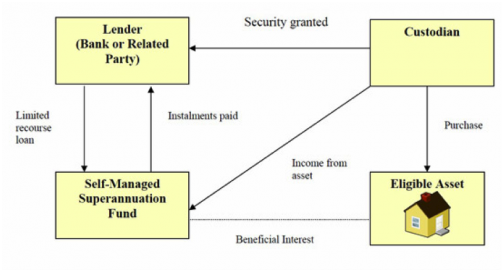
This diagram shows a typical limited recourse borrowing structure:

Borrowing through SMSF

Funding Options

There are two main funding options available:

1) Related party lending: There is no restriction on you, your family, a related trust, or similar entity lending the money to the SMSF. The benefits of this are that you can avoid costly bank legal adviser fees and other incidental costs of borrowing from a bank. You must follow the suggested ‘Safe Harbour Provisions’ outlined in ATO guidance on related party SMSF loans (LRBAs) . You cannot put in place a loan that is worse in commercial terms for the SMSF.

In any self -funding scenario you have to expect greater scrutiny by the auditor and regulators so as to avoid any compliance issues, SMSF members choosing self-funding should ensure their loan to the fund is properly documented and meets the requirements of the SIS Act. For example, the trustee of the SMSF must ensure that all investments are conducted on an arm’s length basis. This means that a proper lease agreement must be in place, repayments must be scheduled and met and as mentioned above the terms of the loan cannot disadvantage the SMSF in comparison to what’s available in the market.

2) Third party lending: Nearly all the major banks, and some specialised non-bank lenders, have developed SMSF loan packages specifically tailored to meet the requirements of the Act. I really do recommend that you seek advice from a broker who has experience in this area as the terms and conditions offered by the various lenders differ dramatically as some deal with them through their residential lending division and others through their commercial divisions.

The bottom line:  Placing real estate assets into your self-managed superannuation fund can be both straightforward and financially sensible, but there are certain rules you need to follow carefully, In the next instalment of our SMSF session we will guide you through the steps involved in the process from start to finish. Please seek independent professional advice to ensure that any proposed strategy complies with the law, because there are severe penalties that can apply if the trustee gets it wrong.

NEXT STEP : THE PROCESS OF BUYING PROPERTY IN AN SMSF (all states are slightly different but follow these steps to ensure you don’t fall foul of the rules)

As always please contact me if you want to look at your own options. You can make an appointment by clicking here. We have offices in Castle Hill and Windsor but can meet clients anywhere in Sydney or via Teams or Zoom or FaceTime .

Liam Shorte B.Bus FSSA™ AFP

Financial Planner & Fellow SMSF Specialist Advisor™


Tel: 02 98993693, Mobile: 0413 936 299

PO Box 6002, Norwest NSW 2153

40/8 Victoria Ave Castle Hill NSW 2154

Corporate Authorised Representative of Viridian Advisory Pty Ltd ABN 34 605 438 042, AFSL 476223

This information has been prepared without taking account of your objectives, financial situation or needs. Because of this you should, before acting on this information, consider its appropriateness, having regard to your objectives, financial situation and needs. This website provides an overview or summary only and it should not be considered a comprehensive statement on any matter or relied upon as such.