



• Benefits of a Self Managed Super Fund – SMSF
  • Videos
  • Why Self Managed Super?
  • Costs / Fees
  • About us
  • Testimonials
  • Contact Us
  • Property in a SMSF

The SMSF Coach

Coaching clients to take back control of their Superannuation and their future
  • Liam Shorte

    Unknown's avatar

    Putting people back in control of their wealth

  • SMSF Adviser of the Year - Winner 2025
  • SMSF Adviser of the Year - Finalist 2025
  • SMSF Adviser of the Year 2024
  • IFA 2023 Excellence Awards – SMSF Advisor of the Year – Finalist

  • IFA 2021 Excellence Awards – SMSF Advisor of the Year – WINNER!!
  • SMSF Adviser of the Year 2022 Finalist
    IFA 2022 Excellence Awards – SMSF Advisor of the Year – Finalist
  • Get advice – Have a chat

  • Enter your email address to subscribe and be first to receive notifications of new posts by email. Go on it's FREE!

    Join 6,177 other subscribers
  • Top Posts & Pages

    • How to elect to pay Division 293 Notice from your SMSF or Super
    • Stamp Duty on Transfers of Property to an SMSF
    • Vanguard Diversified ETFs - A Game Changer for SMSF Portfolio Design
    • When your Husband Retires and the Nightmare Comes True
    • Important Changes to Pension Commencement Rules Now in Effect from 1 July 2025
    • Breach the SMSF access rules and the penalties are high
    • Can I borrow to buy a house and land package off the plan in my SMSF?
  • Connect with me

    • View SMSFCoach’s profile on Facebook
    • View SMSFCoach’s profile on Twitter
    • View SMSFCoach’s profile on Instagram
    • View Smsfcoach’s profile on Pinterest
    • View LiamShorte’s profile on LinkedIn
    • View user44865214’s profile on Vimeo
    • View LiamShorte’s profile on Google+
  • Recent Tweets

    Tweets by SMSFCoach
  • View William Shorte's Adviser Ratings profile
    https://www.adviserratings.com.au/widget/278214/profile.js

All posts in category SMSF Exit Strategies

How to Use Insurance to Pay Out an SMSF Property Mortgage on Death or Disability


 Protect Investment Property

Like every strategy we discuss with clients we stress that have to look at the exit strategies up front rather than scramble to react if something happens that changes the financial position of the members or of the fund.

While a self managed superannuation fund can increase its assets and leverage the potential growth by borrowing to purchase a property, that borrowing can also cause financial distress if a fund member dies or becomes disabled. The lack of liquidity and cash flow could force the trustee to:

  • Sell the property in a difficult or dropping market
  • Realise capital gains or losses before expected i.e. before the members are in pension phase
  • Have to deal with increased transaction costs.

Since August 2012 Trustees of an SMSF have been required to consider insurance for members and we would say that is very sensible when debt is involved.

SUPERANNUATION INDUSTRY (SUPERVISION) REGULATIONS 1994 – REG 4.09 (2)(e)

The trustee of the entity must formulate, review regularly and give effect to an investment strategy that has regard to the whole of the circumstances of the entity including, but not limited to, the following:

for a self managed superannuation fund – whether the trustees of the fund should hold a contract of insurance that provides insurance cover for one or more members of the fund

In the past strategies like Cross insurance on each member of superannuation fund was often used to reduce the impact that the sudden death or disability of a member may have on a fund however the ATO have ruled out many of these strategies including using the SMSF to fund Buy-Sell Agreements between business partners.

SMSF mortgage repayment solutions on death

If there is life insurance on the member that dies then any proceeds are added to their account balance and can be paid as a lump sum out of the fund to beneficiaries but that may leave a fund a debt still to be paid off and with less contributions going in as one member is deceased and the fund may not have the free cash-flow to fund the full balance pay out without selling the property.

The strategies outlined below are those now available as  to manage the cash-flow liquidity issues and death benefit payment requirements that have arisen when a fund member dies suddenly, whilst the fund still has a Limited Recourse Loan Arrangement in place.

Payment of insurance benefits as an income stream to spouse

If it is 2 spouses or defacto’s that have set up an SMSF and borrowed to purchase an investment property, life insurance is often used to extinguish the debt. The reason for this is that generally the disability or death will eliminate or reduce the level of contributions that are made for the member, from which the loan repayments have been sourced.

Where the members of a fund are spouses then death benefits can be paid as an income stream. This means that even if a fund has borrowed to purchase a property, the property does not need to be disposed of to pay out the death benefit. This is even more important if your business is run out of the property.

In this case the life/TPD cover can be held by the member covered by the insurance and the premium can be paid from that members account. These arrangements comply with the SIS Regs, and the policy can be held through the self managed fund.

If the member dies or becomes disabled, the proceeds will be credited to the affected member’s account and loan will be repaid. Following the repayment of the loan a pension will commence to be paid to the member in the event of TPD or to the spouse in the event of death. If under 65 they can take as little as 4% per annum to keep as much in the fund as possible.

Example: Tax Dependants like spouses

Jack and Diane are married and members of Mellencamp Family Super Fund (“SMSF”)
Account Balances:
Jack – $100,000
Diane – $100,000
SMSF took out a loan of $300,000 to acquire property valued at $500,000

example-1-tax-dependants

Jack dies after getting a bad knock playing football ( for the younger readers get the full story here

anyway thank you for indulging me and now back to the example:

SMSF Cash flow after Jack’s death

  1. The loan is paid out.
  2. Diane starts a minimum 4% annual death benefit pension. Only one member left contributing now but no interest to pay.
Rent $17,500
Concessional contributions $5,000
Total inflows $22,500
Interest $0
Operating costs ($2,000)
Life premiums $0
Pension ($16,000)
Total outflows ($18,000)
Tax ($675)
Net cash flow (surplus) $3,825

what are the tax implications of the pension

Age at Death Type of Super Death Benefit Age of Recipient- DEPENDANT Taxation Treatment of Taxed Element
Any age Lump Sum Any age Tax free
60 & above Income stream Any age Tax free
Below 60 Income stream 60 & above Tax free
Below 60 Income stream Below 60 Marginal rate of tax less 15% tax offset

To implement the strategy, the following factors, need to be considered:

  • The funds trust deed must permit the fund to hold the insurance and to pay the TPD or death benefits as an income stream
  • The fund’s investment strategy should state that the trustees have considered the needs of the individual members and determined to take out life insurance for the fund members in order to repay any outstanding mortgage under an LRBA
  • Whether the fund’s cash flow allows for the taking out of the insurance policies. The premiums will normally be deductible in this circumstance as the benefits can be paid as a pension. For younger trustees you should consider Level Premiums and reviewing the cover as the loan is paid down.

Funding benefits from a reserve

If a fund is not able to pay a death or disability benefit in the form of a pension because they don’t have a spouse or the fund trust deed does not permit the payment of a benefit as a pension, then it may need to consider the use of a reserve strategy.

This strategy involves the fund trustee taking sufficient TPD and death cover over the lives of the fund members to enable the repayment of a loan and the payment of benefits as a lump sum.

The fact that the insurance policies are paid from the fund’s reserve and the insurance proceeds in the event of an insured event are credited to the reserve, means that the insurance benefit can remain in the fund. The fact that the insurance proceeds can remain in the fund means that insurance liabilities can be met and the loan repaid without the asset purchased under the borrowing arrangement needing to be sold.

In order to implement the strategy effectively, insurance policies premiums for each of the fund members will need to be paid from the reserve. The fact that the premium is paid from the reserve will then require any insurance proceeds after an insured event to be credited to the reserve.

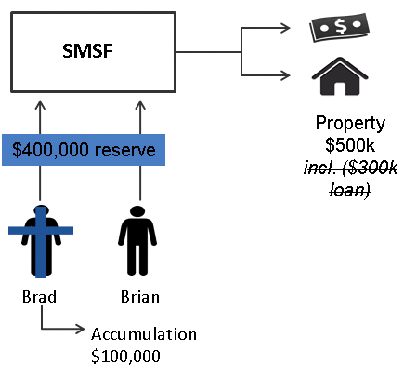
Example 2 – Non- Tax Dependants – 2 brothers in a business

example-2-non-tax-dependants

So sadly Brad dies …big ahhhh!

example-2-non-tax-dependants-outcome

SMSF Cash flow after Brad’s death

  1. Death benefits are held in a Reserve.
  2. The loan is paid out but the value is held in the reserve account
  3. Results in large reserve ($400,000)
    allocate back to Brian < 5% of his balance p.a. or
    allocate up to $25,000 p.a. this year and $25,000pa going forward to Brian’s account depending on other concessional contributions in year
Rent $17,500
Concessional contributions $10,000
Total inflows $27,500
Interest ($18,000)
Operating costs ($2,000)
Life premiums ($1,500)*
Pension $0
Total outflows ($21,500)
Tax ($900)
Net cash flow (surplus) $5,100

* Deducted from general fund expenses

Other Issues to consider

There are a number of other issues that fund trustees will need to consider when implementing this strategy:

  • If the members of the fund are business partners rather than spouses, the spouse of the deceased member may feel that the business partners are benefiting from the death of their spouse. It is really important to discuss these strategies upfront with family so they know they are provided for but that the business needs stability too.
  • When the insurance proceeds are credited to a reserve, it may be difficult to transfer that reserve back to fund members without exceeding the excessive concessional contributions cap.
  • The insurance premiums are not tax-deductible under Section 295-465 of the ITAA 97 because the policy is not held for the purpose of providing a fund member with a death or disability benefit.
  • The cost of the insurance premiums could be very high so seek advice on all possible solutions.
  • The cost of the insurance premiums may limit the trustee’s capacity to take out other insurance cover for members

By the Way – one other reason to cover your exit strategies

What happens if a trustee fails to address insurance in their SMSF?

The trustees could be fined 100 penalty units ($21,000) for each trustee – Section 34 SIS Act; Section 4AA Crimes Act 1911

and if someone else has been affected by the loss as a result:

A person who suffers loss or damage …may recover … against that other person or against any person involved in the contravention.  – Section 55(3) SIS Act

I hope this guidance has been helpful and please take the time to comment. Feedback always appreciated. Please reblog, retweet, like on Facebook etc to make sure we get the news out there. As always please contact me if you want to look at your own options. We have offices in Castle Hill and Windsor but can meet clients anywhere in Sydney or via Skype. Just click the Schedule Now button up on the left to find the appointment options.

Liam Shorte B.Bus SSA™ AFP

Financial Planner & SMSF Specialist Advisor™

SMSF Specialist Adviser 

 Follow SMSFCoach on Twitter Liam Shorte on Linkedin NextGen Wealth on Facebook   

 Top 50 Logo 12%Verante Financial Planning

Tel: 02 98941844, Mobile: 0413 936 299

PO Box 6002 BHBC, Baulkham Hills NSW 2153

5/15 Terminus St. Castle Hill NSW 2154

Corporate Authorised Representative of Viridian Select Pty Ltd ABN 41 621 447 345, AFSL 51572

This information has been prepared without taking account of your objectives, financial situation or needs. Because of this you should, before acting on this information, consider its appropriateness, having regard to your objectives, financial situation and needs. This website provides an overview or summary only and it should not be considered a comprehensive statement on any matter or relied upon as such.

Image courtesy of Vichaya Kiatying-Angsulee at FreeDigitalPhotos.net

Share this:

  • Click to email a link to a friend (Opens in new window) Email
  • Click to print (Opens in new window) Print
  • Tweet
  • Pocket
  • Click to share on Reddit (Opens in new window) Reddit
Like Loading...
1 Comment
by SMSF Coach - Liam Shorte on November 17, 2016  •  Permalink
Posted in Estate Planning, Insurance Strategies, Life Insurance, LRBA, Property, SMSF Exit Strategies, SMSF Management
Tagged Account Based Pension, Alzheimer's, Baulkham Hills, budget, Castle Hill, death benefits, Debt, dementia, DIY Super, Dural, Enduring Power of Attorney, EPoA, Estate Planning, Hawkesbury, Incapacity, income planning, Insurance, insurance solutions, Investment, investment property, Investment Strategy, Mortgage, pension phase, Pensions, powers of attorney, property, Ricjmond, Self Managed Superannuation Fund, SMSF, tax, Tax Free Pensions, Tax Planning, Transition, Transition to Retirement, Windsor

Posted by SMSF Coach - Liam Shorte on November 17, 2016

https://smsfcoach.com.au/2016/11/17/how-to-use-insurance-to-pay-out-an-smsf-property-mortgage-on-death-or-disability/

Small APRA Fund as an Exit Strategy for SMSF Trustees


Exit Strategies

On the home page of this blog I outline the Benefits of a Self Managed Super Fund – SMSF in some detail. Well, when looking at any investment structure I always like to assess the alternative options and eventual exit strategies. While many of you will know of the Retail and Industry superannuation fund options, you may not be as familiar with a close relation to the SMSF known as a Small APRA fund (SAF). So let’s look at little closer at this option.

What is an Small APRA Fund (SAF)?

An SAF is similar to an SMSF but instead of the client(s) being the trustee(s), a professional licensed trustee is responsible for all of the administrative,  compliance and legislative responsibilities of running the superannuation fund.

SAFs offer an alternative for clients looking for the increased flexibility of an SMSF but without the burden of being a trustee and the associated compliance risk. They are also an effective solution for clients who are non-residents or bankrupt and therefore unable to be trustees of an SMSF.

I always warn new clients that if your career or business relies on you being a director then you must take the decision to set up an SMSF very carefully and be ready to put the time and effort in or choose SMSF specialist advisors to ensure your fund remains compliant so that you don’t lose your ability to be a director of any company because of breaching SMSF legislation.

SAFs provide all of the legislative advantages afforded to SMSFs, without the risks associated with breaching legislative compliance requirements.

Let be very honest up front and say this is not a suitable option for small balances as you are incurring an extra layer of trustee fees. However for those with larger balances the option can be very cost-effective especially when you consider the ability to relieve yourself of the trustee responsibilities.

Main benefits of the SAF structure

1. Offloading the Compliance risk

The main advantage of running an SAF is that the compliance risk is borne by the professional licensed trustee whose core responsibility is the provision of trustee services. If an SAF is in breach of the rules, the members of the fund will not be liable for the compliance mistakes of the professional trustee. In an SMSF, all members must be a trustee or director of a corporate trustee which means all members bear the compliance liability. You cannot claim your spouse was solely responsible for running the fund. One case clearly shows the risk of being a “silent trustee”where the verdict found the former wife, in her role as a trustee of the fund, was personally liable when it became non-complying after her former husband stripped out most of the assets and headed overseas. See Shail Superannuation Fund and Commissioner of Tax [2011] AATA 940

2. Administration of the fund

A professional licensed trustee in charge of an SAF typically appoints professional organisations to carry out the administration of the fund or is skilled and experienced enough to avoid common breaches of legislative requirements. As the professional licensed trustee administers all information and transactions, record keeping is typically timely and accurate. In SMSFs, the trustees are typically responsible for collating all the documentation and reports so their chosen administration service can prepare the financials of their fund (Not so hard as it sounds nowadays but when your busy?…paperwork suffers)

3. Travelling overseas for extended periods

SAFs are more flexible for people who may go overseas for an indefinite period compared to SMSFs which are strictly regulated in that circumstance. Members of an SMSF who relocate for an extended period of time have to fulfil two requirements – the central management and control of an SMSF needs to be in Australia, and the active member test needs to be fulfilled . If any of these requirements are breached, the SMSF loses its residency status, is deemed non-compliant and will face exorbitant penalty taxes of up to 46.5%. An SAF however can have offshore members – as long as they are Australian residents for tax purposes.

4. Protection and access to Superannuation Complaints Tribunal

In the case of fraudulent conduct or theft, SAFs have more readily available redress options including a grant of financial assistance as statutory compensation and access to the Superannuation Complaints Tribunal which deals with complaints about the decisions and conduct of APRA-regulated fund trustees and other decision makers. Conversely, no compensation scheme exists for SMSFs and they instead have to rely on courts to resolve disputes or look to the Corporations Law to take action against a financial adviser, accountant or administrator for losses they believe are due to misconduct, negligence or inappropriate action.

5. Disqualified persons – Bankruptcy or Criminal record

Individuals are not allowed to be trustees of an SMSF or directors of a corporate trustee if they have committed a crime involving dishonesty such as fraud, theft or embezzlement or if they have been declared bankrupt. The Tax Office will ban individuals from taking on positions of responsibility  in an SMSF if it believes the person has breached the superannuation laws either very seriously or persistently or it believes the person is not a fit or proper person and hence should be disqualified. There are no issues with a disqualified person becoming a member of an SAF as they are not required to fill the role of trustee and it is in fact an often preferred solution for those with an SMSF who find themselves in that unenviable position with assets that aren’t liquid.

6. Responsibility concerns due to ageing or onset of mental illness

Some older people may prefer to use an SAF because they have reached an age where they are no longer able, or may not want to, make effective management and operational decisions. SAFs still allow investors to be in charge of the asset allocation – subject to trustee approval (but they are becoming a lot more flexible) – and to maintain or acquire a similarly broad range of assets and avail of strategies available to SMSF investors. Problems often arise in an SMSF when an older trustee loses the capacity to function and participate in the fund’s inner workings whereas in an SAF, the professional licensed trustee will continue to manage the fund for the benefit of its members.

7. Estate planning

There are a number of estate planning scenarios  where an SAF being a better alternative to an SMSF. In an SMSF, the death of a fund trustee changes the composition of the trustees and may provide potential for disputes especially in blended families. In an SAF, the licensed trustee is an independent and unbiased party with no family relationship issues that we often see arise with estates. In an SMSF, it is possible to try to include safeguards into the trust documentation; however, if one of several feuding beneficiaries has the cheque book, it may take the remaining beneficiaries considerable time and expense to track down the person and the money. As one colleague said:

“a remaining trustee with a cheque book can do a lot of damage to an SMSF balance while family fight for control in the courts”

8. Taking care of vulnerable beneficiaries

SAFs can provide very tax effective death benefit income streams to intellectually disabled adult children. The hurdle of the person with a disability or their legal personal representative needing to be a trustee is removed because, unlike an SMSF, an SAF has a professional trustee. The use of the professional trustee also ensures that ongoing services can continue to be provided to a disabled person is over 18 and once the parents have died or lost capacity. There is the ability to pay a death benefit income stream to the disabled child and then have any capital remaining return to the parent’s estate on death.

9. Employer – Employee Fund

In an SMSF, a trustee cannot be an employee of another member – unless they are family. In an SAF however, a member can be an employee of another member. Further, since SAFs have a professional licensed trustee, the related-party issues that crop up in an SMSF are not an issue in an SAF.

In summary while an SMSF may be ideal for people who want to be fully in control of their investment decisions and retirement savings, an SAF is ideal for those who would like to actively participate in investment decisions but retain a low-level of compliance and legislative responsibilities. It is possible to switch from an SMSF to an SAF or vice versa without incurring capital gains tax as all they have to do is retire as trustees themselves and appoint a professional licensed trustee to govern their SAF.

So why may a SAF be a better option than a Retail or Industry Fund?

  • Moving to a SAF is Not a CGT event whereas it would be if you moved to a retail or industry fund
  • Likely to be able to keep assets such as direct shares, bullion, collectables and residential and commercial property subject to rules.
  • The member can still  direct investments within the approved list
  • Member directed death benefit nominations are still possible and in fact often more achievable as the trustee can follow your wishes.
  • No issues with single member funds
  • Retains privacy for those in high-profile positions

I would like to acknowledge that much of my information in this area has been gathered from articles and presentations by Julie Steed of Australian Executor Trustees who are very experienced in running SAFs and working as a team with clients and their financial planners.

I hope this guidance has been helpful and please comment below. Feedback always appreciated. Please reblog, retweet, like on Facebook etc to make sure we get the news out there. As always please contact me if you want additional information on switching fund structures.We have offices in Castle Hill and Windsor but can meet clients anywhere in Sydney or via Skype. Just click the Schedule Now button up on the left to find the appointment options.

Liam Shorte B.Bus SSA™ AFP

Financial Planner & SMSF Specialist Advisor™

SMSF Specialist Adviser 

 Follow SMSFCoach on Twitter Liam Shorte on Linkedin NextGen Wealth on Facebook   

Verante Financial Planning

Tel: 02 98941844, Mobile: 0413 936 299

PO Box 6002 BHBC, Baulkham Hills NSW 2153

5/15 Terminus St. Castle Hill NSW 2154

Corporate Authorised Representative of Viridian Select Pty Ltd ABN 41 621 447 345, AFSL 51572

This information has been prepared without taking account of your objectives, financial situation or needs. Because of this you should, before acting on this information, consider its appropriateness, having regard to your objectives, financial situation and needs. This website provides an overview or summary only and it should not be considered a comprehensive statement on any matter or relied upon as such.

Share this:

  • Click to email a link to a friend (Opens in new window) Email
  • Click to print (Opens in new window) Print
  • Tweet
  • Pocket
  • Click to share on Reddit (Opens in new window) Reddit
Like Loading...
Leave a comment
by SMSF Coach - Liam Shorte on August 29, 2016  •  Permalink
Posted in Estate Planning, SMSF Exit Strategies, SMSF Management, Trustee
Tagged Account Based Pension, Ageing, Alternative trustee, Alzheimer's, Baulkham Hills, budget, Castle Hill, dementia, DIY Super, Dural, Enduring Power of Attorney, EPoA, Estate Planning, Exit Strategies, Hawkesbury, Incapacity, income planning, Investment, Investment Strategy, pension phase, Pensions, powers of attorney, property, SAF, SAFs, Self Managed Superannuation Fund, Small APRA fund, SMSF, SMSF exit strategy, Succession Planning, Tax Free Pensions, Tax Planning, Transition, Transition to Retirement, Travelling overseas

Posted by SMSF Coach - Liam Shorte on August 29, 2016

https://smsfcoach.com.au/2016/08/29/small-apra-fund-as-an-exit-strategy-for-smsf-trustees/

  • Search for specific topics

  • Liam is a Fellow of the SMSF Association, their highest Specialist rating
  • Recent Posts

    • Age Pension & Deeming Changes September 2025
    • Could an Unsigned Will Be Valid? What about your BDBN in the SMSF?
    • Important Changes to Pension Commencement Rules Now in Effect from 1 July 2025
    • The Ultimate SMSF End of Financial Year Checklist 2025
    • Superannuation – General Transfer Balance Cap Increases to $2.0 Million from 1 July 2025
    • SMSF Business Real Property: It’s not what type of property that counts, it’s the use that matters.
    • The Ultimate SMSF End of Financial Year Checklist 2024
    • How to check your Superannuation data via myGov online
    • The Ultimate SMSF End of Financial Year Checklist 2023
    • So How Much Can I Contribute to my SMSF Using the Bring Forward Rule from 1 July 2025
  • Previous Posts by Topic

    • Contribution Strategies (83)
      • In Specie transfers (5)
      • Salary Sacrifice (15)
      • Small Business CGT (2)
      • Superannuation Splitting (18)
      • Tax Planning (64)
    • education (15)
    • Education costs (2)
    • Estate Planning (39)
      • Anti-Detriment (2)
      • Binding Death Nominations (15)
      • Enduring Power of Attorney (7)
      • Reversionary Pension (13)
      • testamentary trust (1)
    • Financial Planning (62)
      • Bankruptcy Protection (1)
      • Contributions (10)
      • Divorce (5)
      • downsizing (6)
      • Superannuation (27)
    • Insurance Strategies (14)
      • Income Protection (3)
      • Life Insurance (7)
      • Salary Continuance (3)
      • Total & Permanent Disability (4)
    • Investment Strategies (73)
      • Asset Allocation (22)
      • Behavioural Finance (3)
      • Bonds (5)
      • Borrowing (21)
        • Loans (12)
        • LRBA (14)
      • Botcoin (1)
      • Buy-backs (1)
      • Franking Credits (14)
      • Hybrids (3)
      • International Investing (7)
      • Investor Education (6)
      • Property (25)
      • Results Season (2)
      • Term Deposits (7)
    • Retirement Planning (91)
      • Age Pension (7)
      • Centrelink (19)
        • CHSC (2)
      • Downsizing (1)
      • Lifestyle (4)
      • Pension Strategies (36)
      • Pensions (33)
    • SMSF (102)
      • News & Stats (47)
    • SMSF alternatives (2)
    • SMSF Management (122)
      • Audit (18)
      • Checklists (23)
      • Deeds (1)
      • Scam Alert (2)
      • SMSF Exit Strategies (2)
      • TBAR reporting (4)
      • Trustee (70)
  • Like us on Facebook

    Like us on Facebook
  • Blog Stats

    • 863,243 hits
Blog at WordPress.com.
<div data-adviser-id="278214">

<a href="https://www.adviserratings.com.au/adviser/278214/William-Shorte">
View William Shorte's Adviser Ratings profile
</a>
</div>

https://www.adviserratings.com.au/widget/278214/profile.js
  • Subscribe Subscribed
    • The SMSF Coach
    • Join 297 other subscribers
    • Already have a WordPress.com account? Log in now.
    • The SMSF Coach
    • Subscribe Subscribed
    • Sign up
    • Log in
    • Report this content
    • View site in Reader
    • Manage subscriptions
    • Collapse this bar
 

Loading Comments...
 

    %d