




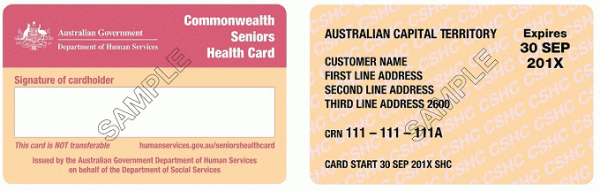
Deeming Rates have changed again and so that makes it a little easier to access the Commonwealth Seniors Heath Card (CSHC) so I thought I should revisit the way you can access this valuable benefit.
A key change to legislation that commenced on 1 January 2015 impacts the Commonwealth Seniors Heath Card (CSHC) Income Test. Previously the Income Test only looked at a person’s adjusted taxable income, however the new rules include deemed income from account-based income streams. This may mean higher assessable income for some, making them ineligible for the card. For others, it may mean the loss of the card under certain situations from 1 January 2015.
It is important that SMSF Trustees and Self Funded Retirees in general understand how these new rules work and how they can impact them in different scenarios so that appropriate adjustments can be made to their strategies where necessary.
So here in this guide, we look at the rules around the CSHC as they apply from 1 January 2015 and the implications on different client situations. We will also explore options available to those effected from 1 January 2015 that can help them obtain or retain the card.
The benefits
The CSHC is designed to assist eligible self-funded retirees with certain medical and prescription costs. A summary of these concessions and other benefits available to card holders are as follows:
- prescription medicines at concessional rates through the Pharmaceutical Benefits Scheme (PBS)
- access to PBS prescriptions, generally without charge, for the remainder of the calendar year after reaching the PBS Safety Net
- bulk-billed doctor (GP) appointments, at the discretion of the GP (the Australian Government provides financial incentives for GPs to bulk-bill concession card holders)
- tax-free energy supplement1 of $366.60 per annum for singles and $275.60 per annum for each member of a couple
- tax-free seniors supplement2 of $886.60 per annum for singles and $668.20 per annum for each member of a couple
- concessional travel on Great Southern Rail services (the Indian Pacific, the Ghan and the Overland)
- other concessions offered by local governments and private businesses at their own discretion. These concessions vary between states and territories.
Eligibility
With the exception of the Income Test, eligibility for the CSHC has largely remained unchanged. To qualify for the card a person must:
- have reached the qualifying age for the Age Pension (currently 65 for men and women) or Department of Veterans’ Affairs (DVA) Service Pension (currently 60 for veterans and 65 for non-veterans)
- be an Australian citizen, a holder of a permanent visa, or a Special Category Visa holder and meet other residence requirements
- reside in Australia
- not be receiving a Centrelink pension or benefit, a DVA Service Pension or Income Support Supplement
- meet the requirements of an Income Test (there is no Asset Test when determining eligibility for the card)
- provide their tax file number.
Applicants are required to be in Australia at the time of claim, however once received, card holders can travel outside Australia temporarily without having their card cancelled providing the period of absence is less than 19 weeks. This will be particularly important for those who wish to retain grandfathering on their account- based income streams (discussed further under the grandfathering provisions section).
The Income Test
From 1 January 2015, the Income Test assesses both a person’s ATI and deemed income from account-based income streams that are not grandfathered.
A person will satisfy the Income Test if their ATI plus deemed income from their account-based income stream is below the relevant income threshold.
Income thresholds
The income thresholds are indexed on 20 September each year and are currently:
Table 1: CSHC income thresholds applying from 20 September 2014 to 19 September 2015
| Single | Couple (combined) | Couple separated by illness (combined) |
| $51,500 | $82,400 | $103,000 |
These income limits are increased by $639.60 for each dependent child in the person’s care.
Adjusted taxable income (ATI)
Adjusted taxable income is the sum of:
- taxable income
- reportable superannuation contributions (salary sacrifice, personal deductible and additional employer contributions)
- total net investment losses (including net rental property losses)
- target foreign income (income and certain other amounts from sources outside Australia that are not included taxable income or received as a fringe benefit), and
- employer provided fringe benefits.
For many people applying for the CSHC, the most important component of their ATI is their taxable income. However, there are circumstances where the other components of their ATI may be important such as where the person claiming the CSHC or their spouse is still working (e.g. on a part-time basis).
To verify the person’s income, Centrelink/DVA will generally require their tax return and/ or tax notice of assessment for the financial year prior to the year of claim. In situations where the person does not complete annual tax returns, Centrelink/DVA will request other documentation to verify the person’s ATI.
For example, where a person only receives tax-free income from an account-based pension and does not complete an annual tax return, Centrelink/DVA will request their latest superannuation statement to work out deemed income (see the following section on deemed income for further information).
For others, an estimate of their income as opposed to their tax return can be used. This is where they are able to demonstrate a change in their personal circumstances, such as retirement and ill-health, which would cause their income to be significantly different to their tax return.
Managing adjusted taxable income
Where a person is expected to exceed the CSHC income threshold for a particular income year, and where they have significant ATI, a few options that may help bring them back below the threshold include:
- investing in an insurance/investment bond as earnings are internally taxed at a maximum rate of 30% and are not included in a person’s assessable income for tax purposes
- investing in a non-account-based non-superannuation term or lifetime annuity that has a deductible amount for tax purposes
- setting up a family trust and distributing income to other beneficiaries
- invest in growth assets instead of income producing investments
- deferring and/or spreading realised capital gains across multiple income years.
Deemed income
From 1 January 2015, account-based income streams will be deemed and included as part of the CSHC Income Test unless grandfathering provisions apply. Where grandfathering does not apply to the account-based income stream, the entire account balance will be used to work out deemed income.
It is important to note that deemed income is in addition to ATI; meaning a person with no ATI (e.g. a retiree with no other income apart from tax-free income from an account-based pension) may still be ineligible for the card if their account-based income streams have large account balances. The table below shows the amount required in account-based income streams to have deemed income exceed the relevant CSHC income threshold (assuming no ATI). It also highlights how this amount changes from 20 March 2015 and if deeming rates were to rise to 3% and 4.5%.
Table 2: Total account-based income stream balance that would exceed the CSHC income threshold
| Applicants are: | Deeming rates as at 20 March 20151.75% and 3.25% | If deeming rates are 3% and 4.5% |
| Single | $1,606,770 | $1,160,445 |
| Couple | $2,572,124 | $1,857,645 |
| Couple separated by illness | $3,205,970 | $2,315,423 |
Also worth noting is that, unlike deeming of financial investments for social security pensions (although the same deeming rates and thresholds are used), only the account-based income stream will be deemed i.e. other financial assets are not deemed under the CSHC Income Test.
If you want to know current thinking on the amount needed for a comfortable retirement then read my earlier article How much do I need to live comfortably in retirement?
Feel you are falling behind? Then read 10 Tips For Salvaging Your Retirement Plans and then contact me for personal advice.
Are you looking for an advisor that will keep you up to date and provide guidance and tips like in this blog? then why now contact me at our Castle Hill or Windsor office in Northwest Sydney to arrange a one on one consultation. Just click the Schedule Now button up on the left to find the appointment options.
Liam Shorte B.Bus SSA™ AFP
Financial Planner & SMSF Specialist Advisor™


Tel: 02 98941844, Mobile: 0413 936 299
PO Box 6002 BHBC, Baulkham Hills NSW 2153
5/15 Terminus St. Castle Hill NSW 2154
Corporate Authorised Representative of Viridian Select Pty Ltd ABN 41 621 447 345, AFSL 51572
This information has been prepared without taking account of your objectives, financial situation or needs. Because of this you should, before acting on this information, consider its appropriateness, having regard to your objectives, financial situation and needs. This website provides an overview or summary only and it should not be considered a comprehensive statement on any matter or relied upon as such.



 The SMSF Coach