


• Benefits of a Self Managed Super Fund – SMSF
  • Videos
  • Why Self Managed Super?
  • Costs / Fees
  • About us
  • Testimonials
  • Contact Us
  • Property in a SMSF

The SMSF Coach

Coaching clients to take back control of their Superannuation and their future
  • Liam Shorte

    Unknown's avatar

    Putting people back in control of their wealth

  • SMSF Adviser of the Year - Winner 2025
  • SMSF Adviser of the Year - Finalist 2025
  • SMSF Adviser of the Year 2024
  • IFA 2023 Excellence Awards – SMSF Advisor of the Year – Finalist

  • IFA 2021 Excellence Awards – SMSF Advisor of the Year – WINNER!!
  • SMSF Adviser of the Year 2022 Finalist
    IFA 2022 Excellence Awards – SMSF Advisor of the Year – Finalist
  • Get advice – Have a chat

  • Enter your email address to subscribe and be first to receive notifications of new posts by email. Go on it's FREE!

    Join 6,177 other subscribers
  • Top Posts & Pages

    • How the Centrelink Gifting rules work
    • What can my SMSF invest in?
    • Benefits of a Self Managed Super Fund - SMSF
    • Is your SMSF lending money to someone?
    • Can I borrow to buy a house and land package off the plan in my SMSF?
    • In-specie contributions to and from an SMSF
    • How To Wind Up Your SMSF
    • Trusts 101 - A Guide to What They are and How They Work in Australia
    • Property through super in a SMSF - Part 3: 20 most common mistakes
    • Using Beer To Explain How Tax Concessions Work
  • Connect with me

    • View SMSFCoach’s profile on Facebook
    • View SMSFCoach’s profile on Twitter
    • View SMSFCoach’s profile on Instagram
    • View Smsfcoach’s profile on Pinterest
    • View LiamShorte’s profile on LinkedIn
    • View user44865214’s profile on Vimeo
    • View LiamShorte’s profile on Google+
  • Recent Tweets

    Tweets by SMSFCoach
  • View William Shorte's Adviser Ratings profile
    https://www.adviserratings.com.au/widget/278214/profile.js

All posts tagged non-concessional

How does the Budget 2016 affect contributions to an SMSF


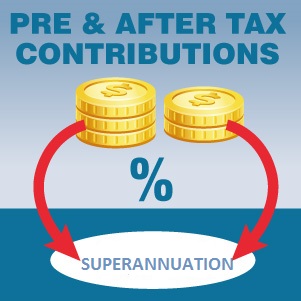
pre_after_tax_super_contributions

I am breaking the Budget down in to bite size chunks with strategies to consider going forward for SMSF Trustees. The first part which dealt with pension strategies is available here . This second part deals with changes to contribution options, methods and caps.

Before I go into detail here is a summary of the changes that are relevant to SMSF members (No coverage of Defined Benefit Schemes in this article):

Concessional (Pre-Tax Contributions like employer superannuation guarantee (SGC), salary sacrifice and those contributions where you claim a tax deduction).

  • Reduction in the concessional contribution cap to $25,000 regardless of age
  • Carried forward concessional cap for account balances below $500,000 from 1 July 2018
  • All individuals under 65 will be eligible to claim a tax deduction for personal contributions (bye bye 10% rule). work test applies ot over those 65
  • Reduction in income threshold to $250,000 where additional super contribution tax applies
  • Reduction in contribution tax for people earning less than $37,000
  • Extension of low-income spouse contribution tax offset

Non-Concessional (Post Tax Contribution like personal after tax contributions and Government co-contributions).

  • Reduction in Non-concessional contribution cap limit to $100 per annum
  • Reduction of existing annual non-concessional bring forward provisions

Now the detail:

Reduction in the concessional contribution cap to $25,000 regardless of age

The concessional contribution cap will be reduced from the current level of $30,000 to $25,000 from 1 July 2017, irrespective of the age of the individual. The higher cap of $35,000 that currently applies to individuals over age 50 will be abolished. The reduced cap will continue to be indexed in future years in line with wages growth.

Carried Forward or Catch-up concessional contributions
From 1 July 2018 individuals will be able to make additional concessional contributions where they have not reached their concessional contributions cap in previous years. Access to these unused cap amounts will be limited to those individuals with a superannuation balance less than $500,000. Unused amounts accrued from 1 July 2018 will be able to be carried forward on a rolling basis for a period of five consecutive years.

This measure allows some additional flexibility in the timing of your contributions like making $125,000 for a tax deduction on the sale of a property or share portfolio if you did not make contributions in the previous 4 years. Your ability to save may vary throughout your career and this measure will assist to some extent, but falls well short of my preferred option for a lifetime cap on concessional contributions. The restriction based on size of account balance will add complication to the administration of this measure when multiple funds are involved.

All individuals under 65 will be eligible to claim a tax deduction for personal contributions

From 1 July 2017, all superannuation fund members up to age 65 will be able to claim an income tax deduction for personal superannuation contributions up to the concessional contribution cap ($25,000), regardless of their employment circumstances. This is good news for people who are partially self-employed and partially wage and salary earners, and individuals whose employers do not offer salary sacrifice arrangements, as they will benefit from this proposal. Personal contributions for which a tax deduction is claimed will count towards the concessional, rather than the non-concessional cap.

While I accept the government’s intention is to increase flexibility for more people to access the concessional contribution cap if they are able to do so, the mechanism requiring individuals to notify their fund of their intention to claim a tax deduction for their personal contributions will add considerable complexity to fund administration. the “she’ll be right” and “I’ll do it later factor” will lead to many missing opportunities.

Over 65’s will still need to meet the work test.

Reduction in income threshold to $250,000 where additional super contribution tax applies

From 1 July 2017, individuals with “relevant income” greater than $250,000 will pay an additional 15 per cent tax on their concessional contributions, down from $300,000. The additional tax, referred to as “Division 293 tax” after the section of the tax legislation which governs the tax, will be payable where the individual’s taxable income (including reportable fringe benefits and certain other amounts) plus concessional contributions (excluding those that exceed the concessional contributions cap) is greater than the $250,000 threshold.
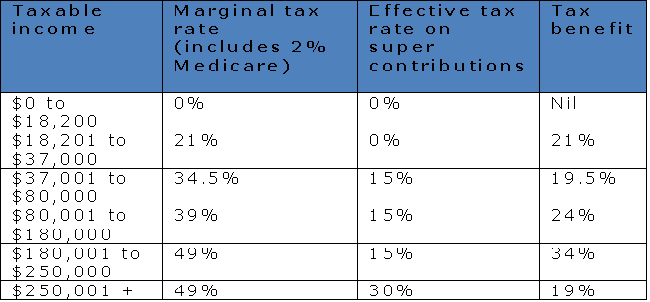
Table Div 293

Superannuation still remains attractive despite this change, the 30% tax applied to concessional contributions is still less than the marginal tax rate on earnings so contributing to super remains attractive. But with the lower $25,000 concessional contribution there will be limited scope for you to make optional concessional contributions. For example, if you earn $250,000 and your employer pays the 9.5% SG on your full salary this is an annual employer contribution of $23,750 which has almost fully utilised the new lower cap. If you are on a higher income with disposable income you may look for alternatives outside superannuation or top up your partner/spouse’s superannuation (and potentially receive a tax offset if they earn less than $37,000).

After earlier reports that the threshold would be reduced to $180,000, the proposed threshold of $250,000 means the tax will apply to only around 1 per cent of superannuation fund members. Retention of the existing mechanism which minimises the administrative costs to superannuation funds associated with this tax is welcome.

Reduction in tax for people earning less than $37,000

From 1 July 2017, the Government will introduce a Low Income Superannuation Tax Offset (LISTO) to reduce the tax on superannuation contributions for low-income earners. The measure will apply to individuals with taxable income less than $37,000, and will effectively refund the tax on concessional contributions up to an annual cap of $500. This measure will replace the Low Income Superannuation Contribution (LISC) which was scheduled to be abolished from 1 July 2017, however, the mechanism will be slightly different. Rather than the government making a direct
contribution to the individual’s superannuation account, the offset will apply to the contribution tax deducted by the superannuation fund. The Australian Taxation Office will determine an individual’s eligibility for the LISTO and advise their superannuation fund annually. The fund will then contribute the LISTO to the individual’s account. The government will consult on the implementation of this scheme.

Extension of low-income spouse contribution tax offset
The government will increase access to the low-income spouse superannuation tax offset by raising the income threshold for the low-income spouse from $10,800 to $37,000 and phasing out up to $40,000. This arrangement provides a tax offset of 18 per cent of contributions made by the contributing spouse, up to a maximum offset of $540 per annum.

Non-concessional contribution cap limit of $100,000 or phasing down towards $300,000 using the bring forward provisions

For 2016-17 the single year capped contribution amount is $180,000 and then from 1 July 2017 it reduces to $100,000. So this year you can still use the bring forward rule to contribute the full $540,000 before June 30th 2017 and that has been confirmed by treasury. However if you do not have enough to meet that full contribution limit you can still trigger your cap by contributing at least $180,001 before the end of the year. Note that you may also have already triggered that rule in one of the 2 previous financials years and be wondering how much of the cap you have remaining. Well this table will clarify that for you.
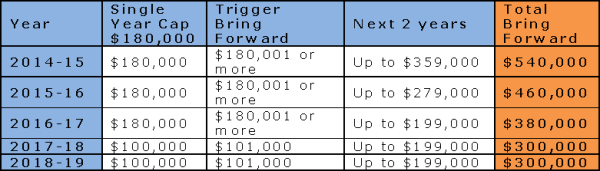
bring-forward-caps

In summary the Limit to Bring Forward Contributions  based on year triggered are:

bring-forward-caps-summary

See a full explanation in this article : So How Much Can I Contribute to my SMSF Using the Bring Forward Rule

The cap now also limits the ability to use the cash-out and recontribution strategy for members who have triggered a condition of release.  We normally used this between age 60 -65 to reduce the taxable component of your account balance. Before considering this strategy you should check the available lifetime cap with your administrator / advisor including all retail / industry funds you have been a member of at any time. Many SMSF members took annual pensions and simply recontributed the payments as NCC every year. DO NOT DO THIS! check your cap first PLEASE!

Phew! that was a lot!

I hope this guidance has been helpful and please take the time to comment. Feedback always appreciated. Please reblog, retweet, like on Facebook etc to make sure we get the news out there. As always please contact me if you want to look at your own options. We have offices in Castle Hill and Windsor but can meet clients anywhere in Sydney or via Skype. Just click the Schedule Now button up on the left to find the appointment options.

Liam Shorte B.Bus SSA™ AFP

Financial Planner & SMSF Specialist Advisor™

SMSF Specialist Adviser 

 Follow SMSFCoach on Twitter Liam Shorte on Linkedin NextGen Wealth on Facebook   

Verante Financial Planning

Tel: 02 98941844, Mobile: 0413 936 299

PO Box 6002 BHBC, Baulkham Hills NSW 2153

5/15 Terminus St. Castle Hill NSW 2154

Corporate Authorised Representative of Viridian Select Pty Ltd ABN 41 621 447 345, AFSL 51572

This information has been prepared without taking account of your objectives, financial situation or needs. Because of this you should, before acting on this information, consider its appropriateness, having regard to your objectives, financial situation and needs. This website provides an overview or summary only and it should not be considered a comprehensive statement on any matter or relied upon as such.

Share this:

  • Click to email a link to a friend (Opens in new window) Email
  • Click to print (Opens in new window) Print
  • Tweet
  • Pocket
  • Click to share on Reddit (Opens in new window) Reddit
Like Loading...
2 Comments
by SMSF Coach - Liam Shorte on May 5, 2016  •  Permalink
Posted in Contribution Strategies, Contributions, Salary Sacrifice, Superannuation Splitting, Tax Planning
Tagged Account Based Pension, Baulkham Hills, budget, cap, Castle Hill, concessional, DIY Super, Dural, Hawkesbury, income planning, Investment, Investment Strategy, lifetime cap, non-concessional, pension phase, Pensions, post-tax, pre-tax, Self Managed Superannuation Fund, SMSF, spouse contribution, Tax Free Pensions, tax offset, Tax Planning, Transition, Transition to Retirement

Posted by SMSF Coach - Liam Shorte on May 5, 2016

https://smsfcoach.com.au/2016/05/05/how-does-the-budget-2016-affect-contributions-to-an-smsf/

SMSF Member Guide to Salary Sacrifice and Superannuation


This guide has been requested by a number of our younger clients under 50 who are now taking an interest in retirement savings and tax planning but applies to all working SMSF members especially those who can combine Salary Sacrifice with a Transition to Retirement Pension. Please view this short ATO video on super contributions first and then we will go in to detail:

http://www.youtube.com/watch?v=SqcUjMpfjHM

So what is salary sacrifice?

Salary sacrifice is an arrangement between an employer and an employee, whereby the employee agrees to forgo part of their future entitlement to salary or wages in return for the employer providing them with benefits of a similar value.

Contributions made through a Salary Sacrifice Arrangement (SSA) into super are made with pre-tax dollars, meaning they are not taxed at the member’s marginal tax rate.

They are treated as Concessional Contributions (CCs) and tax of up to 15% will usually be payable, so long as the member does not exceed their CC cap. Higher income earners may have CCs within the cap taxed at 30% (refer to our article Will you be paying the new top up tax on your SMSF contributions? )

The difference between your marginal tax rate and the tax rate on contributions is what makes up the benefit of salary sacrifice for the member of your fund. This has nothing to do with investments, it is just income planning and using the tax system legally to your advantage.

Unlike Superannuation Guarantee (SG) or other employer contributions required under an award or workplace agreement, there is no legislative time-frame specifying when salary sacrifice contributions must be made to superannuation. It’s recommended that a time-frame be specified in the SSA. This could be, for example:

  •  at the same time as SG is paid, or
  •  within three business days of being withheld from salary.

An SSA is only valid until the person turns age 75. Salary sacrifice contributions generally cannot be accepted by a super fund after 28 days from the end of the month in which the member turns 75. Only mandated employer contributions can be made for an employee age 75 or older (SIS Reg 7.04).

What makes a Salary Sacrifice Arrangement (SSA) valid?

There is no legal obligation for employers to offer salary sacrifice to employees. To be effective, only prospective earnings can be sacrificed. This means an SSA will only be valid if there is a prospective agreement in place before the employee has earned the entitlement to receive the relevant amount as salary and wages.

Remember, there is no requirement for an SSA to be in writing, nor is there a standard SSA. It is strongly recommended that a written agreement be in place which states the terms and conditions of that agreement. The ATO provides a detailed explanation in tax ruling TR 2001/10.

 What forms of income can be salary sacrificed?

Salary or wages are the most common types of payments that are sacrificed into super. As only future entitlements can be sacrificed, an effective arrangement can’t be made for salary or wages that have already been earned.

This means payments to which an employee is already entitled to (such as earned salary and wages, accrued leave and bonuses or commissions already earned), cannot be salary sacrificed into super unless an effective arrangement was in place prior to the employee becoming entitled to that remuneration. For example, annual and long service leave paid on termination of employment can’t be sacrificed.

If an employee has entered into an SSA and takes leave during employment, the SSA is still effective and salary sacrifice amounts can still be directed to superannuation.

What are the tax implications?

Amounts salary sacrificed into super under an effective SSA are not ‘salary and wages’ in the hands of the employee. Accordingly, employers have no PAYG withholding liabilities in relation to the payment.

Although the super contributions are a benefit derived due to employment, it is specifically exempt from Fringe Benefits Tax (FBT). However, this doesn’t extend to salary sacrifice amounts into another person’s super account (eg a spouse).

Super contributions made under an effective SSA are considered employer contributions for the purposes of the Income Tax Assessment Act 1997 and are deductible to the employer.

Usually, an SSA favours taxpayers subject to the higher marginal tax rates, as they pay just 15% contributions tax on the amount sacrificed into super (or 30% for high income earners). See this ATO video below for a short explanation of the Division 293 Tax

http://www.youtube.com/watch?v=Woy5kSPwxro

However, for taxpayers with incomes under the 19%( + 2% Medicare)  tax rate threshold (currently $37,000), the marginal rate is not markedly different to the 15% tax payable on contributions by the receiving super fund for the sacrificed contribution.

A minor saving can still be made of almost 6% as Medicare Levy (of up to 2%) is not payable on the amount sacrificed to super.

An alternative strategy for lower-income earners is to make personal after-tax contributions to obtain a Government co-contribution of up to $500. Note: Salary sacrificed employer contributions do not qualify for the Government’s co-contribution.

What are the Centrelink implications?

 An amount of salary voluntarily sacrificed into super is still counted as income for Centrelink / social security purposes. Contributions are assessed as income where a person voluntarily sacrifices income into super and has the capacity to influence the size of the amount contributed or the way in which the contribution is made reduces their assessable income.

Super contributions that an employer is required to make under the SG Act, an award, a collective workplace agreement or the super fund’s rules are not assessed as income for the member.

What issues should be considered?

 Employer or other limitations

It is not compulsory for an employer to allow salary sacrificing, including amounts to superannuation. The first step is for the member to know is if their employer permits salary sacrificing.

Also, even where allowed, the arrangement under which the person is employed may impose limitations. This could be terms in a workplace agreement or award.

For example, some awards specify that a certain level of an employee’s package must be paid as salary. This would effectively place a limit on the amount that could be sacrificed to superannuation

Super Guarantee payments

Salary sacrifice amounts are treated as employer contributions. An employer may decrease an employee’s SG contributions when taxable income is reduced through salary sacrifice.

This is because the minimum amount of SG an employer is required to pay is based on the employee’s Ordinary Time Earnings (OTE). As entering into an SSA reduces an employee’s OTE, it will reduce the amount of SG that an employer is required to pay.

It is also the case that a salary sacrificed amount, being an employer contribution, could meet some or all of employers SG obligations.  SMSF members should negotiate with their employer that SG payments are maintained at pre-salary sacrifice levels and include this in the SSA.

Example

Malcolm’s salary and OTE is $105,000 pa. He enters into an effective SSA to forego $20,000 of his salary for additional employer super contributions. Malcolm’s salary/OTE reduces to $85,000 for SG purposes and his employer is only legally required to pay 9.5% on this amount.

Malcolm should have negotiated with his employer to maintain the SG based on his original salary and the salary sacrifice amounts are made in addition.

Entitlements upon ceasing employment

As outlined above, an SSA reduces the salary component of a person’s package. This may also reduce other entitlements when ceasing employment (through resignation or redundancy) such as:

 leave loading

 calculation of leave entitlements, and

 calculation of redundancy payments.

Members of your SMSF should ensure that they understand the impact of entering into an SSA. Where possible, the agreement should ensure no reduction in benefits. However confirmation from the employer is necessary.

Timing of employer contributions

There are clear rules governing an employers’ legal obligation to pay its contributions to a complying super fund either monthly or quarterly.

There are no such rules governing an employer to make a pre-tax voluntary contribution/salary sacrifice contribution into an employee’s super fund when the employee requests it. This means an employer can pay this contribution whenever they want.

SMSF members should include in the SSA the frequency of salary sacrifice contributions to super (eg the same frequency as salary payments).

Reportable employer contributions

Reportable employer super contributions (RESC) including salary sacrifice, are counted as ‘income’ for many Government benefits and concessions, such as:

 Government co-contributions

 Senior Australians tax offset

 Spouse contribution tax offset

 10% rule for making personal deductible super contributions

 Medicare Levy Surcharge

 Family assistance benefits, and

 Centrelink and DVA income tests.

RESCs are not added back when calculating the low-income tax offset and Medicare levy.

Termination payments

Long service leave and annual leave paid on termination cannot be salary sacrificed, unless an effective SSA was put in place prior to the leave being accrued.

If termination payments are based on a definition of salary that excludes employer superannuation contributions, the employer can effectively exclude the salary sacrifice amount from the total salary on which these entitlements would be calculated.

As a result, the employee’s termination package would be reduced. SMSF members should ensure that the SSA does not impact on other benefits and entitlements.

Contribution caps

An employer is eligible for a tax deduction for super contributions made on behalf of employees, regardless of the amount.

There is also no limit on the amount that an employee can sacrifice into super. However, salary sacrifice amounts are counted towards the employee’s CC cap. Excess CCs are taxed at the person’s marginal tax rate plus a charge. See the ATO video below for more details

This effectively limits the tax-effectiveness of salary sacrifice to superannuation to the employee’s annual CC cap.

At the beginning of the financial year, it’s critical to review your SMSF member’s existing SSA to ensure they won’t exceed their CC cap.

For example, if a member has received a pay rise, they may now be getting higher SG contributions from their employer. They may therefore need to reduce their salary sacrifice contributions to ensure they don’t breach their CC cap.

Ongoing reviews may also be necessary as the member may receive a pay rise during the financial year or elect to salary sacrifice a bonus which impacts on the total CCs. As well as if the concessional contribution cap increases in future years or the client becomes eligible to use the transitional higher CC cap. We recommend a April or May review of contributions to make sure your SMSF members are under their caps and will stay so up to June 30th.

Checklist

While salary sacrifice can be a tax-effective way for people to save for retirement, there are a number of steps that should be taken to ensure it is properly implemented. The following checklist could be used to help ensure all the key issues are addressed.

1. Check that the employer permits salary sacrifice
2. Check on limitations placed on an agreement by employment conditions (eg award, workplace agreement, etc)
3. Ensure agreement is for future earnings and valid 
4. Ensure other employment entitlements are not impacted by agreement (eg SG, 
5. Check available concessional contribution cap and ensure client will not exceed the cap 
6. Establish the agreement in writing (including timing of contributions) 
7. Review agreement and level of contributions at least on an annual basis (around 

I hope this guidance has been helpful and please take the time to comment. Feedback always appreciated. Please reblog, retweet, like on Facebook etc to make sure we get the news out there. As always please contact me if you want to look at your own options. We have offices in Castle Hill and Windsor but can meet clients anywhere in Sydney or via Skype. Just click on the Schedule now link to see some options.

Liam Shorte B.Bus SSA™ AFP

Financial Planner & SMSF Specialist Advisor™

SMSF Specialist Adviser 

 Follow SMSFCoach on Twitter Liam Shorte on Linkedin NextGen Wealth on Facebook   

Verante Financial Planning

Tel: 02 98941844, Mobile: 0413 936 299

PO Box 6002 BHBC, Baulkham Hills NSW 2153

5/15 Terminus St. Castle Hill NSW 2154

Corporate Authorised Representative of Viridian Select Pty Ltd ABN 41 621 447 345, AFSL 51572

This information has been prepared without taking account of your objectives, financial situation or needs. Because of this you should, before acting on this information, consider its appropriateness, having regard to your objectives, financial situation and needs. This website provides an overview or summary only and it should not be considered a comprehensive statement on any matter or relied upon as such.

Information sourced and valid as of February 2015 from ATO, BT, MLC, Challenger, SIS Act.

Share this:

  • Click to email a link to a friend (Opens in new window) Email
  • Click to print (Opens in new window) Print
  • Tweet
  • Pocket
  • Click to share on Reddit (Opens in new window) Reddit
Like Loading...
Leave a comment
by SMSF Coach - Liam Shorte on February 25, 2016  •  Permalink
Posted in Contribution Strategies, Salary Sacrifice, Tax Planning
Tagged Account Based Pension, Asset Allocation, Baulkham Hills, budget, Castle Hill, concessional contributions, DIY Super, Dural, Hawkesbury, income, income planning, non-concessional, Pre-tax contributions, Retire, Retirement, Retirement Planning, Salary Sacrifice, Self MAnaged Super, Self Managed Superannuation Fund, SMSF, SSA, Strategy, TTRAP, Windsor

Posted by SMSF Coach - Liam Shorte on February 25, 2016

https://smsfcoach.com.au/2016/02/25/smsf-member-guide-to-salary-sacrifice-and-superannuation/

Turned 65 this year? Superannuation Contribution Rules, Limits and Traps


I have had three calls this week on the subject of  making contributions for people who turned 65 this year and want to make non-concessional (after tax) contributions to their funds. I have had to tell one to reject the contribution already made. one to go do some work and the other to relax. The lessons to learn are; do not listen to friends, don’t rush in and seek professional advice from your accountant, financial planner or if you are really smart a SMSF Specialist Advisor™.

Check with Liam Shorte

Get advice – Get it right

GENERAL INFORMATION ONLY: DO NOT RELY ON THIS CONTENT FOR YOUR PERSONAL SITUATION – GET PERSONAL ADVICE.

  • If you are 64 then you can still make a contribution of up to the $300,000 max up to June 30th as long as long as you have not triggered your “bring forward” cap previously or exceeded your Total Super Balance Cap.
  • If you have turned 65 this year already then you can still make a contribution of up to the $300,000  max up to June 30th as long as you meet the work test this year (40 hours in 30 days) or if you meet the criteria for the Work Test Exemption which applies from 1 July 2019. Again you must not have exceeded your Total Super Balance Cap
  • If you have turned 65 this year already and have not met the work test yet, then you cannot make a contribution until after you meet the work test this year (40 hours in 30 days).

So here is how each of my callers found my advice essential to making their decision.

Client 1

He turned 65 in January 2018 and had fully retired but made a large contribution on the basis he would be managing their son’s business for 2 weeks in June 2018 and would meet the work test easily. As he had not met the test at the time of contribution I had to tell him as SMSF Trustee, he had to reject the contribution and return the funds to his personal account. They can contribute the funds in late June after meeting the work test.

Client 2

He is fully retired and turned 65 in March and at least called me before making the contribution. He has not met the work test yet but has an offer of part-time work in the “Big Green Shed”.  Great way of meeting the 40 hours in 30 day Work Test and I personally would probably pay them to work there as I spend so much time and money in there already.

Client 3

She is still working but turns 65 next week and sent through an urgent request to sell down shares in her personal name and so I called to ask why and “her friend had told her she could not use the bring forward rule after her 65th birthday.” So she had panicked and decided to sell down what are excellent shares but with huge capital gains. I had to tell her to relax and take a breath! We have a term deposit maturing in the May and can use that to make the contribution and avoid the estimated $300,000 CGT on the sale of the shares. As she running her own business, she has met the work test and can make her $300,000 contribution anytime up to June 30th 2020 as long as she does not exceed her Total Super Balance cap..

 So here is a breakdown of the specific contribution rules applying at various ages.

If you turn 65 in a financial year the question of whether you are able to make a contribution to superannuation depends on:

• the amount you wish to contribute;

• whether you wish to claim a tax deduction for all or some of the contribution;

• whether you need to meet a work test during the year;

• whether you are under your Total Super Balance Cap.

 Here are some tables that put it all together.

Table 1: Non-concessional Contributions

Age at the beginning of the financial year Work test or Work Test Exemption to contribute? Maximum non-concessional contribution without penalty
Less than 64 No As long as you have room in your Ttoal Super Balance cap, $100,000 standard non-concessional contribution; $300,000 two year bring forward rule is triggered if greater than $100,000 has been contributed in year 1.
64 Only required if age 65 when contributing As long as you have room in your Ttoal Super Balance cap, up to $300,000 if two year bring forward rule is triggered.
65 and up to the person’s 75th birthday* Yes As long as you have room in your Ttoal Super Balance cap, $100,000 standard non-concessional contribution.


Table 2: 
Personal Concessional Contributions*Once a person reaches 75 they can contribute up until 28 days after the month in which they turn 75.

Age at the beginning of the financial year Work test or Work Test Exemption to contribute? Maximum concessional contribution without penalty
Less than 64 No $25,000
64 Only required if age 65 when contributing $25,000
65 and up to the person’s 75th birthday* Yes $25,000

So what is the WORK TEST EXEMPTION?

Work test exemption (applies form 1/7/2019) Allows an individual’s super fund to accept voluntary contributions made by individuals ages 65 to 74 for an additional 12-month period from the end of the financial year in which they last met the work test, subject to their total super balance being less than $300,000.

Are you looking for an advisor that will keep you up to date and provide guidance and tips like in this blog? Then why now contact me at our Castle Hill or Windsor office in Northwest Sydney to arrange a one on one consultation. Just click the Schedule Now button up on the left to find the appointment options.*Once a person reaches 75 they can contribute up until 28 days after the month in which they turn 75.

Liam Shorte B.Bus SSA™ AFP

Financial Planner & SMSF Specialist Advisor™

SMSF Specialist Adviser 

 Follow SMSFCoach on Twitter Liam Shorte on Linkedin NextGen Wealth on Facebook   

Verante Financial Planning

Tel: 02 98941844, Mobile: 0413 936 299

PO Box 6002 BHBC, Baulkham Hills NSW 2153

5/15 Terminus St. Castle Hill NSW 2154

Corporate Authorised Representative of Viridian Select Pty Ltd ABN 41 621 447 345, AFSL 51572

This information has been prepared without taking account of your objectives, financial situation or needs. Because of this you should, before acting on this information, consider its appropriateness, having regard to your objectives, financial situation and needs. This website provides an overview or summary only and it should not be considered a comprehensive statement on any matter or relied upon as such.

Image courtesy of Stuart Miles at FreeDigitalPhotos.net

-33.730531 150.979740

Share this:

  • Click to email a link to a friend (Opens in new window) Email
  • Click to print (Opens in new window) Print
  • Tweet
  • Pocket
  • Click to share on Reddit (Opens in new window) Reddit
Like Loading...
7 Comments
by SMSF Coach - Liam Shorte on April 13, 2015  •  Permalink
Posted in Contribution Strategies, Trustee
Tagged Account Based Pension, age 65, Baulkham Hills, Cash rate, Castle Hill, Change of trustee, chnage of SMSF Trustee, concessional contributions, Cost of Living, DIY Super, Dural, Government, Hawkesbury, income, income planning, Interest Rates, Investment, non-concessional, Office of State Revenue, OSR, rate cuts, RBA, RBA cash rate, Retirement, Retirement Planning, Self Managed Superannuation Fund, SMSF, SRO, Stamp Duty, Strategy, superannuation, turning 65

Posted by SMSF Coach - Liam Shorte on April 13, 2015

https://smsfcoach.com.au/2015/04/13/turned-65-this-year-superannuation-contribution-rules-limits-and-traps/

  • Search for specific topics

  • Liam is a Fellow of the SMSF Association, their highest Specialist rating
  • Recent Posts

    • Age Pension & Deeming Changes September 2025
    • Could an Unsigned Will Be Valid? What about your BDBN in the SMSF?
    • Important Changes to Pension Commencement Rules Now in Effect from 1 July 2025
    • The Ultimate SMSF End of Financial Year Checklist 2025
    • Superannuation – General Transfer Balance Cap Increases to $2.0 Million from 1 July 2025
    • SMSF Business Real Property: It’s not what type of property that counts, it’s the use that matters.
    • The Ultimate SMSF End of Financial Year Checklist 2024
    • How to check your Superannuation data via myGov online
    • The Ultimate SMSF End of Financial Year Checklist 2023
    • So How Much Can I Contribute to my SMSF Using the Bring Forward Rule from 1 July 2025
  • Previous Posts by Topic

    • Contribution Strategies (83)
      • In Specie transfers (5)
      • Salary Sacrifice (15)
      • Small Business CGT (2)
      • Superannuation Splitting (18)
      • Tax Planning (64)
    • education (15)
    • Education costs (2)
    • Estate Planning (39)
      • Anti-Detriment (2)
      • Binding Death Nominations (15)
      • Enduring Power of Attorney (7)
      • Reversionary Pension (13)
      • testamentary trust (1)
    • Financial Planning (62)
      • Bankruptcy Protection (1)
      • Contributions (10)
      • Divorce (5)
      • downsizing (6)
      • Superannuation (27)
    • Insurance Strategies (14)
      • Income Protection (3)
      • Life Insurance (7)
      • Salary Continuance (3)
      • Total & Permanent Disability (4)
    • Investment Strategies (73)
      • Asset Allocation (22)
      • Behavioural Finance (3)
      • Bonds (5)
      • Borrowing (21)
        • Loans (12)
        • LRBA (14)
      • Botcoin (1)
      • Buy-backs (1)
      • Franking Credits (14)
      • Hybrids (3)
      • International Investing (7)
      • Investor Education (6)
      • Property (25)
      • Results Season (2)
      • Term Deposits (7)
    • Retirement Planning (91)
      • Age Pension (7)
      • Centrelink (19)
        • CHSC (2)
      • Downsizing (1)
      • Lifestyle (4)
      • Pension Strategies (36)
      • Pensions (33)
    • SMSF (102)
      • News & Stats (47)
    • SMSF alternatives (2)
    • SMSF Management (122)
      • Audit (18)
      • Checklists (23)
      • Deeds (1)
      • Scam Alert (2)
      • SMSF Exit Strategies (2)
      • TBAR reporting (4)
      • Trustee (70)
  • Like us on Facebook

    Like us on Facebook
  • Blog Stats

    • 864,047 hits
Blog at WordPress.com.
<div data-adviser-id="278214">

<a href="https://www.adviserratings.com.au/adviser/278214/William-Shorte">
View William Shorte's Adviser Ratings profile
</a>
</div>

https://www.adviserratings.com.au/widget/278214/profile.js
  • Subscribe Subscribed
    • The SMSF Coach
    • Join 297 other subscribers
    • Already have a WordPress.com account? Log in now.
    • The SMSF Coach
    • Subscribe Subscribed
    • Sign up
    • Log in
    • Report this content
    • View site in Reader
    • Manage subscriptions
    • Collapse this bar
 

Loading Comments...
 

    %d