








Stay informed, seek advice and adjust strategies accordingly!
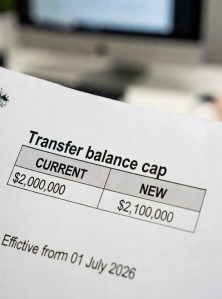
One of the most common questions we get asked is “How is my Personal TBC affected by the increase in the General TBC from $2m to $2.1 on 1 July 2026?
Your Personal Transfer Balance Cap (TBC) is calculated by the Australian Taxation Office (ATO) based on the highest ever balance in your Transfer Balance Account (TBA). It tracks, in reasonably real-time (if you or your accountant have reported correctly quarterly via a TBAR – transfer balance cap report), the amount of super transferred into retirement phase (credits) minus any voluntary commutations (debits), typically starting at $1.6M to $2.0M+ depending on when you first started a pension. Note from 01 July 2026 the General Transfer Balance Cap will rise to $2.1m for those starting their first pension after that date.
How the TBC Calculation Works
- Initial Cap: The General TBC ($2M in 2025–26 and rising to $2.1m for 2026-2027) is your personal cap if you start a pension for the first time on or after 1 July of each tax year.
- Highest Ever Balance: If you had a pension before 1 July 2025, your TBC is proportional to the highest amount you ever had in retirement phase.
- Indexation Calculation: If the general cap increases, and you have unused cap space, your personal cap increases proportionately based on your highest ever balance.
- Example: If you used 60% of your cap in 2024-25, you are only eligible for 40% of any new indexation increase. So if General Transfer Balance Cap rises by $100,000 your TBC has only risen by $40,000 to $1,940,000 in 2025-26
Key Components
- Credits: Starting a retirement pension, structured settlement contributions.
- Debits: Commuting a pension (moving money back to accumulation phase), death benefit payments.
- Defined Benefits: How the Special Value is Calculated
- Lifetime Pensions/Annuities: The formula is
AnnualPensionPayment
×16.
- First Payment Basis: The credit is calculated based on the first payment you are entitled to receive, annualized by the fund.
- Indexation: If your pension increases (indexed) over time, this generally does not trigger a new, separate reportable TBC credit
- Lifetime Pensions/Annuities: The formula is
Worked Example by ATO
Example: highest ever balance below $1.6 million before indexation with credits
Nina started a retirement phase income stream with a value of $1.2 million on 1 October 2018 and her cap was $1.6 million.
The general transfer balance cap indexed by $100,000 to $1.7 million from 1 July 2021.
There were no more events in Nina’s transfer balance account before indexation. The highest ever balance in her transfer balance account is $1.2 million.
Nina’s unused cap percentage is 25% of $1.6 million.
Nina’s personal transfer balance cap was indexed by 25% of $100,000 (increment amount) when indexation started on 1 July 2021, increasing her personal transfer balance cap to $1.625 million.
The general transfer balance cap was indexed by $200,000 to $1.9 million from 1 July 2023. Nina’s personal transfer balance cap is increased to $1,675,000 (25% of the $200,000 increase to the general transfer balance cap).
Nina started a $400,000 retirement phase income stream on 1 October 2023. This increased the balance of her transfer balance account to $1.6 million. This is a credit event in Nina’s transfer balance account before indexation.
Nina’s highest ever transfer balance is $1.6 million.
Nina’s new unused cap percentage is calculated as follows:
- 0.95522 being $1.6 million (highest ever balance of her transfer balance account) divided by $1.675 million (transfer balance cap on the first day she had that balance)
- 95% expressed as a percentage, rounded down to the nearest whole number
- subtract 95 from 100 = 5%.
The general transfer balance cap was indexed by $100,000 to $2 million from 1 July 2025.
Nina’s personal transfer balance cap is indexed by 5% of $100,000 on 1 July 2025, increasing it by $5,000 to $1.68 million.
Important Notes 1
Excess TBC: If you exceed your personal cap, you must remove the excess, any associated earnings and also pay tax on those earnings from the tax-free retirement phase to avoid ongoing penalties.
Key Actions to Rectify Excess TBC:
- Commute the Excess: You must “commute” the excess amount, which means transferring it from your retirement phase income stream (pension) back into an accumulation account or withdrawing it as a lump sum from the super system.
- Act Quickly: Excess transfer balance tax is calculated on notional earnings that accrue daily until the excess is removed.
- Voluntary vs. Compulsory: You can initiate a voluntary commutation directly with your super fund as soon as you are aware of the excess. If you do not, the ATO will issue an “excess transfer balance determination” and a “commutation authority” to your fund, requiring them to remove the excess.
- Calculate Earnings: If you act before an ATO determination, you must calculate the earnings on the excess amount yourself and remove them as well.
- Death Benefits: If the excess arises from a death benefit income stream, the excess must be withdrawn from the super system as a lump sum; it cannot be rolled back into an accumulation account.
Important Notes 2
No Re-calculation: There is no recalculation of the TBC based on your Pensions growth in value and Pension payments do not reduce your cap, nor do investment losses.
So what does reduce your TBC? Well here are the key events that reduce your TBC (create a TBC debit):
- Commutations (Partial or Full): This is the most common method. When you transfer money out of a retirement phase income stream (pension) and move it back into an accumulation account, it creates a debit in your TBC.
- Lump Sum Withdrawals: If you withdraw a lump sum directly from your retirement phase pension, this is considered a commutation and reduces your TBC.
- Structured Settlement Contributions: If you make a contribution to your super fund due to a personal injury (structured settlement), and this is later rolled into a super income stream, it creates a debit.
- Death Benefit Income Streams: If you are a beneficiary receiving a death benefit income stream, specific rules apply to how it is counted, and a debit can occur when this pension is fully or partially commuted.
- Family Law Payment Splits: A reduction in your TBC may occur if your pension is divided due to a relationship breakdown.
- Loss Due to Fraud or Bankruptcy: A debit can occur if your super interest is lost due to fraudulent activity or bankruptcy.
- Pension Ceasing to Comply: If a super income stream stops meeting the required standards, a debit may occur. Not something you want to test!
Are you looking for an advisor that will keep you up to date and provide guidance and tips like in this blog? then why now contact us at our Castle Hill or Windsor office in Northwest Sydney to arrange a one-on-one consultation, just click the Schedule Now button up on the left to find the appointment options.
Please consider passing on this article to family or friends. Pay it forward!
Liam Shorte B.Bus FSSA™ AFP
Financial Planner & Fellow SMSF Specialist Advisor™


Tel: 02 9899 3693, Mobile: 0413 936 299
- PO Box 6002 NORWEST NSW 2153
- Suite 40, 8 Victoria Ave, Castle Hill NSW 2154
- Suite 4, 1 Dight St., Windsor NSW 2756
Corporate Authorised Representative of Viridian Advisory Pty Ltd ABN 34 605 438 042, AFSL 476223
This information has been prepared without taking into account your objectives, financial situation, or needs. Because of this, you should, before acting on this information, consider its appropriateness, having regard to your objectives, financial situation, and needs. This website provides an overview or summary only and it should not be considered a comprehensive statement on any matter or relied upon as such.




 The SMSF Coach