


• Benefits of a Self Managed Super Fund – SMSF
  • Videos
  • Why Self Managed Super?
  • Costs / Fees
  • About us
  • Testimonials
  • Contact Us
  • Property in a SMSF

The SMSF Coach

Coaching clients to take back control of their Superannuation and their future
  • Liam Shorte

    Unknown's avatar

    Putting people back in control of their wealth

  • SMSF Adviser of the Year - Winner 2025
  • SMSF Adviser of the Year - Finalist 2025
  • SMSF Adviser of the Year 2024
  • IFA 2023 Excellence Awards – SMSF Advisor of the Year – Finalist

  • IFA 2021 Excellence Awards – SMSF Advisor of the Year – WINNER!!
  • SMSF Adviser of the Year 2022 Finalist
    IFA 2022 Excellence Awards – SMSF Advisor of the Year – Finalist
  • Get advice – Have a chat

  • Enter your email address to subscribe and be first to receive notifications of new posts by email. Go on it's FREE!

    Join 6,177 other subscribers
  • Top Posts & Pages

    • What can my SMSF invest in?
    • In-specie contributions to and from an SMSF
    • Property through super in a SMSF - Part 3: 20 most common mistakes
    • How the Centrelink Gifting rules work
    • How to elect to pay Division 293 Notice from your SMSF or Super
    • Property in a SMSF
    • Benefits of a Self Managed Super Fund - SMSF
    • Property through super in a SMSF - Part 2: The Process
    • About us
    • How to check your Superannuation data via myGov online
  • Connect with me

    • View SMSFCoach’s profile on Facebook
    • View SMSFCoach’s profile on Twitter
    • View SMSFCoach’s profile on Instagram
    • View Smsfcoach’s profile on Pinterest
    • View LiamShorte’s profile on LinkedIn
    • View user44865214’s profile on Vimeo
    • View LiamShorte’s profile on Google+
  • Recent Tweets

    Tweets by SMSFCoach
  • View William Shorte's Adviser Ratings profile
    https://www.adviserratings.com.au/widget/278214/profile.js

All posts in category Small Business CGT

Superannuation changes for Self-Managed Super Funds – useful ATO links


The changes to the superannuation system, announced by the Australian Government in the 2016–17 Budget, have now received royal assent and the finer details of how to implement them have been released. While the government claim these changes were designed to improve the sustainability, flexibility and integrity of Australia’s superannuation system, they did not work with industry or the ATO before announcing them and as such it has been a nightmare to try to get your head around what the actual changes are and how strategies need to be implemented to manage them.

As a result we are getting last-minute guidance from the ATO and software providers as well as SMSF, Industry and Retail Super providers. The government have back-flipped on some measures, amended others because of collateral damage and tightened other measures for obscure reasons.  With most of these changes commencing from 1 July 2017 I have tried to put some useful links together.

A short video overview of the changes is provided below. I have provided more detailed information links and will update these as they are progressively published to help you understand the changes, how they may affect you, and what you may need to know and do now, or in the future as a trustee of a self-managed super fund (SMSF). Even more detailed information is available to help you understand the changes, including for some topics, law companion guidelines (see below) to provide certainty about how the changes will be administered.

Overview of super changes

  • Spouse tax offset
  • Personal super contributions deduction
  • Low income super tax offset
  • Introducing a transfer balance cap of $1.6M for pension phase accounts
  • Reduction of Division 293 income threshold to $250,000
  • Lowering the non-concessional (post-tax) contributions cap to $100,000 per annum
  • Reduction of concessional (pre-tax) contributions cap to $25,000 per annum
  • Carry-forward concessional contributions of unused caps over five years
  • Improve the integrity of retirement income streams
  • Removal of anti-detriment payment
  • Innovative retirement income stream products
  • Co-contributions

Law Companion Guides

For those who wish to dive in to the detail please view the Law Companion Guides below. A law companion guideline is a type of public ruling. It gives the ATO view on how recently enacted law applies. It is usually developed at the same time as the drafting of the Bill.

The ATO normally release a law companion guideline in draft form for comment when the Bill is introduced into Parliament. It is finalised after the Bill receives Royal Assent. It provides early certainty in the application of the new law. Please make sure to look for updates before relying on this information.

LCG 2016/8 – Superannuation reform: transfer balance cap and transition-to-retirement reforms: transitional CGT relief for superannuation funds
LCG 2016/9 – Superannuation reform: transfer balance cap
LCG 2016/D10 – Superannuation reform: defined benefit income streams – non commutable, lifetime pensions and lifetime annuities
LCG 2016/11 – Superannuation reform: concessional contributions – defined benefit interests and constitutionally protected funds
LCG 2016/12 – Superannuation reform: total superannuation balance
LCG 2017/D1 – Superannuation reform: defined benefit income streams – pensions or annuities paid from non-commutable, life expectancy or market-linked products
LCG 2017/D3 – Superannuation reform: Transfer Balance Cap – Superannuation death benefits

Super changes Q&As

The ATO have also released access to answers to some frequently asked questions and they can be found in this document Super Changes Q & As

Example: Q. How are my pensions and annuities valued for transfer balance cap purposes?

ANSWER : You need to contact your fund about the value of your pensions and annuities.

The value of your pension or annuity will generally be the value of your pension account for an account-based pension.

Special rules apply to calculate the value of: • lifetime pensions • lifetime annuities that existed on 30 June 2017, and • life expectancy and market linked pensions and annuities where the income stream existed on 30 June 2017

Lifetime pension and annuities These are valued by multiplying the annual entitlement by a factor of 16.This provides a simple valuation rule based on general actuarial considerations. Your annual entitlement to a superannuation income stream is worked out by reference to the first payment entitlement for the year. The first payment is annualised based on the number of days in the period to which the payment refers. (I.e. the first payment divided by the number of days the payment relates to multiplied by 365).

This means that a lifetime pension that pays $100,000 per annum will have a special value of $1.6 million which counts towards your transfer balance cap in the 2017-18 financial year.

For a lifetime pension or annuity already being paid on 1 July 2017, the special value will be based on annualising the first payment in the 2017-18 financial year. This may include indexation, so may be slightly higher than your current annual lifetime pension payments.

Life expectancy and market linked pensions and annuities being paid on or before 30 June 2017 are valued by multiplying the annual entitlement by the number of years remaining on the term of the product (rounded up to the nearest year).

I hope this guidance has been helpful and please take the time to comment. Feedback always appreciated. Please reblog, retweet, like on Facebook etc to make sure we get the news out there. As always please contact me if you want to look at your own options. We have offices in Castle Hill and Windsor but can meet clients anywhere in Sydney or via Skype. Just click the Schedule Now button up on the left to find the appointment options.

Liam Shorte B.Bus SSA™ AFP

Financial Planner & SMSF Specialist Advisor™

SMSF Specialist Adviser 

 Follow SMSFCoach on Twitter Liam Shorte on Linkedin NextGen Wealth on Facebook   

Verante Financial Planning

Tel: 02 98941844, Mobile: 0413 936 299

PO Box 6002 BHBC, Baulkham Hills NSW 2153

5/15 Terminus St. Castle Hill NSW 2154

Corporate Authorised Representative of Viridian Select Pty Ltd ABN 41 621 447 345, AFSL 51572

This information has been prepared without taking account of your objectives, financial situation or needs. Because of this you should, before acting on this information, consider its appropriateness, having regard to your objectives, financial situation and needs. This website provides an overview or summary only and it should not be considered a comprehensive statement on any matter or relied upon as such.

Share this:

  • Email a link to a friend (Opens in new window) Email
  • Print (Opens in new window) Print
  • Tweet
  • Pocket
  • Share on Reddit (Opens in new window) Reddit
Like Loading...
2 Comments
by SMSF Coach - Liam Shorte on April 21, 2017  •  Permalink
Posted in Checklists, Contribution Strategies, Estate Planning, News & Stats, Pension Strategies, Pensions, Retirement Planning, Salary Sacrifice, Small Business CGT, SMSF, SMSF Management, Superannuation, Superannuation Splitting, Tax Planning, Trustee
Tagged Account Based Pension, Age Pension, Alzheimer's, Asset Allocation, assets test, Baulkham Hills, budget, Castle Hill, Cost of Living, dementia, DIY Super, Dural, Enduring Power of Attorney, EPoA, Estate Planning, Hawkesbury, Incapacity, income planning, Interest Rates, Investment, Investment Strategy, pension phase, Pension Strategies, Pensions, powers of attorney, private company valuations, property, protection, RBA, reset pensions, Retire, Retirement, Retirement Planning, Self MAnaged Super, Self Managed Superannuation Fund, SMSF, Strategy, superannuation, Tax Free Pensions, Tax Planning, Transition, Transition to Retirement, Trustee, Trusts asset valuations, Windsor

Posted by SMSF Coach - Liam Shorte on April 21, 2017

https://smsfcoach.com.au/2017/04/21/superannuation-changes-for-self-managed-super-funds-useful-ato-links/

How to sell a business tax-effectively using small business capital gains tax (CGT) concessions


tax-breaks

Small business is hard work. Ask any small business owner and he or she will tell you about the hard work, sacrifices and many hours of dedication it’s taken to get to where they are. Many see their business as their superannuation and have poured profits back in to it over the years. Which is why when they sell, they absolutely deserve to get the highest return they can.

While the 2016 federal budget was full of surprises and we have seen back-flips and changes to the proposals, there was some relief for small business owners. All the media attention has been on the changes proposed to be made to superannuation contributions and balances in pension phase. There was, however, some welcome news for small business owners with regard to continued access to the small business CGT tax concessions.

So what do you know about these very valuable concessions and how do you qualify for them if you are selling a business or business assets. Firstly, identify if you need to be considering them at all:

  • Are you selling a business asset and expecting a significant capital gain?
  • Are you looking to retire after the sale of your business?
  • Do you wish to use the sale proceeds to fund your retirement?

How does it work?

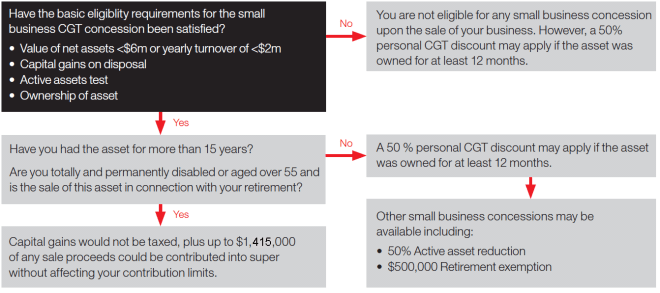
Subject to meeting the basic requirements, business owners can take advantage of the Government’s small business concessions to reduce or even extinguish any capital gains tax (CGT) realised from the sale of a business or business asset.

If the business asset was held for more than 15 years, and the owner is either over 55 and retiring or permanently incapacitated when the asset is sold:

• any capital gains could be disregarded; plus
• up to $1,415,000 of any sale proceeds could be contributed into super without counting towards the concessional or non-concessional contributions caps.

What does it mean for me?

This is potentially a significant opportunity for small business owners. Not only does it provide scope to reduce your CGT liability, it also allows you to turn the proceeds from the sale of your business into a tax-effective income stream in retirement
through your super.

If you’re considering this strategy, it’s important to seek professional financial, legal and tax advice specific to your circumstances. You should also note that lifetime limits apply to all contributions under these concessions, and the specific forms must be completed and given to the super fund before or at the time the super contribution is made to be effective.

How do I know if I qualify?

To be eligible for the small business CGT concession, you need to meet the following basic requirements:

• Your net asset value is less than $6 million or your business turnover is less than $2 million p.a. Your net asset value includes assets used in your business but are owned by
your affiliates or an entity connected with you.

• The asset you own is an ‘active’ asset – meaning it has been used or held ready for use in a business carried on by yourself (whether alone or in partnership), your affiliate, your
spouse, your child under 18 or an entity connected with you.

• The asset has been used in the business for at least half of the ownership period or for a minimum of 7.5 years if you’ve owned it for at least 15 years.

sm-cgt

Strategy in action

Sarah and James are joint owners of a retail shop in a small town from which they’ve run their newsagency for the last 20 years. They acquired the property in 1992 for $300,000 and have
continuously owned it outright.

In 2015, in line with their pending retirement, Sarah and James sold the property for $1 million. Both aged 60, their net assets are less than $6 million and they are looking to use the sale proceeds to fund their retirement.

Because they’ve owned their shop for more than 15 years and are retiring, Sarah and James would be eligible for the small business CGT concessions. They can apply the sale of their business as follows:

• Proceeds of sale: $1 million
• Capital gain: $700,000 ($1 million – $300,000)
• Assessable capital gain: $0

As a result, Sarah and James can contribute $500,000 each into super under the CGT cap election without it affecting their concessional or non-concessional contributions caps for the financial year. This means they could potentially contribute more into superannuation or an SMSF in the same year under their other contribution caps.

I hope this guidance has been helpful and please take the time to comment. Feedback always appreciated. Please reblog, retweet, like on Facebook etc to make sure we get the news out there. As always please contact me if you want to look at your own options. We have offices in Castle Hill and Windsor but can meet clients anywhere in Sydney or via Skype. Just click the Schedule Now button up on the left to find the appointment options.

Liam Shorte B.Bus SSA™ AFP

Financial Planner & SMSF Specialist Advisor™

SMSF Specialist Adviser 

 Follow SMSFCoach on Twitter Liam Shorte on Linkedin NextGen Wealth on Facebook   

Verante Financial Planning

Tel: 02 98941844, Mobile: 0413 936 299

PO Box 6002 BHBC, Baulkham Hills NSW 2153

5/15 Terminus St. Castle Hill NSW 2154

Corporate Authorised Representative of Viridian Select Pty Ltd ABN 41 621 447 345, AFSL 51572

This information has been prepared without taking account of your objectives, financial situation or needs. Because of this you should, before acting on this information, consider its appropriateness, having regard to your objectives, financial situation and needs. This website provides an overview or summary only and it should not be considered a comprehensive statement on any matter or relied upon as such.


Share this:

  • Email a link to a friend (Opens in new window) Email
  • Print (Opens in new window) Print
  • Tweet
  • Pocket
  • Share on Reddit (Opens in new window) Reddit
Like Loading...
1 Comment
by SMSF Coach - Liam Shorte on November 7, 2016  •  Permalink
Posted in Contribution Strategies, Retirement Planning, Small Business CGT
Tagged Account Based Pension, Alzheimer's, Baulkham Hills, budget, Castle Hill, CGT, dementia, DIY Super, Dural, Enduring Power of Attorney, EPoA, Estate Planning, Hawkesbury, Incapacity, income planning, Investment, Investment Strategy, pension phase, Pensions, powers of attorney, property, Self Managed Superannuation Fund, Smallbiz, Smallbusiness, sme, SMSF, tax, Tax Free Pensions, Tax Planning, Transition, Transition to Retirement

Posted by SMSF Coach - Liam Shorte on November 7, 2016

https://smsfcoach.com.au/2016/11/07/how-to-sell-a-business-tax-effectively-using-small-business-capital-gains-tax-cgt-concessions/

  • Search for specific topics

  • Liam is a Fellow of the SMSF Association, their highest Specialist rating
  • Recent Posts

    • Age Pension & Deeming Changes September 2025
    • Could an Unsigned Will Be Valid? What about your BDBN in the SMSF?
    • Important Changes to Pension Commencement Rules Now in Effect from 1 July 2025
    • The Ultimate SMSF End of Financial Year Checklist 2025
    • Superannuation – General Transfer Balance Cap Increases to $2.0 Million from 1 July 2025
    • SMSF Business Real Property: It’s not what type of property that counts, it’s the use that matters.
    • The Ultimate SMSF End of Financial Year Checklist 2024
    • How to check your Superannuation data via myGov online
    • The Ultimate SMSF End of Financial Year Checklist 2023
    • So How Much Can I Contribute to my SMSF Using the Bring Forward Rule from 1 July 2025
  • Previous Posts by Topic

    • Contribution Strategies (83)
      • In Specie transfers (5)
      • Salary Sacrifice (15)
      • Small Business CGT (2)
      • Superannuation Splitting (18)
      • Tax Planning (64)
    • education (15)
    • Education costs (2)
    • Estate Planning (38)
      • Anti-Detriment (1)
      • Binding Death Nominations (15)
      • Enduring Power of Attorney (7)
      • Reversionary Pension (13)
      • testamentary trust (1)
    • Financial Planning (62)
      • Bankruptcy Protection (1)
      • Contributions (10)
      • Divorce (5)
      • downsizing (6)
      • Superannuation (27)
    • Insurance Strategies (14)
      • Income Protection (3)
      • Life Insurance (7)
      • Salary Continuance (3)
      • Total & Permanent Disability (4)
    • Investment Strategies (73)
      • Asset Allocation (22)
      • Behavioural Finance (3)
      • Bonds (5)
      • Borrowing (21)
        • Loans (12)
        • LRBA (14)
      • Botcoin (1)
      • Buy-backs (1)
      • Franking Credits (14)
      • Hybrids (3)
      • International Investing (7)
      • Investor Education (6)
      • Property (25)
      • Results Season (2)
      • Term Deposits (7)
    • Retirement Planning (91)
      • Age Pension (7)
      • Centrelink (19)
        • CHSC (2)
      • Downsizing (1)
      • Lifestyle (4)
      • Pension Strategies (36)
      • Pensions (33)
    • SMSF (102)
      • News & Stats (47)
    • SMSF alternatives (2)
    • SMSF Management (122)
      • Audit (18)
      • Checklists (23)
      • Deeds (1)
      • Scam Alert (2)
      • SMSF Exit Strategies (2)
      • TBAR reporting (4)
      • Trustee (70)
  • Like us on Facebook

    Like us on Facebook
  • Blog Stats

    • 865,636 hits
Blog at WordPress.com.
<div data-adviser-id="278214">

<a href="https://www.adviserratings.com.au/adviser/278214/William-Shorte">
View William Shorte's Adviser Ratings profile
</a>
</div>

https://www.adviserratings.com.au/widget/278214/profile.js
  • Subscribe Subscribed
    • The SMSF Coach
    • Join 297 other subscribers
    • Already have a WordPress.com account? Log in now.
    • The SMSF Coach
    • Subscribe Subscribed
    • Sign up
    • Log in
    • Report this content
    • View site in Reader
    • Manage subscriptions
    • Collapse this bar
 

Loading Comments...
 

    %d