

New changes to Superannuation in summary for SMSF Trustees


Firstly nothing to scary but some stings in the tail.    Tax Reform

Mr Swan and Superannuation Minister Bill Shorten fronted announced a tax exemption on superannuation earnings supporting pensions and annuities will be capped at $100,000, and anything above that level taxed at a rate of 15 per cent from 01/07/2014.

Based on a 5% earnings rate that would only impact on those with super assets of more than $2 million. Remember this is per account so for a couple each of them could have $2,000,000 without paying tax on their pension

The $100,000 threshold will be indexed to the Consumer Price Index (CPI), and will increase in $10,000 increments.

Special Treatment for Capital gains on Assets purchased before 01/07/2014 ( Did not proceed)

-  For existing assets (such as property or shares) that were purchased before 5 April 2013, the reform will only apply to capital gains that accrue after 1 July 2024;

-  For new assets that are purchased from 5 April 2013 to 30 June 2014, individuals will have the choice of applying the reform to the entire capital gain, or only that part that accrues after 1 July 2014; and

-  For new assets that are purchased after 1 July 2014, the new limits will apply to the entire capital gain.

Higher concessional cap for people aged 60 and over brought forward

Accordingly, the government will bring forward the start date for the new higher concessional cap of $35,000  to July 1 for people aged 60 and over. Concessional includes employer SGC (9-12%) and Salary Sacrifice.

Individuals aged 50 and over will be able to access the higher concessional cap of $35,000 from the current planned start date of 1 July 2014.

The general concessional cap is expected to reach $35,000 from 1 July 2018 for those under 50.

Excess contributions tax to be reformed

Mr Shorten said the government will reform the system of excess contributions tax (ECT) that was introduced by the former government in 2007, to make it fairer and give individuals greater choice.

Under the current arrangements, concessional contributions that are in excess of the annual cap are effectively taxed at the top marginal tax rate (46.5 per cent) rather than the normal rate of 15 per cent.

Now you will pay tax on the excess contribution to match what you would have paid at your marginal tax rate. for example if you are on the 37% tax bracket you would pay ECT at 22% rather than 30% if you had to pay it on the top marginal rate of 45% (plus Medicare).

Income Streams will be Deemed like non-superannuation assets

Under the change announced today, standard pension deeming arrangements will apply to new superannuation account-based income streams assessed under the pension income test rules after 1 January 2015.

Instead of the concessional treatment of Account Based Pensions currently for those accessing an Aged Pension, they will be deemed like normal assets. This will affect those on the borderline of $55K income for a single person and $80K for a couple who previously benefited from deductible amounts on their account based or allocated pensions.

Extending concessional tax treatment to deferred lifetime annuities

The Government will encourage the take-up of deferred lifetime annuities (DLAs), by providing these products with the same concessional tax treatment that superannuation assets supporting income streams receive. This reform will apply from 1 July 2014.

Mr Swan also announced the Gillard government will establish a Council of Superannuation Custodians to ensure that any future changes are consistent with an agreed Charter of Superannuation Adequacy and Sustainability.

Here is the link to the full press release “A fairer superannuation system”

As always please contact me if you want to look at your own particular situation and we will break it down in plain English for you. We have offices in Castle Hill and Windsor but can meet clients anywhere in Sydney or online via Skype.

Liam Shorte B.Bus SSA™ AFP

Financial Planner & SMSF Specialist Advisor™

SMSF Specialist Adviser 

 Follow SMSFCoach on Twitter Liam Shorte on Linkedin NextGen Wealth on Facebook   

Verante Financial Planning

Tel: 02 98941844, Mobile: 0413 936 299

PO Box 6002 BHBC, Baulkham Hills NSW 2153

5/15 Terminus St. Castle Hill NSW 2154

Corporate Authorised Representative of Viridian Select Pty Ltd ABN 41 621 447 345, AFSL 51572

This information has been prepared without taking account of your objectives, financial situation or needs. Because of this you should, before acting on this information, consider its appropriateness, having regard to your objectives, financial situation and needs. This website provides an overview or summary only and it should not be considered a comprehensive statement on any matter or relied upon as such.

What happens if I don’t take the minimum pension?


The Australian Tax Office (ATO) in January 2013 released guidance on the consequences of trustees not paying minimum amounts from account based pensions, including the loss of tax exempt status. It has issued two documents on starting and stopping a superannuation income stream (pensions) for self-managed superannuation funds. Tax Free

 (more…)

ATO backs off on SMSF property crunch | | MacroBusiness


In November 2011, a draft tax ruling (TR2011/D3) by the ATO caused concern among Self Managed Superannuation Fund trustees and property investors in particular. The ruling suggested that the pension tax exemption …

See the full article on www.macrobusiness.com.au

Superannuation — tax certainty for deceased estates – Government MYEFO announcement good for SMSFs


The release of draft taxation ruling TR 2011/D3 in July last year caused much concern when it suggested that the pension exemption ceases automatically upon death (unless a reversionary pension was in place).

Under those proposed rules if an SMSF member died with assets carrying unrealised Capital Gains, even if the deceased were receiving a pension, upon death the pension would cease (unless the pension qualified as an auto-reversionary pension). If SMSF assets were then sold/transferred, the SMSF would have CGT implications.  (more…)

Don’t depend on working longer to save for your Retirement Income


Looking to RetirementMany clients believe delaying their retirement is a solution to inadequate savings, but they often find themselves out of the workforce sooner than they’d planned. None of us has that crystal ball!

It is likely that the shortfall in retirement savings here in Australia stems in part from our “she’ll be right” attitude towards life, which leads us to believe that we do not need to start saving early and that somehow it will all work out ok.

Delaying retirement can be a powerful boost to your superannuation nest-egg. But relying on the ability to work for a few extra years to stretch retirement savings out a little longer is fraught with risk and does not reflect personal and family health or other issues that may arise. As an example I have had some clients forced to retire to look after their grandchildren due to the illness of the parent.

If you played with any retirement planning calculator or have spoken to an adviser, the “work a little longer” solution would have been investigated and many put it forward as the solution to the GFC “dip” (read plunge) in savings.

The concept is easy to grasp: By working longer then you originally planned, you get more years of concessionally taxed growth in your superannuation accounts especially if you used a Transition to Retirement Pension from 55 or 60. You can also continue to salary sacrifice and make non-concessional contributions while getting the benefit of the Senior And Pensioners Tax Offset (SAPTO) that I mentioned a few weeks ago here.

The idea is the longer you work and save and more you get into a superannuation income stream then your capital will last longer and you may also benefit from more Age Pension when required.

Back to reality with a jolt!

But there is a huge disconnect between workers’ expectations and retirement reality. Over half of the retirees surveyed in a US study last year said they left the workforce earlier than planned, and just 8% of them said that positive factors — such as the ability to afford early retirement — prompted the move. For the vast majority of early retirees, negative circumstances, such as personal or spouse health problems or company downsizing played a role.

40% of Australians will suffer a critical illness before age 65 (Cologne Life Re study). They will most likely survive but their retirement funding will be devastated.

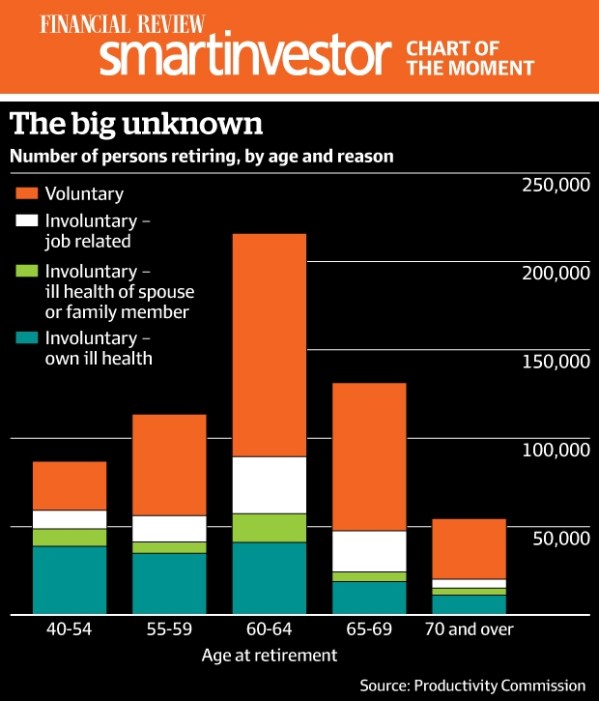
The 2015 Productivity Commission report on post-retirement shows that about 40 per cent of Australians who retire between the age of 60 and 64 do so involuntarily, either because of their own or a family member’s ill health, or redundancy.

For those aged between 65 and 69 who retire involuntarily is not that different, while for younger age groups most people who retire do so involuntarily.

Retirement ages

Clearly, workers relying on delayed retirement are rolling the dice. Yet, most people discount the future so much that they’re willing to take that gamble. May hope that an inheritance will save the day but do not realise that age care costs and parents living longer may eat heavily into any expected inheritance.

Strangely the people most likely to plan on working a few more years to boost their retirement security may actually have the least ability to postpone their retirement. People who suffer an illness or injury  are more likely than those in good health to have pushed back their expected retirement date in recent years, according to  a report from consulting firm Towers Watson. Yet health problems or disabilities were cited by more than half of retirees forced to retire earlier than planned.

Don’t put you head in the sand – start now

As psychologists are quick to point out, we all have that inner voice that loves to procrastinate who loves to put off till tomorrow what we should do today – beause its “all too hard to get your head around”. Saving more today is a sure thing, and extra years in the workforce are anything but. If you know you don’t have enough, you should start saving more today, because that’s by far the less risky alternative.

Let’s look at an example using the Retirement Planner on the MoneySmart.gov.au site for a 55-year-old pre-retiree with just $30K in superannuation. If she earns $80,000, makes $17,500 annual salary sacrifice contributions (in addition to Employers SGC contributions of 9.5%)  and earns a 7.5% return pre retirement and 6.5% after, she could be looking at an Income in retirement of $32,143 by age 67 including the Age Pension. If she’s forced to retire at that point, she’s still in better shape than most Australian’s. And if she can continue working, she  counld improve on this lifestyle with a better retirement income.

Retirement Income

A final don’t is cancelling TPD or Income Protection insurances to save money while in your most productive earning years (read here for more on that subject). The loss of 5-10 years of earnings potential is one guaranteed way to destroy your lifestyle in retirement. Your ability to earn is your biggest asset

Are you looking for an advisor that will keep you up to date and provide guidance and tips like in this blog? Then why now contact me at our Castle Hill or Windsor office in Northwest Sydney to arrange a one on one consultation. Just click the Schedule Now button up on the left to find the appointment options.

Liam Shorte B.Bus SSA™ AFP

Financial Planner & SMSF Specialist Advisor™

SMSF Specialist Adviser 

 Follow SMSFCoach on Twitter Liam Shorte on Linkedin NextGen Wealth on Facebook   

Verante Financial Planning

Tel: 02 98941844, Mobile: 0413 936 299

PO Box 6002 BHBC, Baulkham Hills NSW 2153

5/15 Terminus St. Castle Hill NSW 2154

Corporate Authorised Representative of Viridian Select Pty Ltd ABN 41 621 447 345, AFSL 51572

This information has been prepared without taking account of your objectives, financial situation or needs. Because of this you should, before acting on this information, consider its appropriateness, having regard to your objectives, financial situation and needs. This website provides an overview or summary only and it should not be considered a comprehensive statement on any matter or relied upon as such.

Merging of Pensioner Tax Offset and Senior Australians Tax Offset to new Seniors and Pensioners Tax Offset (SAPTO)


Don’t you just love another acronym to learn!

The seniors and pensioners tax offset (SAPTO) replaced the senior Australians tax offset (SATO) and the pensioner tax offset from 1 July 2012. This means older Australians who were previously eligible for either SATO or the pensioner tax offset may now be eligible for the SAPTO.

The rebate amount and thresholds are illustrated below:

Seniors and pensioners tax offset (SAPTO)
Family status Maximum tax offset Shade-out threshold Cut-out threshold
Single $2,230 $32,279 $50,119
Couple (each)33 $1,602 $28,974 $41,790
Couple (separated due to illness)33 $2,040 $31,279 $47,599
  1. The shade-out threshold is the maximum rebate income at which individuals will be entitled to the maximum tax offset. The tax offset reduces by 12.5 cents for each dollar of rebate income in excess of the shade-out threshold.
  2. The cut-out threshold is the level of rebate income at which the offset reduces to nil. At or above this level of rebate income, there is no entitlement to the tax offset.
  3. Any unused portion of the tax offset may be transferable to the partner under TR 93/31.

Are you looking for an advisor that will keep you up to date and provide guidance and tips like in this blog? Then why now contact me at our Castle Hill or Windsor office in Northwest Sydney to arrange a one-on-one consultation. Just click the Schedule Now button up on the left to find the appointment options.

Liam Shorte B.Bus SSA™ AFP

Financial Planner & SMSF Specialist Advisor™

SMSF Specialist Adviser 

 Follow SMSFCoach on Twitter Liam Shorte on Linkedin NextGen Wealth on Facebook   

Verante Financial Planning

Tel: 02 98941844, Mobile: 0413 936 299

  • PO Box 6002 NORWEST NSW 2153
  • 5/15 Terminus St. Castle Hill NSW 2154
  • Suite40, 8 Victoria Ave, Castle Hill NSW 2154
  • Suite 4, 1 Dight St., Windsor NSW 2756

Corporate Authorised Representative of Viridian Advisory Pty Ltd ABN 34 605 438 042, AFSL 476223

This information has been prepared without taking into account your objectives, financial situation, or needs. Because of this, you should, before acting on this information, consider its appropriateness, having regard to your objectives, financial situation, and needs. This website provides an overview or summary only and it should not be considered a comprehensive statement on any matter or relied upon as such.

Last minute planning checklists for everyone from Small Business Owners to SMSF Trustees as well as Personal planning.


Have you left your financial planning until the last minute?  Go over this checklist with your accountant or financial planner as soon as possible.  Some of these strategies apply every year, while others are specific to this year because of the changes in the tax rate, the end to the flood levy, and some changes to small business write offs in the next year.

Checklists for:

Personal / Family

Small Business Owner:

SMSF Trustee

Investment Property Landlord

See full article: http://myob.com.au/blog/end-of-financial-year-planning-checklists/#ixzz1ysA6ExvQ

I hope this guidance  has been helpful and please take the time to comment. Feedback always appreciated.

Liam Shorte B.Bus SSA™ AFP

Financial Planner & SMSF Specialist Advisor™

SMSF Specialist Adviser 

 Follow SMSFCoach on Twitter Liam Shorte on Linkedin NextGen Wealth on Facebook   

Verante Financial Planning

Tel: 02 98941844, Mobile: 0413 936 299

PO Box 6002 BHBC, Baulkham Hills NSW 2153

5/15 Terminus St. Castle Hill NSW 2154

Corporate Authorised Representative of Viridian Select Pty Ltd ABN 41 621 447 345, AFSL 51572

This information has been prepared without taking account of your objectives, financial situation or needs. Because of this you should, before acting on this information, consider its appropriateness, having regard to your objectives, financial situation and needs. This website provides an overview or summary only and it should not be considered a comprehensive statement on any matter or relied upon as such.

Consider prepaying next years Private Health Insurance before June 30th – EOFY Money Saving TIP #1


As a result of the introduction of mean testing of the Private Health Insurance Premium Rebate wewant to alert you to a one-off savings possibility in relation to the private health insurance rebate.

If you pre-pay your 2012/13 private health insurance premium before 30 June 2012, you may still be able to access the Government rebate.

As you may be aware, the Government currently provides a non-means tested rebate for private health insurance premiums. The rebate can be claimed directly from the insurer, or as a tax offset when you lodge your income tax return. the majority of clients claim it upfront and if you don’t then you may need to consider doing so this year.

The rebate is currently 30% for those under 65 and rising  from 35% to 40% of the premium depending on the age of the policy holder.

The Government has now passed the required legislation that will apply an income test to the availability of the rebate to any premiums paid on or after 1 July 2012. The more income you earn, the lower the rebate as follows:

Private Health Insurance Incentive Tiers (2011-2012) with effect 1 July 2012

Singles

<$84,000 

$84,001-97,000

$97,001-130,000

>$130,001

Families

<$168,000

$168,001-194,000

$194,001-260,000

>$260,001

Rebate
< age 65 30% 20% 10% 0%
Age 65-69 35% 25% 15% 0%
Age 70+ 40% 30% 20% 0%
Medicare Levy Surcharge
All ages 0.0% 1.0% 1.25% 1.5%

Note: The thresholds increase annually, based on growth in Average Weekly Ordinary Time Earnings (AWOTE). Single parents and couples (including de facto couples) are subject to the family tiers. For families with children, the thresholds are increased by $1,500 for each child after the first.

Singles earning $84,000 or less and families earning $168,000 or less will continue to receive the existing 30, 35 and 40 per cent rebate, depending on their age.

Once your ‘adjusted’ income is greater than $130,000 (or $260,000 as a family), no rebate will be available.

For a family with gross premiums of say $2,500, this will result in an increase to the out of pocket premium costs of $750.00

The current rebate applies to a premium ‘paid’ during the income year. Accordingly, it follows that if you prepay your 2012-13 premium on or before 30 June 2012, the current rules should apply and the rebate should be available.

If you are interested in this one-off savings opportunity, we suggest you contact your private health insurer to discuss the possibility of pre-paying next year’s premium and ensure that their is no penalty for prepayment and that their system can cope with the prepayment.

Increase to Medicare Surcharge levy for High Income Earners

For those without Private Health Cover be aware that  the Medicare levy surcharge for people without private health insurance will lift to 1.5 per cent of taxable income for those top earners without private health insurance cover. (see table above)

I hope this guidance  has been helpful and please take the time to comment. Feedback always appreciated.

Liam Shorte B.Bus SSA™ AFP

Financial Planner & SMSF Specialist Advisor™

SMSF Specialist Adviser 

 Follow SMSFCoach on Twitter Liam Shorte on Linkedin NextGen Wealth on Facebook   

Verante Financial Planning

Tel: 02 98941844, Mobile: 0413 936 299

PO Box 6002 BHBC, Baulkham Hills NSW 2153

5/15 Terminus St. Castle Hill NSW 2154

Corporate Authorised Representative of Viridian Select Pty Ltd ABN 41 621 447 345, AFSL 51572

This information has been prepared without taking account of your objectives, financial situation or needs. Because of this you should, before acting on this information, consider its appropriateness, having regard to your objectives, financial situation and needs. This website provides an overview or summary only and it should not be considered a comprehensive statement on any matter or relied upon as such.

The added value of franking credits in a SMSF Portfolio


 One of the least understood and core benefits of SMSFs are the value of franking credits attached to many blue chip share dividends.  You can tilt your portfolio to enhance the taxation benefits to your fund.

Targeting of imputation credits received predominantly from direct share investment in Australian, and to a lesser extent through managed funds is not that difficult. Franking credits (properly known as Imputation credits) can also be used to offset the tax payable on the taxable income of the fund if still in accumulation stage or refunds can be received from the ATO if in pension phase (don’t you just love receiving money from the ATO!)

The key point to understand around franking credits is the fact that the income tax rate for super funds is only 15% in Accumulation phase and 0% in Pension phase, while imputation credits from fully franked dividends can be as high as 30% of the gross dividend of an Australian share. This means that the franking credit covers the tax payable on the dividend received, and leaves a significant excess to be used to reduce the other tax payable by the fund or to be claimed as a refund

So how does it work in reality ?

So company Widget Ltd makes $1.00 profit and therefore is required to pay company tax at the rate of 30% on this $1 profit. Consequently the taxed $0.30 (30% of $1) will be paid in cash to the tax office and the company then records this $0.30 into their franking account. The franking account is only a record of what was paid and does not contain actual money. The company’s ability to frank its dividend will depend on the balance of this franking account. If the franking credit contains a surplus, the company may declare a fully franked (100% franked) dividend. If the franking account isn’t large enough, perhaps because it pays tax overseas, then the company may declare a partially franked dividend. That is, the dividend received by the SMSF is “grossed up” by the amount of the imputation credit to achieve a grossed up dividend. It is on this amount that tax is then assessed at 15% or 05 depending on the phase of your SMSF. The fund is then entitled to a tax offset for the franking credit.

Example: a worked example below of a SMSF that only holds Telstra shares and ANZ shares:

Dividend Franking Credits Taxable Income Accumulation Phase Taxable Income Accumulation Phase
TLS Shares $1260 $540 $1,800 $1,800
ANZ Shares $840 $360 $1,200 $1,200
Total $2100 $900 $3,000 $3,000
Tax @ 15% $450
Tax @ 0% $0
Less: Franking credits $900 $900
Excess Franking credits $450 $900

In this example, not only will the fund pay no tax on the dividend income of these two shareholdings, but it will have:

  • Accumulation Phase $450 of excess franking credits
  • Pension Phase $900 of excess franking credits ;

Which the SMSF Trustees can use to offset against other tax liabilities of the fund (such as other income, capital gains, and taxable contributions) or if  none exists, then the SMSF fund can receive a refund of this amount. (Love it!)

The 45 day rule

As the examples have shown fully franked dividends and franking credits make investing in Australian shares a very tax effective strategy. However, the ATO realises this and to prevent investors from abusing the system (called dividend stripping) they introduced the 45 day rule. The 45 day rule states that shareholder must hold shares for 45 days (not counting days of purchase or sale) for any franking credits over $5,000.

Beware of blind dividend chasing , you can hit a wall!

A word of warning before you decide to put your life savings into chasing shares with the highest dividends. While some high yielding dividend stocks may look enticing it would be useless if those shares drop in value (falling capital value). Always research the company and look for strong fundamentals, for example what does the company’s dividend history look like? Are the dividends growing year on year in line with the earnings per share? Is there long term potential for this company? Will earnings rise in the near term and are they sustainable.

Want a Superannuation Review or are you just looking for an adviser that will keep you up to date and provide guidance and tips like in this blog? Then why now contact me at our Castle Hill or Windsor office in Northwest Sydney to arrange a one on one consultation. Just click the Schedule Now button up on the left to find the appointment options. Do it! make 2016 the year to get organised or it will be 2026 before you know it.

Please consider passing on this article to family or friends. Pay it forward!

Liam Shorte B.Bus SSA™ AFP

Financial Planner & SMSF Specialist Advisor™

SMSF Specialist Adviser 

 Follow SMSFCoach on Twitter Liam Shorte on Linkedin NextGen Wealth on Facebook   

Verante Financial Planning

Tel: 02 98941844, Mobile: 0413 936 299

PO Box 6002 BHBC, Baulkham Hills NSW 2153

5/15 Terminus St. Castle Hill NSW 2154

Corporate Authorised Representative of Viridian Select Pty Ltd ABN 41 621 447 345, AFSL 51572

This information has been prepared without taking account of your objectives, financial situation or needs. Because of this you should, before acting on this information, consider its appropriateness, having regard to your objectives, financial situation and needs. This website provides an overview or summary only and it should not be considered a comprehensive statement on any matter or relied upon as such.

Superannuation Guarantee Age Limit to be Abolished in 2013


This change last November has gone under the radar but its needs to be highlighted as it will be especially important to Self Managed Super Fund members who run their own businesses as it will enhance their ability to tax plan and continue contributing to Super tax effectively.

The Government has announced that the 70 year age limit for superannuation contributions required to be made by an employer under the Superannuation Guarantee (Administration) Act, 1992 will be abolished.  Currently, employers are not required to make any SG contributions in respect of employees once they attain age 70.

The Government had originally aimed to increase the age limit to 75 but has subsequently decided to remove the age limit entirely.

This is a win for older working Australians with the House of Representatives passing amendments to the Superannuation Guarantee (Administration) Amendment Bill 2011 that abolish the superannuation guarantee age limit.

From 1 July 2013, eligible employees aged 70 and over will receive the superannuation guarantee for the first time. This increases the coverage of the superannuation guarantee scheme to an additional 51,000 Australians aged 70 and over, who will get the benefit of the superannuation guarantee if they continue working.

“Making superannuation contributions compulsory for these mature-age employees will improve the adequacy and equity of the retirement income system, and provide an incentive to older Australians to remain in the workforce for longer,” Mr Shorten said.

A 1 July 2013 commencement date provides time for employers and older Australians to adjust to the new superannuation arrangements.

The changes will also ensure that employers will be able to claim income tax deductions for superannuation guarantee contributions made to employees aged 70 and over from 1 July 2013.

It ensures employers will not bear a higher cost in employing workers 70 and over compared with other workers.

Feedback always appreciated.

Liam Shorte B.Bus SSA™ AFP

Financial Planner & SMSF Specialist Advisor™

SMSF Specialist Adviser 

 Follow SMSFCoach on Twitter Liam Shorte on Linkedin NextGen Wealth on Facebook   

Verante Financial Planning

Tel: 02 98941844, Mobile: 0413 936 299

PO Box 6002 BHBC, Baulkham Hills NSW 2153

5/15 Terminus St. Castle Hill NSW 2154

Corporate Authorised Representative of Viridian Select Pty Ltd ABN 41 621 447 345, AFSL 51572

This information has been prepared without taking account of your objectives, financial situation or needs. Because of this you should, before acting on this information, consider its appropriateness, having regard to your objectives, financial situation and needs. This website provides an overview or summary only and it should not be considered a comprehensive statement on any matter or relied upon as such.

Superannuation Splitting to a Spouse already in or entering Transition to Retirement Phase


So I got a question about continuing to Super Split to a spouse who is over 55 and already using a Transition to retirement Pension but not fully retired.

If a client is over 55 with a TRIS/TTRAP Pension and an Accumulation Account as they are still working or not fully retired, can they continue to receive Super Splits from their spouse?

The answer is yes they can receive the splits into their accumulation account as they are between 55 and 64 and not retired which meets the eligibility rules. The ATO guidelines state:

“Which members are eligible to apply?
All your members are eligible, although it’s your decision whether to offer a splitting facility to all members. They can apply to split contributions regardless of their own age, but their spouse, to whom you transfer the contributions, must be either:

less than 55 years old
55 to 64 years old and not retired.”

The super contributions splitting provisions operate independently from the pension payment rules. So as long as each set of provisions are complied with, there shouldn’t be an issue.

The question was then asked “could the spouse then consolidate their TRIS/TTRAP and Accumulation accounts the following year and thereby moving those funds to pension phase and possibly accessing a higher maximum pension including the amount super split from their spouse.”

 I again believe yes as otherwise the accounting would have to quarantine Super Split amounts until 65 or retirement and the ATO have again said:

“There are no requirements for funds to specially report to us amounts that have been rolled over or received as a result of a contributions-splitting application”

 This clarifies the way to continue implementing two strategies:

  • When looking to maximise clients TRIS/TTRAP pensions – often to use the 10% to pay off debt
  • Ensuring a member can do rollbacks, consolidations and recommencements to maximise the amount in pension phase.

Make sure to get individual advice on your personal circumstances and be aware that the Super split amount will count towards the receiving spouse’s concession caps.

I hope this guidance  has been helpful and please take the time to comment. Feedback always appreciated. Click here to arrange a meeting/call back or contact our Castle Hill or Windsor offices for an appointment to discuss your needs.

Liam Shorte B.Bus SSA™ AFP

Financial Planner & SMSF Specialist Advisor™

SMSF Specialist Adviser 

 Follow SMSFCoach on Twitter Liam Shorte on Linkedin NextGen Wealth on Facebook   

Verante Financial Planning

Tel: 02 98941844, Mobile: 0413 936 299

PO Box 6002 BHBC, Baulkham Hills NSW 2153

5/15 Terminus St. Castle Hill NSW 2154

Corporate Authorised Representative of Viridian Select Pty Ltd ABN 41 621 447 345, AFSL 51572

This information has been prepared without taking account of your objectives, financial situation or needs. Because of this you should, before acting on this information, consider its appropriateness, having regard to your objectives, financial situation and needs. This website provides an overview or summary only and it should not be considered a comprehensive statement on any matter or relied upon as such.

What can my SMSF invest in?


Control over investment decisions lies with the Trustees of the Fund.

7E623C9E-5F9E-46CF-890E-ABC89D961462

We find this is the main reason so many Australians are establishing their own Self-Managed Superannuation Fund or SMSF for short. The range of investments you can consider for your portfolio include almost anything you yourself could invest in as an individual including:

  • Direct investments  (such as shares, ETFs, cash, term deposits, hybrids, income securities, gold/silver bullion and bonds)
  • Cryptocurrencies, Bitcoin, Ethereum, initial Coin Offerrings (Just because you can doesn’t mean you should)
  • Direct property (Residential houses, villas, units, as well as Commercial property such as offices, warehouses, factory units, shops and land.)
  • Managed funds (retail or wholesale, domestic and/or international)
  • Private Unit Trusts
  • A business (non-related party to avoid hassle) and business property
  • Non-traditional assets such as coins, antiques, art , taxi plate licences, ATMs (some of these have been subject to major losses)

The first step is to ensure your Trust Deed allows you to invest in the items you are considering. I know it is a long boring document but you need to know its contents so go through it regularly to get a handle on it. If it does not specifically mention cryptocurrencies then you should have the trust deed updated to allow them as they may not fall under any other category.

Once satisfied the Trust deed does not exclude an investment, the types of investments the SMSF actually holds are determined by the fund’s investment strategy, which is formulated by you, along with the other members in the fund, and often advised by an SMSF Specialist Advisor™. The fund’s strategy should reflect your objectives, risk profile/tolerance, liquidity needs and the investments you intend to utilise. This is not set and forget or forged in stone. The investment strategy can be changed as often as you wish, to suit your changing circumstances and to take advantage of new investment opportunities. The fund can also incorporate different strategies to suit each of its members.

An important benefit of this having this ultimate control is that, during retirement phase, you can continue to invest in growth assets. This contrasts the approach of many retail providers, who lock ‘pension phase’ investors into income-producing assets such as cash and fixed interest, increasing the risk that the investor may outlive their retirement savings. This is coming back on the agenda now as many funds move to ”Lifecycle strategies” which I believe are dangerous in assuming that fixed interest is low risk when inflation is a real risk and bubbles can effect the capital value of even “conservative”options.

It is important to understand that there are certain regulatory limitations placed on SMSF; for example, a fund cannot borrow money to invest in assets such as property or shares unless the funds are provided through a Limited Recourse Borrowing Arrangement (LRBA) .

A fund cannot acquire assets from related parties of the fund or invest in in-house assets; for example the fund could not purchase your assets (such as your house or residential investment property) from you. Other restrictions placed on the fund include the inability to lend funds to members or their relatives or to provide the assets of the fund as security for personal borrowing.

As part of our service, we can provide you with access to a range of investments for your SMSF.

Can I invest in equipment and leased it to my business?

Technically yes but there are so many ways you can get in trouble it may not be worth the hassle. I went into this in more debt in this article.

Can I buy a Classic or Vintage Car within my SMSF?

Again technically and theoretically yes you can, but it would be very difficult with many pitfalls. You’d also have to be able to prove to the ATO that the investment meeting the sole purpose test and was going to generate income for your retirement and not for personal enjoyment now! You can own but you or a related party cannot drive it even for maintenance purposes! If you invest in classic cars, they would have to be hired out to generate income. It would be difficult for you to drive. Remember if you are driving you need to be covered by the vehicle’s insurance, and that would make it obvious to the ATO you are using the car for your own purposes.

Can I use a property within my SMSF?

SMSFs are expressly forbidden from investing in the family home or holiday home for your personal use. But they are able to invest in investment properties – as long as the property is only used for investment purposes. Likewise properties within holiday resorts or golf courses can draw the ire of the ATO as again you may be seen to benefitting members personally rather than providing for retirement

This means fund members can’t go and stay in the property or rent it out to family members. The property should generally be managed by a real estate agent to satisfy the sole purpose test regulations unless you can show genuine evidence that you are managing it professionally yourself.

If I want to push the limits! Coins, jewellery, antiques, wine and art?

You can invest in coins – but you can’t display them if you want to satisfy the sole purpose test. Coins are collectables if their value exceeds their face value. Therefore, if bullion coins have a value that exceeds their face value and they are traded at a price above the spot price of their metal content, they will be a collectable and your SMSF must comply with regulation 13.18AA in relation to the investment

Likewise, you can invest in wine but you can’t drink it unless you are in pension fully retired and taking it out as a lump sum pension payment! If your fund acquired the wine on or after 1 July 2011 it must not be stored in the private residence of any related party. A private residence includes all parts of a private dwelling (above or below ground), the land on which the private residence is situated and all other buildings on that land, such as garages or sheds.

SMSF investments in art operate in a similar way. You can’t hang it in the hall at home, but you can rent it to a non-related company or an art bank that rents out artworks on an ongoing basis.

Here is a link to the ATO’s guidance on leasing and selling artworks:

ok so what about stepping into the Cryptocurrency or Bitcoin mania?

Just because it may be possible does not mean you should. If you want to then you need to do some major research and follow normal compliance rules to the Nth degree. Read my blog SMSF Research – BITCOIN, DOLLARS, GOLD: What Is the Future of Money?

Although it might seem like a good idea to use your super to invest in exotic assets, the value of these types of investments is notoriously volatile and the market for these asset classes is generally pretty illiquid. If you have special or professional knowledge in a particular subject then you may be able to put forward a better case than an ordinary person for engaging in those assets as part of your funds strategy. Again make sure that you are not using your SMSF or its assets to prop up your own business.

I hope these thoughts  have been helpful and please take the time to comment if you know of other investments as I know this is not an exhaustive list. Would love some feedback as well.

Liam Shorte B.Bus SSA™ AFP

Financial Planner & SMSF Specialist Advisor™

SMSF Specialist Adviser 

 Follow SMSFCoach on Twitter Liam Shorte on Linkedin NextGen Wealth on Facebook   

Verante Financial Planning

Tel: 02 98941844, Mobile: 0413 936 299

PO Box 6002 BHBC, Baulkham Hills NSW 2153

5/15 Terminus St. Castle Hill NSW 2154

Corporate Authorised Representative of  Viridian Advisory Pty Ltd (ABN 34 605 438 042) (AFSL 476223)

This information has been prepared without taking account of your objectives, financial situation or needs. Because of this you should, before acting on this information, consider its appropriateness, having regard to your objectives, financial situation and needs. This website provides an overview or summary only and it should not be considered a comprehensive statement on any matter or relied upon as such.