Reminder: Minimum annual payments for Superannuation Income Streams in 2014 / 15 including SMSF Pensions.


Yes the Government have been messing about with the system so much over the last few years that many clients have been totally confused and had to confirm their minimum pension payments for last year so I thought I would just remind everyone of this years limits so they can put their payment plans in place.

How much to take to stay compliant with your pension

How much to take to stay compliant with your pension

If you started a pension or annuity on or after 1 July 2007, a minimum pension amount is required to be paid each year. There is no maximum amount other than the balance of your super account, unless it is a transition to retirement pension in which case the maximum amount is 10% of the account balance.

The minimum payment amounts will not be reduced for the  2014-15 year. The following table shows the minimum percentage factor (indicative only) for each age group.

Age

Minimum % withdrawal (2014-15)

Under 65

4%

65-74

5%

75-79

6%

80-84

7%

85-89

9%

90-94

11%

95 or more

14%

Note that these withdrawal factors are indicative only. To determine the precise minimum annual payment (especially for market linked income streams), see the pro-rating, rounding and other rules in the Superannuation Industry (Supervision) Regulations 1994.

For rules and limits on other Payments from super here are the relevant links to the ATO site.

Low rate cap amount

Untaxed plan cap amount

Minimum annual payments for super income streams

Preservation age

Super lump sum tax table

Super income stream tax tables

Are you looking for an advisor that will keep you up to date and provide guidance and tips like in this blog? Then why not contact me at our Castle Hill or Windsor office in Northwest Sydney to arrange a one on one consultation. Just click the Schedule Now button up on the left to find the appointment options. Please reblog, retweet, put on your Facebook page if you found information helpful.

Liam Shorte B.Bus SSA™ AFP

Financial Planner & SMSF Specialist Advisor™

SMSF Specialist Adviser 

 Follow SMSFCoach on Twitter Liam Shorte on Linkedin NextGen Wealth on Facebook   

Verante Financial Planning

Tel: 02 98941844, Mobile: 0413 936 299

PO Box 6002 BHBC, Baulkham Hills NSW 2153

5/15 Terminus St. Castle Hill NSW 2154

Corporate Authorised Representative of Viridian Select Pty Ltd ABN 41 621 447 345, AFSL 51572

This information has been prepared without taking account of your objectives, financial situation or needs. Because of this you should, before acting on this information, consider its appropriateness, having regard to your objectives, financial situation and needs. This website provides an overview or summary only and it should not be considered a comprehensive statement on any matter or relied upon as such.

Protecting your Retirement and your Grandchildren


Sometimes it pays to think outside the square when wondering how you can help your adult children and at the same time protect your own enjoyment of your retirement. I’ll use a case study to explain this further. Insurance Safety Net

Case Study

Sam & Penny are 63 year-old retirees with two adult children. Both children have their own families and one also owns his own business. Sam & Penny wanted to give their children’s finances a boost now while they had young children and needed help rather than on their death.


Challenge

Although Sam & Penny were keen to help out their children, they also wanted to keep the money in the immediate family (protected from in-laws and creditors).

In addition, they wanted to make sure their grandchildren were protected financially in case something happened to their parents.

They had seen friends having to take over raising grandchildren after a death of a child and saw the health, social and financial effects that had on their retirement so they wanted to put some protection in place.


Solution

We facilitated private loan agreements giving each of their children $100,000 to use towards reducing their mortgage debt. The loan required a minimal amount of interest to be paid yearly and no principal but it was enough to confirm a valid contract was in place. It cost $100 for each completely valid loan agreement

Importantly, if one of their children splits up from their spouse or their son’s business goes under, Sam & Penny can call in that loan, protecting their money from any family settlement and/or creditors. They can then later re-gift the children back the money when appropriate. I know this sounds harsh but they worked hard for their money and want to see it benefit their own children.

Sam & Penny also set up an annual $1,000 super contribution (Non-concessional) for each of their children, and their spouses, on the condition that it’s used to fund life, disability or income protection insurance. The added benefit is that they families also got some additional funds from the Government Co-Contribution which enabled better cover to be purchased on level premiums.

These contributions ensure that Sam & Penny’s grandchildren are financially set up if something happens to their parents. This strategy also protects Sam & Penny’s nest egg, because their grandchildren won’t need their financial support if the worst happens.

They are perfectly happy to step in if needed to care for their grandchildren but they have seen what the added financial worries did to their friend’s health and want to ensure they don’t suffer likewise.


Benefits

  • Help their children get ahead
  • Protect the family’s money from ex-spouses, de-facto partners and creditors
  • Protect their grandchildren’s education and lifestyle
  • By locking in level premiums at a young age their children will benefit from lower premiums for life.
  • Keep their own nest egg intact for their retirement and provide a safety net.

Summary

There are ways to pass money to your adult children while protecting it from loss in the event of relationship breakdown.

Sometimes offering funds to insure your children is a far more cost effective way of coping with tragedies protecting everyone’s financial future.

Verante Financial Planning provides comprehensive financial planning services, covering both wealth creation and wealth protection. We help our clients grow their wealth and protect their families and businesses.

Why not click here to Schedule a Meeting by phone, face to face or via Skype if you want to look at your own insurance and family protection options. We have offices in Castle Hill and Windsor but can meet clients anywhere in Sydney or online via Skype.

Liam Shorte B.Bus SSA™ AFP

Financial Planner & SMSF Specialist Advisor™

SMSF Specialist Adviser 

 Follow SMSFCoach on Twitter Liam Shorte on Linkedin NextGen Wealth on Facebook   

Verante Financial Planning

Tel: 02 98941844, Mobile: 0413 936 299

PO Box 6002 BHBC, Baulkham Hills NSW 2153

5/15 Terminus St. Castle Hill NSW 2154

Corporate Authorised Representative of Viridian Select Pty Ltd ABN 41 621 447 345, AFSL 51572

This information has been prepared without taking account of your objectives, financial situation or needs. Because of this you should, before acting on this information, consider its appropriateness, having regard to your objectives, financial situation and needs. This website provides an overview or summary only and it should not be considered a comprehensive statement on any matter or relied upon as such.

Using your SMSF to plan now for a future downsize and a seachange


Living in Sydney and I have many clients who dream of retiring up or down the coast or inland to more suitable and often slower paced areas of Australia.  SMSF Property Investment

Many plan to downsize and sell their Sydney home in retirement and purchase a place on the coast. The issue that arises is that they often feel they have identified the area or actual property they want to live in during retirement and want to secure it now. Others are afraid that the selected area will be priced out of their budget in future years with so many baby boomers retiring over the coming decades.

So here is a solution we used for a few of our clients wanting to plan ahead and reduce that risk.

Jeff & Joan (of course it’s not their real names!) came to see me in 2006 and they had a lovely house in Hills District of Sydney but it was 2 storeys and with Jeff’s knees playing up they knew that they would need a single level property later. Also they planned to move to Lake Macquarie in 10 years to be nearer their children and hopefully future grandchildren in Newcastle in retirement.

They could not borrow to buy a property in their own names as they had business and family commitments that reduced their borrowing capacity.

They had a decent sized SMSF and could afford to buy a property as part of their diversified strategy so we put this strategy to them.

Sole Purpose Test issues

Due to the issues with the sole purpose test we convinced them that rather than looking for a specific property in the range of $750,000 they might use themselves but stretch their budget, they should identify a suitable investment property with good rental and capital growth prospects to deliver the best possible return for their retirement. Our argument was that the debt burden would be too high and their personal circumstances and needs can change but a good investment property could deliver the result they need to fund a better retirement regardless of those changing circumstances.

They identified a good investment property in Lake Macquarie that ticked all the boxes including affordability and was currently tenanted. We revised the SMSF Investment strategy and put the trustees reasoning for investing in residential property and the projected returns and maintained a diversified investment portfolio with the other funds. We also looked at options and exit strategies as part of the analysis and the investment stood up as a sound one for their portfolio.

There SMSF purchased the property in early 2007 for $400,000 and it was a sound investment over the following 5 years providing a reasonable rental income and about 3% capital growth per year over that time which was decent for a single level property just one street back from the water.

In 2012 Jeff decided to retire early and Joan agreed to reduce her hours. They put their house in Castle Hill on the market on reviving their needs thy believe it would be prudent not spend too much for their dream home and settle for the current investment property. gave the Lake Macquarie Tenants 4 months notice which they felt was fair. Their Sydney property sold a few months later for $850,000.

We got a professional valuation on the Lake Macquarie property and it was valued between $480,000-$500,000, so we agreed a market value of $490,000. The couple elected for a lump sum pension commutation from their SMSF paid “in-specie” as the Lake Macquarie property from their Self Managed Super fund and because it was in NSW they did have to pay Stamp Duty on the transfer. I believe on Victoria and WA there  are exemptions that apply on such transfers as long as it is the same Beneficial Owners after the transaction. We sought legal advice here in NSW and were unable to get this concession.

The couple then used $150,000 to renovate the property and kept $150,000 in Term Deposits in their own name. This left approximately $500,000 which they contributed as Non-Concessional contributions equally to the SMSF.

What were the benefits?

  1. If they had stretched to the mor expensive property they would gave had to take on debt and could not have considered the early retirement.
  2. Secured a foothold in the property market in their area of choice for future retirement.  The relief of having some certainty should not be underestimated by advisers.
  3. They did not over extend their personal debt which would have left them very exposed during a downturn in their business from 2008-2010
  4. Rental income from 2007 to 2012 was taxed at only 15% rather than their higher marginal rates.
  5. Secured a $90,000 tax-free gain on the investment property as they were in pension phase.
  6. Turned their superannuation accounts from mostly a Taxable component to accounts with more than $250,000 each of non-concessional components and Tax Free to their adult children as part of their Estate Planning.
  7. Oh and they missed the GFC effect on this portion of their investments!

Downside:

  1. Yes we had to pay Stamp duty but that was highlighted from the start as a possibility
  2. The house prices did not run away from them in Lake Macquarie but at least they were not worried.

I must also mention a comment the clients made in their latest review and that was that in the 12 months since they moved they realise a waterfront property comes with higher rates and maintenance costs that would not have suited their retirement budget so well. Oh and they now have 2 grandchildren that they look after 2 days per week while enjoying the Lake Macquarie lifestyle they wanted.

Why not checkout my article “ What can my SMSF invest in?” as a good place to start.

As always please contact me if you want to look at your own options. We have offices in Castle Hill and Windsor but can meet clients anywhere in Sydney or online via Skype.

Keep updated by putting an email address in on the left hand column and pressing the “Sign me up!” button. Happy to take comments in the section below.

Bye for now.

Liam Shorte B.Bus SSA™ AFP

Financial Planner & SMSF Specialist Advisor™

SMSF Specialist Adviser 

 Follow SMSFCoach on Twitter Liam Shorte on Linkedin NextGen Wealth on Facebook   

Verante Financial Planning

Tel: 02 98941844, Mobile: 0413 936 299

PO Box 6002 BHBC, Baulkham Hills NSW 2153

5/15 Terminus St. Castle Hill NSW 2154

Corporate Authorised Representative of Viridian Select Pty Ltd ABN 41 621 447 345, AFSL 51572

This information has been prepared without taking account of your objectives, financial situation or needs. Because of this you should, before acting on this information, consider its appropriateness, having regard to your objectives, financial situation and needs. This website provides an overview or summary only and it should not be considered a comprehensive statement on any matter or relied upon as such.

New changes to Superannuation in summary for SMSF Trustees


Firstly nothing to scary but some stings in the tail.    Tax Reform

Mr Swan and Superannuation Minister Bill Shorten fronted announced a tax exemption on superannuation earnings supporting pensions and annuities will be capped at $100,000, and anything above that level taxed at a rate of 15 per cent from 01/07/2014.

Based on a 5% earnings rate that would only impact on those with super assets of more than $2 million. Remember this is per account so for a couple each of them could have $2,000,000 without paying tax on their pension

The $100,000 threshold will be indexed to the Consumer Price Index (CPI), and will increase in $10,000 increments.

Special Treatment for Capital gains on Assets purchased before 01/07/2014 ( Did not proceed)

-  For existing assets (such as property or shares) that were purchased before 5 April 2013, the reform will only apply to capital gains that accrue after 1 July 2024;

-  For new assets that are purchased from 5 April 2013 to 30 June 2014, individuals will have the choice of applying the reform to the entire capital gain, or only that part that accrues after 1 July 2014; and

-  For new assets that are purchased after 1 July 2014, the new limits will apply to the entire capital gain.

Higher concessional cap for people aged 60 and over brought forward

Accordingly, the government will bring forward the start date for the new higher concessional cap of $35,000  to July 1 for people aged 60 and over. Concessional includes employer SGC (9-12%) and Salary Sacrifice.

Individuals aged 50 and over will be able to access the higher concessional cap of $35,000 from the current planned start date of 1 July 2014.

The general concessional cap is expected to reach $35,000 from 1 July 2018 for those under 50.

Excess contributions tax to be reformed

Mr Shorten said the government will reform the system of excess contributions tax (ECT) that was introduced by the former government in 2007, to make it fairer and give individuals greater choice.

Under the current arrangements, concessional contributions that are in excess of the annual cap are effectively taxed at the top marginal tax rate (46.5 per cent) rather than the normal rate of 15 per cent.

Now you will pay tax on the excess contribution to match what you would have paid at your marginal tax rate. for example if you are on the 37% tax bracket you would pay ECT at 22% rather than 30% if you had to pay it on the top marginal rate of 45% (plus Medicare).

Income Streams will be Deemed like non-superannuation assets

Under the change announced today, standard pension deeming arrangements will apply to new superannuation account-based income streams assessed under the pension income test rules after 1 January 2015.

Instead of the concessional treatment of Account Based Pensions currently for those accessing an Aged Pension, they will be deemed like normal assets. This will affect those on the borderline of $55K income for a single person and $80K for a couple who previously benefited from deductible amounts on their account based or allocated pensions.

Extending concessional tax treatment to deferred lifetime annuities

The Government will encourage the take-up of deferred lifetime annuities (DLAs), by providing these products with the same concessional tax treatment that superannuation assets supporting income streams receive. This reform will apply from 1 July 2014.

Mr Swan also announced the Gillard government will establish a Council of Superannuation Custodians to ensure that any future changes are consistent with an agreed Charter of Superannuation Adequacy and Sustainability.

Here is the link to the full press release “A fairer superannuation system”

As always please contact me if you want to look at your own particular situation and we will break it down in plain English for you. We have offices in Castle Hill and Windsor but can meet clients anywhere in Sydney or online via Skype.

Liam Shorte B.Bus SSA™ AFP

Financial Planner & SMSF Specialist Advisor™

SMSF Specialist Adviser 

 Follow SMSFCoach on Twitter Liam Shorte on Linkedin NextGen Wealth on Facebook   

Verante Financial Planning

Tel: 02 98941844, Mobile: 0413 936 299

PO Box 6002 BHBC, Baulkham Hills NSW 2153

5/15 Terminus St. Castle Hill NSW 2154

Corporate Authorised Representative of Viridian Select Pty Ltd ABN 41 621 447 345, AFSL 51572

This information has been prepared without taking account of your objectives, financial situation or needs. Because of this you should, before acting on this information, consider its appropriateness, having regard to your objectives, financial situation and needs. This website provides an overview or summary only and it should not be considered a comprehensive statement on any matter or relied upon as such.

What happens if I don’t take the minimum pension?


The Australian Tax Office (ATO) in January 2013 released guidance on the consequences of trustees not paying minimum amounts from account based pensions, including the loss of tax exempt status. It has issued two documents on starting and stopping a superannuation income stream (pensions) for self-managed superannuation funds. Tax Free

 (more…)

ATO backs off on SMSF property crunch | | MacroBusiness


In November 2011, a draft tax ruling (TR2011/D3) by the ATO caused concern among Self Managed Superannuation Fund trustees and property investors in particular. The ruling suggested that the pension tax exemption …

See the full article on www.macrobusiness.com.au

Superannuation — tax certainty for deceased estates – Government MYEFO announcement good for SMSFs


The release of draft taxation ruling TR 2011/D3 in July last year caused much concern when it suggested that the pension exemption ceases automatically upon death (unless a reversionary pension was in place).

Under those proposed rules if an SMSF member died with assets carrying unrealised Capital Gains, even if the deceased were receiving a pension, upon death the pension would cease (unless the pension qualified as an auto-reversionary pension). If SMSF assets were then sold/transferred, the SMSF would have CGT implications.  (more…)

Don’t depend on working longer to save for your Retirement Income


Looking to RetirementMany clients believe delaying their retirement is a solution to inadequate savings, but they often find themselves out of the workforce sooner than they’d planned. None of us has that crystal ball!

It is likely that the shortfall in retirement savings here in Australia stems in part from our “she’ll be right” attitude towards life, which leads us to believe that we do not need to start saving early and that somehow it will all work out ok.

Delaying retirement can be a powerful boost to your superannuation nest-egg. But relying on the ability to work for a few extra years to stretch retirement savings out a little longer is fraught with risk and does not reflect personal and family health or other issues that may arise. As an example I have had some clients forced to retire to look after their grandchildren due to the illness of the parent.

If you played with any retirement planning calculator or have spoken to an adviser, the “work a little longer” solution would have been investigated and many put it forward as the solution to the GFC “dip” (read plunge) in savings.

The concept is easy to grasp: By working longer then you originally planned, you get more years of concessionally taxed growth in your superannuation accounts especially if you used a Transition to Retirement Pension from 55 or 60. You can also continue to salary sacrifice and make non-concessional contributions while getting the benefit of the Senior And Pensioners Tax Offset (SAPTO) that I mentioned a few weeks ago here.

The idea is the longer you work and save and more you get into a superannuation income stream then your capital will last longer and you may also benefit from more Age Pension when required.

Back to reality with a jolt!

But there is a huge disconnect between workers’ expectations and retirement reality. Over half of the retirees surveyed in a US study last year said they left the workforce earlier than planned, and just 8% of them said that positive factors — such as the ability to afford early retirement — prompted the move. For the vast majority of early retirees, negative circumstances, such as personal or spouse health problems or company downsizing played a role.

40% of Australians will suffer a critical illness before age 65 (Cologne Life Re study). They will most likely survive but their retirement funding will be devastated.

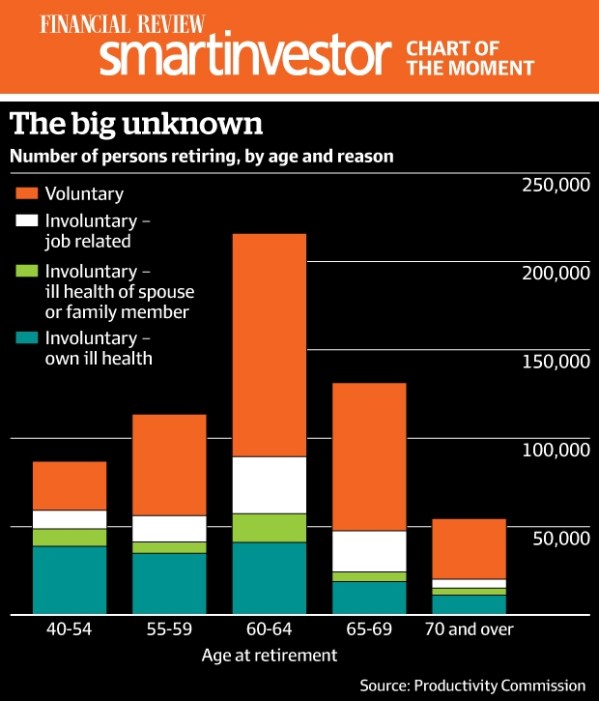
The 2015 Productivity Commission report on post-retirement shows that about 40 per cent of Australians who retire between the age of 60 and 64 do so involuntarily, either because of their own or a family member’s ill health, or redundancy.

For those aged between 65 and 69 who retire involuntarily is not that different, while for younger age groups most people who retire do so involuntarily.

Retirement ages

Clearly, workers relying on delayed retirement are rolling the dice. Yet, most people discount the future so much that they’re willing to take that gamble. May hope that an inheritance will save the day but do not realise that age care costs and parents living longer may eat heavily into any expected inheritance.

Strangely the people most likely to plan on working a few more years to boost their retirement security may actually have the least ability to postpone their retirement. People who suffer an illness or injury  are more likely than those in good health to have pushed back their expected retirement date in recent years, according to  a report from consulting firm Towers Watson. Yet health problems or disabilities were cited by more than half of retirees forced to retire earlier than planned.

Don’t put you head in the sand – start now

As psychologists are quick to point out, we all have that inner voice that loves to procrastinate who loves to put off till tomorrow what we should do today – beause its “all too hard to get your head around”. Saving more today is a sure thing, and extra years in the workforce are anything but. If you know you don’t have enough, you should start saving more today, because that’s by far the less risky alternative.

Let’s look at an example using the Retirement Planner on the MoneySmart.gov.au site for a 55-year-old pre-retiree with just $30K in superannuation. If she earns $80,000, makes $17,500 annual salary sacrifice contributions (in addition to Employers SGC contributions of 9.5%)  and earns a 7.5% return pre retirement and 6.5% after, she could be looking at an Income in retirement of $32,143 by age 67 including the Age Pension. If she’s forced to retire at that point, she’s still in better shape than most Australian’s. And if she can continue working, she  counld improve on this lifestyle with a better retirement income.

Retirement Income

A final don’t is cancelling TPD or Income Protection insurances to save money while in your most productive earning years (read here for more on that subject). The loss of 5-10 years of earnings potential is one guaranteed way to destroy your lifestyle in retirement. Your ability to earn is your biggest asset

Are you looking for an advisor that will keep you up to date and provide guidance and tips like in this blog? Then why now contact me at our Castle Hill or Windsor office in Northwest Sydney to arrange a one on one consultation. Just click the Schedule Now button up on the left to find the appointment options.

Liam Shorte B.Bus SSA™ AFP

Financial Planner & SMSF Specialist Advisor™

SMSF Specialist Adviser 

 Follow SMSFCoach on Twitter Liam Shorte on Linkedin NextGen Wealth on Facebook   

Verante Financial Planning

Tel: 02 98941844, Mobile: 0413 936 299

PO Box 6002 BHBC, Baulkham Hills NSW 2153

5/15 Terminus St. Castle Hill NSW 2154

Corporate Authorised Representative of Viridian Select Pty Ltd ABN 41 621 447 345, AFSL 51572

This information has been prepared without taking account of your objectives, financial situation or needs. Because of this you should, before acting on this information, consider its appropriateness, having regard to your objectives, financial situation and needs. This website provides an overview or summary only and it should not be considered a comprehensive statement on any matter or relied upon as such.

Merging of Pensioner Tax Offset and Senior Australians Tax Offset to new Seniors and Pensioners Tax Offset (SAPTO)


Don’t you just love another acronym to learn!

The seniors and pensioners tax offset (SAPTO) replaced the senior Australians tax offset (SATO) and the pensioner tax offset from 1 July 2012. This means older Australians who were previously eligible for either SATO or the pensioner tax offset may now be eligible for the SAPTO.

The rebate amount and thresholds are illustrated below:

Seniors and pensioners tax offset (SAPTO)
Family status Maximum tax offset Shade-out threshold Cut-out threshold
Single $2,230 $32,279 $50,119
Couple (each)33 $1,602 $28,974 $41,790
Couple (separated due to illness)33 $2,040 $31,279 $47,599
  1. The shade-out threshold is the maximum rebate income at which individuals will be entitled to the maximum tax offset. The tax offset reduces by 12.5 cents for each dollar of rebate income in excess of the shade-out threshold.
  2. The cut-out threshold is the level of rebate income at which the offset reduces to nil. At or above this level of rebate income, there is no entitlement to the tax offset.
  3. Any unused portion of the tax offset may be transferable to the partner under TR 93/31.

Are you looking for an advisor that will keep you up to date and provide guidance and tips like in this blog? Then why now contact me at our Castle Hill or Windsor office in Northwest Sydney to arrange a one-on-one consultation. Just click the Schedule Now button up on the left to find the appointment options.

Liam Shorte B.Bus SSA™ AFP

Financial Planner & SMSF Specialist Advisor™

SMSF Specialist Adviser 

 Follow SMSFCoach on Twitter Liam Shorte on Linkedin NextGen Wealth on Facebook   

Verante Financial Planning

Tel: 02 98941844, Mobile: 0413 936 299

  • PO Box 6002 NORWEST NSW 2153
  • 5/15 Terminus St. Castle Hill NSW 2154
  • Suite40, 8 Victoria Ave, Castle Hill NSW 2154
  • Suite 4, 1 Dight St., Windsor NSW 2756

Corporate Authorised Representative of Viridian Advisory Pty Ltd ABN 34 605 438 042, AFSL 476223

This information has been prepared without taking into account your objectives, financial situation, or needs. Because of this, you should, before acting on this information, consider its appropriateness, having regard to your objectives, financial situation, and needs. This website provides an overview or summary only and it should not be considered a comprehensive statement on any matter or relied upon as such.