• Benefits of a Self Managed Super Fund – SMSF
  • Videos
  • Why Self Managed Super?
  • Costs / Fees
  • About us
  • Testimonials
  • Contact Us
  • Property in a SMSF

The SMSF Coach

Coaching clients to take back control of their Superannuation and their future
  • Liam Shorte

    Unknown's avatar

    Putting people back in control of their wealth

  • SMSF Adviser of the Year - Winner 2025
  • SMSF Adviser of the Year - Finalist 2025
  • SMSF Adviser of the Year 2024
  • IFA 2023 Excellence Awards – SMSF Advisor of the Year – Finalist

  • IFA 2021 Excellence Awards – SMSF Advisor of the Year – WINNER!!
  • SMSF Adviser of the Year 2022 Finalist
    IFA 2022 Excellence Awards – SMSF Advisor of the Year – Finalist
  • Get advice – Have a chat

  • Enter your email address to subscribe and be first to receive notifications of new posts by email. Go on it's FREE!

    Join 6,177 other subscribers
  • Top Posts & Pages

    • How to elect to pay Division 293 Notice from your SMSF or Super
    • Stamp Duty on Transfers of Property to an SMSF
    • Vanguard Diversified ETFs - A Game Changer for SMSF Portfolio Design
    • When your Husband Retires and the Nightmare Comes True
    • Breach the SMSF access rules and the penalties are high
    • Important Changes to Pension Commencement Rules Now in Effect from 1 July 2025
    • Can I borrow to buy a house and land package off the plan in my SMSF?
    • SMSF Using an Unrelated Unit Trust for Property Development
  • Connect with me

    • View SMSFCoach’s profile on Facebook
    • View SMSFCoach’s profile on Twitter
    • View SMSFCoach’s profile on Instagram
    • View Smsfcoach’s profile on Pinterest
    • View LiamShorte’s profile on LinkedIn
    • View user44865214’s profile on Vimeo
    • View LiamShorte’s profile on Google+
  • Recent Tweets

    Tweets by SMSFCoach
  • View William Shorte's Adviser Ratings profile
    https://www.adviserratings.com.au/widget/278214/profile.js

All posts tagged RBA

SMSF Strategies and Investment Expo Event – Sydney


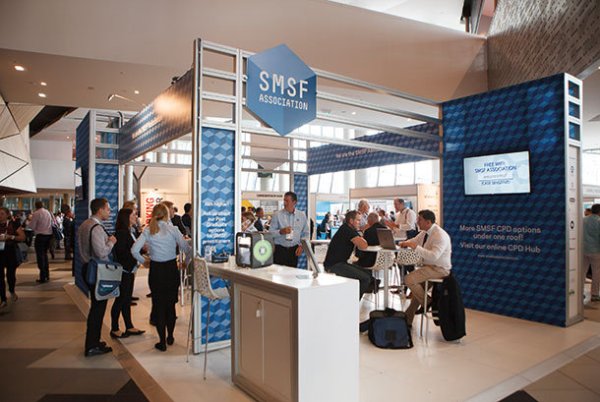
Even the most seasoned SMSF Trustees and members realise that they need to be on top of their game over the coming 12 months. If you are running your own SMSF or your better half is doing so, then drag yourself and them along to the SMSF Association’s SMSF & Investor Event. Let the experts guide you.

Full disclosure, I am a board member of the SMSF Association and I do want as many people as possible to come along and boost their knowledge and be prepared for what the budget and possible new future government will throw at us. I have also bargained for a deal for you and if you use the coupon code “SMSFCoach” when registering you will be able to attend for FREE

So what is on the agenda:

Following the Federal Budget and leading up to the end of the financial year, hear from key SMSF and investment experts on crucial factors you as a trustee or your clients if you’re a n SMSF professional,, should be thinking about in regards to your fund/your clients’ funds. The program will feature:

  • A Special Address on the impact of the removal of franking credit refunds on SMSFs
  • Your SMSF Update – what’s new in self managed super
  • End of Financial Year – review your investment portfolio in light of political and investment markets
  • Peter Hogan our SMSF Education expert will discuss Everything you need to know about starting and receiving pensions – whether you are starting to think about moving into retirement or already earning a pension this session will cover everything you need to know especially as it relates to the Transfer Balance Cap.
  • And more to be announced soon…

WHERE & WHEN

Date: Tuesday 9 April 2019

Time: 8:15am – 3:30pm (including lunch and morning tea)

Venue: Aerial UTS Function Centre, Building 10, Level 7/235 Jones St, Ultimo, Sydney

Register here using the coupon code ‘SMSFCoach’ for Free 

(I confirm that I receive no commissions, fees or incentives for promoting this event and will not receive any of your private information)

SHOUT OUT TO SMSF PROFESSIONALS

If you are a SMSF Accountant, Auditor or Financial Planner then please pass on this opportunity to your clients as we need SMSF Trustees to be more knowledgeable than ever. Understand that ASIC now expects you to be providing education to your clients and you must find cost effective ways of doing this. Why not leverage of your association membership and provide your clients with access to this event or maybe even come along with a group of them.

If you are in Victoria don’t feel left out we will be coming to Melbourne too in June!

Liam Shorte B.Bus SSA™ AFP

Financial Planner & SMSF Specialist Advisor™

SMSF Specialist Adviser 

 Follow SMSFCoach on Twitter Liam Shorte on Linkedin NextGen Wealth on Facebook   

Verante Financial Planning

Tel: 02 98941844, Mobile: 0413 936 299

PO Box 6002 BHBC, Baulkham Hills NSW 2153

5/15 Terminus St. Castle Hill NSW 2154

Corporate Authorised Representative of Viridian Select Pty Ltd ABN 41 621 447 345, AFSL 51572

This information has been prepared without taking account of your objectives, financial situation or needs. Because of this you should, before acting on this information, consider its appropriateness, having regard to your objectives, financial situation and needs. This website provides an overview or summary only and it should not be considered a comprehensive statement on any matter or relied upon as such.

Share this:

  • Click to email a link to a friend (Opens in new window) Email
  • Click to print (Opens in new window) Print
  • Tweet
  • Pocket
  • Click to share on Reddit (Opens in new window) Reddit
Like Loading...
Leave a comment
by SMSF Coach - Liam Shorte on March 13, 2019  •  Permalink
Posted in education, SMSF Management, Tax Planning
Tagged Account Based Pension, Baulkham Hills, Cash rate, Castle Hill, Change of trustee, Check-list, Checkllist, commercial lease, commercial property, company trustee, corporate trustee, Div 293, Div 293 tax, Div293, Division 293 Tax, DIY Super, Dural, Expo, Government, Hawkesbury, income, income planning, Interest Rates, Investment, leasing, Office of State Revenue, OSR, rate cuts, RBA, RBA cash rate, renting, retail lease, retail property, Retirement, Retirement Planning, Self Managed Superannuation Fund, SMSF, smsf company trustee, SMSFExpo, sole purpose corporate trustee, SRO, Stamp Duty, Strategy, superannuation, Trustee

Posted by SMSF Coach - Liam Shorte on March 13, 2019

https://smsfcoach.com.au/2019/03/13/smsf-strategies-and-investment-expo-event-sydney/

Options when you receive your new Division 293 Tax Notice for Superannuation Contributions


Division 293 Tax Guidance

The ATO has recently redesigned the Division 293 notice to provide information clearly and concisely. This includes providing the full assessment calculation to make it easier for people to understand how their tax has been calculated. This will also make it easier to identify any erroneous assessments due to incorrect reporting of information

Julie Steed, Senior Technical Services Manager of Australian Executor Trustees Part of the IOOF group, has kindly provided a refresher on the Division 293 tax and a review of the newly redesigned ATO notice that can be seen here: Div 293 notice of assessment

Division 293 tax

From 1 July 2017, the income threshold above which individuals pay an additional 15% tax on certain superannuation contributions reduced from $300,000 to $250,000. In December 2018 the ATO began issuing over 90,000 Division 293 notices for the 2017/18 income year. It is estimated that approximately 125,000 individuals will receive a Division 293 notice in the 2025FY.

Importantly, there are no strategies that can be used to reduce an individual’s liability for Division 293 tax. However, understanding the options that are available and how the Division 293 notice process works will assist individuals who receive a notice.

Overview

People with Division 293 income greater than $250,000 will pay 15 per cent additional tax on certain superannuation contributions. The tax is a personal tax rather than a tax deducted from super contributions by a fund. However, individuals may elect to release funds from super to pay the tax (see the Choices section below).

Division 293 income

Division 293 income includes:

  • taxable income
  • reportable fringe benefits
  • total net investment losses.

Ad-hoc income

Individuals who are not generally high income earners may still be liable for Division 293 tax if they receive certain one-off payments during a year. Such payments include eligible termination payments, the taxable component of a superannuation death benefit and capital gains.

However, the taxable component of a super lump sum benefit (other than a death benefit) is not included where:

  • it is received by individuals from preservation age to age 59
  • it is up to the current low rate cap of $205,000.

Division 293 contributions

Division 293 contributions include:

  • employer contributions
  • personal deductible contributions
  • contributions for a defined benefit interest (valued by an actuary)
  • employer contributions (including salary sacrifice) to a constitutionally protected fund.

The additional tax does not apply to:

  • excess concessional contributions
  • non-concessional contributions
  • contributions to certain Government funds for senior personnel, unless they are salary sacrifice contributions
  • contributions for certain Judges to defined benefit funds.

Calculation of Division 293 tax

Division 293 tax is 15% of the lesser of:

  • the amount of the Division 293 contributions
  • the amount of Division 293 income and Division 293 contributions above the $250,000 threshold.

Case study

Ryan has the following Division 293 details:

Division 293 income $240,000
Division 293 contributions $20,000
Total $260,000

Division 293 tax is payable on $10,000, being the lesser of:

  • $20,000
  • $260,000 – $250,000 = $10,000

The Division 293 tax amount is 15% x $10,000 = $1,500

Division 293 notice

The ATO issues an Additional tax on concessional contributions (Division 293) notice to individuals which specifies the additional amount of tax that is payable and the due date for payment.

The ATO has recently redesigned the Division 293 notice to provide information clearly and concisely. This includes providing the full assessment calculation to make it easier for people to understand how their tax has been calculated. This will also make it easier to identify any erroneous assessments due to incorrect reporting of information.

The notice will also explain how to avoid interest charges, view statements of accounts online and the process for disagreeing with the assessment.

Choices

When an individual receives a Division 293 assessment they can choose to pay the tax from their personal resources. Alternatively, they can elect to have the amount released from their super fund to pay the tax. The time frame for making the election is 60 days. However, this may be a greater time frame than the date upon which payment of the tax is due.

The ATO encourages people to make their election via their MyGov account. Alternatively, a Division 293 tax due and payable form can be completed.

The election can be made to release the tax amount from any super fund (other than some defined benefit funds). There is no requirement for the release to be made from the fund that received the contributions.

Release authority

If an election to have the amount released from super is made, the ATO will send the super fund a release authority and the fund will make the payment to the ATO. Funds are required to make the payment within 10 business days from the date the release authority is issued by the ATO.

Importantly a fund must not release an amount until they have received the ATO release authority. This requirement is sometimes misunderstood by SMSF trustees.

Conclusion

Understanding the choices available and the process involved in paying Division 293 tax can assist in ensuring that any tax payable is completed in a manner most appropriate to an individual’s circumstances.

Are you looking for an advisor that will keep you up to date and provide guidance and tips like in this blog? Then why not contact me at our Castle Hill or Windsor office in Northwest Sydney to arrange a one on one consultation. Just click the Schedule Now button up on the left to find the appointment options.

Liam Shorte B.Bus FSSA™ AFP

Financial Planner & Fellow SMSF Specialist Advisor™


Color logo with background smaller
Tel: 02 9899 3693, Mobile: 0413 936 299

  • PO Box 6002 NORWEST NSW 2153
  • Suite 40, 8 Victoria Ave, Castle Hill NSW 2154
  • Suite 4, 1 Dight St., Windsor NSW 2756

Corporate Authorised Representative of Viridian Advisory Pty Ltd ABN 34 605 438 042, AFSL 476223

This information has been prepared without taking account of your objectives, financial situation or needs. Because of this you should, before acting on this information, consider its appropriateness, having regard to your objectives, financial situation and needs. This website provides an overview or summary only and it should not be considered a comprehensive statement on any matter or relied upon as such.

Share this:

  • Click to email a link to a friend (Opens in new window) Email
  • Click to print (Opens in new window) Print
  • Tweet
  • Pocket
  • Click to share on Reddit (Opens in new window) Reddit
Like Loading...
1 Comment
by SMSF Coach - Liam Shorte on February 4, 2019  •  Permalink
Posted in education, SMSF Management, Tax Planning
Tagged Account Based Pension, Baulkham Hills, Cash rate, Castle Hill, Change of trustee, Check-list, Checkllist, commercial lease, commercial property, company trustee, corporate trustee, Div 293, Div 293 tax, Div293, Division 293 Tax, DIY Super, Dural, Government, Hawkesbury, income, income planning, Interest Rates, Investment, leasing, Office of State Revenue, OSR, rate cuts, RBA, RBA cash rate, renting, retail lease, retail property, Retirement, Retirement Planning, Self Managed Superannuation Fund, SMSF, smsf company trustee, sole purpose corporate trustee, SRO, Stamp Duty, Strategy, superannuation, Trustee

Posted by SMSF Coach - Liam Shorte on February 4, 2019

https://smsfcoach.com.au/2019/02/04/options-when-you-receive-your-new-division-293-tax-notice-for-superannuation-contributions/

Time to step up and be heard at the Franking Credits Inquiry


Throughout the last year as I have gone through the 30 June 2018 SMSF financials with clients and pointed out to them the amount of franking credits they had earned in their fund and the value of them to their retirement income, many have been alarmed to hear of Labor’s proposal to deny them the refund of any excess franking credits.

There has been a lot written in the press about this matter and much of it amounts to bashing self-funded retirees for carefully using the system to develop portfolios that would deliver the best return for their capital in a way that suited their risk tolerance and bias towards Australian assets.

Well the Labor proposal now puts much of that hard work at risk and while we do not really know if their will be consequences for the economy of companies in which we invest, what we do know is that it will affect SMSFs that do not have at least one member who is currently receiving an age pension. This is very inequitable that one sector of society should be targeted by these measures

Time to Step Up and have your Say

The House of Representatives Standing Committee on Economics will hold public hearings in numerous locations in New South Wales and Queensland for its inquiry into the implications of removing refundable franking credits. I strongly urge you to consider going along to one of the hearings and voicing your opinion or support others who are going to speak but need some back-up.

From the Media Release:

The Chair of the committee, Mr Tim Wilson MP, said ‘the committee is examining how the removal of refundable franking credits would affect investors, in particular older Australians who have planned for their retirement under the existing rules and whose financial security could be compromised.’

Mr Wilson said ‘the committee has received well over 1000 submissions, including many from retires who are concerned they will be forced on to the aged pension if the ability to claim a refund on their franking credits is removed.’ ‘These hearings will provide an opportunity for Australians impacted by a change to refundable franking credits to address the committee directly with a three-minute statement, and we welcome their contributions and participation’. Mr Wilson said.

Public hearing details:

Franking.png

NSW

Merimbula, 9.00am to 10.30am, Monday, 4 February 2019, Merimbula RSL, 52-54 Main St, Merimbula, NSW

Chatswood, 9.00am to 10.30am, Friday, 8 February 2019, The Chatswood Club, Level One, G11 Help Street, Chatswood, NSW

Bondi Junction, 2.00pm to 3.30pm, Friday, 8 February 2019, Bondi Junction RSL, 1/9 Gray St, Bondi Junction, NSW

Queensland

Townsville, 2.00pm to 3.30pm, Tuesday, 29 January 2019, Pandora Room, Hotel Grand Chancellor, 334 Flinders St, Townsville City, Queensland

Alexandra Headland, 9.00am to 10.30am, Wednesday, 30 January 2019, The Bluff Function Room, Alexandra Headland Surf Life Saving Club, 167 Alexandra Parade, Alexandra Headland, Queensland

Paddington, 2.30pm to 4.00pm, Wednesday, 30 January 2019, Presentation Room, The Lavalla Centre, 58 Fernberg Rd, Paddington, Queensland

Eight Mile Plains, 9.00am to 10.30am, Thursday, 31 January 2019, Central Auditorium, Brisbane Technology Park Conference Centre, 1 Clunies Ross Ct, Eight
Mile Plains, Queensland

Upper Coomera, 2.00pm to 3.30pm, Thursday, 31 January 2019, Upper Coomera Centre, 90 Reserve Rd, Upper Coomera, Queensland

Further public hearings will be announced as the inquiry progresses. The hearings will be webcast live (audio only). A number of submissions have been received and are available on the committee’s webpage at: http://www.aph.gov.au/economics.

A number of submissions are currently being processed and will be published over the coming months. Submissions can be made online or by emailing economics.reps@aph.gov.au.

Media enquiries: Mr Tim Wilson MP—Electorate: 03 9557 4644; Parliament: 02 6277 2392

For background information:

House of Representatives Standing Committee on Economics Phone: 02 6277 4587;

Email: economics.reps@aph.gov.au;

Website: http://www.aph.gov.au/economics

Are you looking for an advisor that will keep you up to date and provide guidance and tips like in this blog? Then why not contact me at our Castle Hill or Windsor office in Northwest Sydney to arrange a one on one consultation. Just click the Schedule Now button up on the left to find the appointment options.

Liam Shorte B.Bus SSA™ AFP

Financial Planner & SMSF Specialist Advisor™

SMSF Specialist Adviser 

 Follow SMSFCoach on Twitter Liam Shorte on Linkedin NextGen Wealth on Facebook   

Verante Financial Planning

Tel: 02 98941844, Mobile: 0413 936 299

PO Box 6002 BHBC, Baulkham Hills NSW 2153

5/15 Terminus St. Castle Hill NSW 2154

Corporate Authorised Representative of Viridian Select Pty Ltd ABN 41 621 447 345, AFSL 51572

This information has been prepared without taking account of your objectives, financial situation or needs. Because of this you should, before acting on this information, consider its appropriateness, having regard to your objectives, financial situation and needs. This website provides an overview or summary only and it should not be considered a comprehensive statement on any matter or relied upon as such.

Image courtesy of kittijaroon at FreeDigitalPhotos.net

Share this:

  • Click to email a link to a friend (Opens in new window) Email
  • Click to print (Opens in new window) Print
  • Tweet
  • Pocket
  • Click to share on Reddit (Opens in new window) Reddit
Like Loading...
Leave a comment
by SMSF Coach - Liam Shorte on January 23, 2019  •  Permalink
Posted in Franking Credits, Income Protection, News & Stats, Pension Strategies, SMSF Management, Trustee
Tagged Account Based Pension, ALP, Baulkham Hills, Cash rate, Castle Hill, Change of trustee, Check-list, Checkllist, commercial lease, commercial property, company trustee, corporate trustee, DIY Super, Dural, Franking Credits, Government, Hawkesbury, Imputation, income, income planning, Interest Rates, Investment, Labor, leasing, Office of State Revenue, OSR, rate cuts, RBA, RBA cash rate, renting, retail lease, retail property, Retirement, Retirement Planning, Self Managed Superannuation Fund, SMSF, smsf company trustee, sole purpose corporate trustee, SRO, Stamp Duty, Strategy, superannuation, Trustee

Posted by SMSF Coach - Liam Shorte on January 23, 2019

https://smsfcoach.com.au/2019/01/23/time-to-step-up-and-be-heard-at-the-franking-credits-inquiry/

Beware of Property One-Stop-Shops when buying for your SMSF


ASIC and the ATO have on numerous occasions highlighted the dangers of buying property through one organisation that organises all steps in the process. they call them “one-stop-shops”. This is where you get all or most of the following services for a new SMSF from one associated group:

  • Real Estate recommendation for a specific property and/or manage the property rental
  • Property Adviser who does initial training or introduction to property investing, then pointing you to associated service providers
  • Accounting and Audit to set up and do the admin for your new SMSF
  • Financial Planner to prepare a Statement of Advice on the suitability, risks, costs, benefits of and SMSF and benefits lost in moving to an SMSF
  • Conveyancer to process the property transaction
  • Mortgage Broker to sort out the finance

One of the issues is that they may not be very transparent about how they’re interconnected. Always ask each party what their fees are and do they pay any form of remuneration, fees, referral commission charges etc to any other party.

In its recent Report 575 – SMSFs: Improving the quality of advice and member experiences they were very specific about their concerns. From the report:

SMSF property one-stop shops

397 – “The use of property one-stop shops is an area of significant concern. These models tend to promote the purchase of geared residential property through an SMSF, arranged by groups of related real estate agents, developers, mortgage brokers, accountants and financial advisers.

398 – The one-stop shop model creates inherent conflicts of interest that may affect the advice given to a client to set up an SMSF, make subsequent investments, or use specific services. These conflicts can arise from direct or indirect commissions, referral payment arrangements, representative remuneration structures or even management pressures.

399 – We have previously achieved enforcement outcomes against operators of property one-stop shops involving SMSFs—such as Park Trent Properties
Group Limited and Anne Street Partners. In light of the findings from this project, we will continue to conduct surveillance on these property one-stop
shop operators and take enforcement action where appropriate.

400 – We will also work with other regulators, including the ATO and APRA, to develop a holistic approach to addressing problems that we are seeing with property one-stop shops.”

Despite these warnings ASIC’s further research has shown that people still value the idea of a One-stop-shop for their advice needs when buying property. I assume this is because people just like simplicity and want someone to manage the process for them. Well you can have that simplicity without the inherent dangers involved by choosing to work with professionals who charge a fee for service for their advice and do not accept commission or any remuneration from other parties or fully disclosed like such as with a Mortgage Broker who is remunerated by the lender.

So when thinking about a property for your Self Managed Superannuation Fund or any asset really, you should always ensure that at least some of the providers of services are working in your Best Interests. Financial Planners are obligated by law to act in their Client’s Best Interest but we all know that money , fees or commissions may blur the lines. So don’t be afraid to ask questions about:

  1. who is providing you the advice
  2. how are they being paid,
  3. Are they receiving any other form of remuneration
  4. how are they connected to the other service providers

It is important for your professional service providers to work on strategies on your behalf but that does not mean they need to be paying fees to each other which ultimately increases your costs. Let me explain how I work with other professional service providers for example:

  1. I do not provide specific advice on “the property” for you and stick to my area of expertise; whether an SMSF is right for you and how you can use it to achieve your goals. I charge you a specific fee for this advice which is outlined in a Letter of Engagement before you commit to my service. If you want ongoing advice, again I explain it up front in an Ongoing Service Agreement.
  2. I provide you with a range of SMSF Admin and Audit solutions from other providers that will suit your needs. I have 4-5 options to ensure you can choose what suits you with our guidance and often that may be to use your current Accountant. I do not receive any commission, fees or other remuneration from these providers. I simply insist they take good care of my clients
  3. If people want help choosing a property, again I have a number of trusted Buyer’s Agents throughout the country that are on hand to provide advice. I do not receive any commission, fees or other remuneration from these providers. I simply insist they take good care of my clients.
  4. If you need assistance in getting finance arranged then I refer you to a number of brokers who have experience and expert knowledge in SMSF Lending.  I do not receive any commission, fees or other remuneration from these providers. I simply insist they take good care of my clients.
  5. Legal Advice/Conveyancing – If you do not have a current lawyer or they do not have SMSF experience then I refer clients to a number of lawyers / conveyancers with specific experience and expertise in the rules around SMSFs for property transactions, powers of attorney and estate planning.
  6.  I do not receive any commission, fees or other remuneration from these providers. I simply insist they take good care of my clients.

Can you say the same about your service providers?

Are you looking for an advisor that will keep you up to date and provide guidance and tips like in this blog? Then why not contact me at our Castle Hill or Windsor office in Northwest Sydney to arrange a one on one consultation. Just click the Schedule Now button up on the left to find the appointment options.

Liam Shorte B.Bus SSA™ AFP

Financial Planner & SMSF Specialist Advisor™

SMSF Specialist Adviser 

 Follow SMSFCoach on Twitter Liam Shorte on Linkedin NextGen Wealth on Facebook   

SMSF Adviser of the Year 2021

Tel: 02 9899 3693, Mobile: 0413 936 299

  • PO Box 6002 NORWEST NSW 2153
  • Suite 40, 8 Victoria Ave, Castle Hill NSW 2154
  • Suite 4, 1 Dight St., Windsor NSW 2756


Corporate Authorised Representative of Viridian Advisory Pty Ltd ABN 34 605 438 042, AFSL 476223

This information has been prepared without taking account of your objectives, financial situation or needs. Because of this you should, before acting on this information, consider its appropriateness, having regard to your objectives, financial situation and needs. This website provides an overview or summary only and it should not be considered a comprehensive statement on any matter or relied upon as such.

Share this:

  • Click to email a link to a friend (Opens in new window) Email
  • Click to print (Opens in new window) Print
  • Tweet
  • Pocket
  • Click to share on Reddit (Opens in new window) Reddit
Like Loading...
1 Comment
by SMSF Coach - Liam Shorte on January 14, 2019  •  Permalink
Posted in Borrowing, Property, Scam Alert, SMSF Management
Tagged Account Based Pension, ASIC, ato, Baulkham Hills, Cash rate, Castle Hill, Change of trustee, Check-list, Checkllist, commercial lease, commercial property, company trustee, corporate trustee, DIY Super, Dural, Government, Hawkesbury, income, income planning, Interest Rates, Investment, leasing, Office of State Revenue, one-stop-shop, OSR, property in smsf, property in super, rate cuts, RBA, RBA cash rate, renting, Report 575, retail lease, retail property, Retirement, Retirement Planning, Self Managed Superannuation Fund, SMSF, smsf company trustee, sole purpose corporate trustee, SRO, Stamp Duty, Strategy, superannuation, Trustee

Posted by SMSF Coach - Liam Shorte on January 14, 2019

https://smsfcoach.com.au/2019/01/14/beware-of-property-one-stop-shops-when-buying-for-your-smsf/

Who will be affected by the denial of cash franking credit refunds?


Sometimes you can’t sit back and accept policy changes by governments. You have to step up to stop bad policy regardless of your political persuasion.

I see that Geoff Wilson from Wilson Asset Management is leading a charge against the Labor proposed policy to deny a refund of excess franking credits. You can read more about his efforts in this article here and sign his petition here 

The problem is that many people don’t understand the imputation system so when I sit with clients and we talk about what it means for them we have to put it in terms they understand. For many of my self funded retirees it will mean $5000 to $20,000 loss in income per year going forward if past in to legislation. So they may still be able to meet their basic living expenses but it is the little extras that they worked hard to save for that they will lose and it feels like they are been punished for trying to fund their retirement.

It means cutting out the holiday, the presents for the grandkids, the renos on the bathroom or any other little things they had saved hard to be able to afford. So once alerted to the potential loss of income most are angry but too few have been made aware of it by their tax agents and advisors.

I thought it I would help out in the education of trustees by highlighting the great fact sheet available from the The Alliance for a Fairer Retirement System

I have included below a link to their latest version of the fact sheet and would encourage you to visit their website, share with clients, friends and colleagues and sign up to their newsletters here.

ALLIANCE FACT SHEET

Lets get the word out there so people understand what they will be losing

Are you looking for an advisor that will keep you up to date and provide guidance and tips like in this blog? Then why not contact me at our Castle Hill or Windsor office in Northwest Sydney to arrange a one on one consultation. Just click the Schedule Now button up on the left to find the appointment options.

Liam Shorte B.Bus SSA™ AFP

Financial Planner & SMSF Specialist Advisor™

SMSF Specialist Adviser 

 Follow SMSFCoach on Twitter Liam Shorte on Linkedin NextGen Wealth on Facebook   

Verante Financial Planning

SMSF&ACCOUNTING_Winner__SMSF and Accounting Professional of the Year - Metropolitan
SMSF&ACCOUNTING_Winner__SMSF Adviser Excellence Award
FS-Power50_Badge_2017-18

Tel: 02 98941844, Mobile: 0413 936 299

PO Box 6002 BHBC, Baulkham Hills NSW 2153

5/15 Terminus St. Castle Hill NSW 2154

Corporate Authorised Representative of Viridian Select Pty Ltd ABN 41 621 447 345, AFSL 51572

This information has been prepared without taking account of your objectives, financial situation or needs. Because of this you should, before acting on this information, consider its appropriateness, having regard to your objectives, financial situation and needs. This website provides an overview or summary only and it should not be considered a comprehensive statement on any matter or relied upon as such.

Share this:

  • Click to email a link to a friend (Opens in new window) Email
  • Click to print (Opens in new window) Print
  • Tweet
  • Pocket
  • Click to share on Reddit (Opens in new window) Reddit
Like Loading...
Leave a comment
by SMSF Coach - Liam Shorte on September 26, 2018  •  Permalink
Posted in News & Stats, SMSF Management, Trustee
Tagged Account Based Pension, Baulkham Hills, Cash rate, Castle Hill, Change of trustee, Check-list, Checkllist, commercial lease, commercial property, company trustee, corporate trustee, DIY Super, Dural, Government, Hawkesbury, income, income planning, Interest Rates, Investment, leasing, Office of State Revenue, OSR, rate cuts, RBA, RBA cash rate, renting, retail lease, retail property, Retirement, Retirement Planning, Self Managed Superannuation Fund, SMSF, smsf company trustee, sole purpose corporate trustee, SRO, Stamp Duty, Strategy, superannuation, Trustee

Posted by SMSF Coach - Liam Shorte on September 26, 2018

https://smsfcoach.com.au/2018/09/26/who-will-be-affected-by-the-denial-of-cash-franking-credit-refunds/

How much does it cost to change an SMSF from Individuals to Corporate Trustee Structure


One of my most popular long term blogs is Why Self Managed Super Funds Should Have A Corporate Trustee and thankfully most new SMSFs are finally being set up with a corporate trustee from the outset. But that leaves many existing SMSFs with Individual Trustees and I get numerous questions about the cost of the transfer process. If you are considering an SMSF the I would encourage you to read through that article and feel free to pass it on to your friends, family or advisors.

Watch ATO guidance here – SMSF trustees – individual or corporate

The basic costs depend on your current legal document deed provider or the new provider chosen to implement the changes. But here is a guideline

  1. Cost of Sole Purpose Corporate Trustee would usually be around $660-$880 of which $506 is the ASIC registration fee
  2. Trust Deed Amendment to Retire the current Individual trustees and Appoint the new Corporate Trustee is about $200-$375
  3. Then all assets need to be moved in to new Accounts in the name of the new Trustee company.
    • Shares/ETFs/Hybrids usually cost $55 per share (you can bargain a discount with your broker) but a new Account application is also required
    • Wrap Platforms – depends on the provider but usually you will have to set up a new Account and they will in-specie transfer them across.
    • Managed funds may have stamp duty costs depending on the state. A new application for is required before the transfer
    • Bank account providers just usually require a request in writing, copy of the Company Certificate of Registration and copy of the signed Trust Deed Amendment
    • Property will depend on the State but some have an exemption or concessional stamp duty and only a small fee for changing the trustee on the title. See more detail here Stamp Duty Requirements on Change of SMSF Trustees – I will try to get this update shortly.
    • Bullion/Coins – just usually require a request in writing, copy of the Company Certificate of Registration and copy of the Trust Deed Amendment

Ongoing Costs

Costs should not be a deterrent as a sole Purpose Trustee company  ASIC review fee is only $55 per year and you can lock that in and get a discount for up to 10 years. See here for more detail on that discount.

Don’t feel like trying to do all this yourself? How much do we charge for guiding you through the process

If you require assistance and advice on making the changes our advice fee starts from $4,400 as it is a time consuming process. This includes:

  1. Review of your current circumstances and portfolio to see what needs to be done
  2. Advice on the change of trustee and process
  3. Preparation of all documentation for signature
  4. Assistance with implementation of asset transfers

Finally if you are considering trying to save some costs by using the same company as your Business or Family Discretionary Trust then I would recommend you read this article first: Trading Company as SMSF Trustee or Sole Purpose SMSF Trustee Company?

Are you looking for an advisor that will keep you up to date and provide guidance and tips like in this blog? Then why not contact me at our Castle Hill or Windsor office in Northwest Sydney to arrange a one on one consultation. Just click the Schedule Now button up on the left to find the appointment options.

Liam Shorte B.Bus SSA™ AFP

Financial Planner & SMSF Specialist Advisor™

SMSF Specialist Adviser 

 Follow SMSFCoach on Twitter Liam Shorte on Linkedin NextGen Wealth on Facebook   

Verante Financial Planning

Tel: 02 98941844, Mobile: 0413 936 299

PO Box 6002 BHBC, Baulkham Hills NSW 2153

5/15 Terminus St. Castle Hill NSW 2154

Corporate Authorised Representative of Viridian Select Pty Ltd ABN 41 621 447 345, AFSL 51572

This information has been prepared without taking account of your objectives, financial situation or needs. Because of this you should, before acting on this information, consider its appropriateness, having regard to your objectives, financial situation and needs. This website provides an overview or summary only and it should not be considered a comprehensive statement on any matter or relied upon as such.

Share this:

  • Click to email a link to a friend (Opens in new window) Email
  • Click to print (Opens in new window) Print
  • Tweet
  • Pocket
  • Click to share on Reddit (Opens in new window) Reddit
Like Loading...
2 Comments
by SMSF Coach - Liam Shorte on September 12, 2018  •  Permalink
Posted in News & Stats, SMSF Management, Trustee
Tagged Account Based Pension, Baulkham Hills, Cash rate, Castle Hill, Change of trustee, Check-list, Checkllist, commercial lease, commercial property, company trustee, corporate trustee, DIY Super, Dural, Government, Hawkesbury, income, income planning, Interest Rates, Investment, leasing, Office of State Revenue, OSR, rate cuts, RBA, RBA cash rate, renting, retail lease, retail property, Retirement, Retirement Planning, Self Managed Superannuation Fund, SMSF, smsf company trustee, sole purpose corporate trustee, SRO, Stamp Duty, Strategy, superannuation, Trustee

Posted by SMSF Coach - Liam Shorte on September 12, 2018

https://smsfcoach.com.au/2018/09/12/how-much-does-it-cost-to-change-an-smsf-from-individuals-to-corporate-trustee-structure/

Phew! SCOMO delivers an SMSF friendly 2018-19 Federal Budget


Self-funded retirees have felt like punching bags for the last few years with hit after hit chipping away at their ability to fend for themselves within the rules they had relied upon in making their savings plans over the last 30 years. Combine the changing of goal posts with low interest rates and blue-chip underperformance from the banks, telcos and utilities and they are not to be blamed for thinking a hex had been put on them.

So an SMSF friendly budget is the welcome news coming out of the 2018-19 Federal Budget. With many of us SMSF Specialists and you the SMSF members still working through the wide-reaching and complex superannuation changes which took effect from 1 July 2017, this Federal Budget will provide much needed stability while looking to reduce costs for SMSFs and prove additional flexibility.

The key changes proposed for SMSFs and superannuation are:

Three-yearly audit cycle for some self-managed superannuation funds.

The Government will change the annual SMSF audit requirement to a three yearly requirement for SMSFs with a history of good record keeping and compliance. The measure will start on 1 July 2019 for SMSF trustees that have a history of three consecutive years of clear audit reports and that have lodged the fund’s annual returns in a timely manner.

One concern I have is if trustees make a mistake in year 1 that is not discovered until year 3, will they face 3 years interest charges on the penalties.

Expanding the SMSF member limit from four to six

As already announced, the Federal Government confirmed its decision to expand the number of members allowed in an SMSF from four to six. Expanding the definition of an SMSF to a fund with a maximum of six members will provide greater flexibility in how funds can be structured.

Whilst there are some concerns over making decisions I like this move where as mum and dad in their later years want to reduce their involvement but they want help rather with the fund rather than moving to separate retail funds. It may help prevent elder Financial abuse where instead of one child assuming control of the SMSF, more of the family could be involved. Temptation and inheritance impatience is always there for one person but add a few others in to the decision making and the risk of financial abuse reduces considerably.

Also 6 members of a family small business allows for later drawdown from the parents accounts and recontribution for younger family members to retain business real property in the fund after death of the older generation.

Note; you will need to ensure your trust deed allows more than 4 members and it most likely won’t so you will need to update the trust deed first before accepting new members. READ THE DEED

Over 65, 1 additional year Work test exemption

The Government will provide more time for Australians aged 65 to 74 to boost their retirement savings, by introducing an exemption from the superannuation work test.This exemption will apply where an individual’s total superannuation balance is below $300,000 and will permit voluntary superannuation contributions in the first year that they do not meet the work test requirements.

This is good but limited in its scope as more and More people have reached the $300k level because of Super Guarantee Contributions for most since 1992 or before for some. But it is a female friendly move as they are most likely to have lower balances

Life insurance cover in super to be opt-in for individuals under 25 years of age.

The Government will legislate that life insurance cover in superannuation will be opt-in for those individuals under 25 years of age or with account balances under $6000 to ensure that unnecessary fees do not erode smaller balances.

Life insurance cover will also cease where no contributions have been made for a period of 13 months.

If you have kept a retail or industry fund open with small balances to retain insurances you may need to put a small annual contribution in place (I would recommend $100 per half year just in case) to ensure it does not get tagged as dormant.

Older Australian package

The Government introduced the following measures to enhance the standard of living older Australians:

• Increase to the Pension Work Bonus from $250 to $300 per fortnight.

• Amendments to the pension means test rules to encourage the take up of lifetime retirement income products.

• Expansion of the Pensions Loan Scheme to allow more Australians to use the equity in their homes to increase their incomes.

I think this will be a major bonus for those with a lumpy asset or shareholding’s they wish to retain but need more cashflow. At a current rate of 5.25% the Pensions Loan Scheme is a very decent rate and security that you are borrowing from a bank or predatory lender based on a brokers conflicted commissions.

Personal income tax bracket changes  (take most these with a pinch of salt!)

The Government has provided personal income tax relief to lower and middle income earners. A Low and Middle Income Tax Offset will now be available for individuals with incomes of up to $125,333.

The $87,000 income threshold, above which a 37 per cent tax rate applies, will increase to $90,000.

Other changes

• A surplus of $2.2 billion is expected in 2019-20, one year ahead of schedule.

• The Government’s planned increase in the Medicare levy from 2 per cent to 2.5 per cent, to fund the National Disability Insurance Scheme, will now not go ahead due to increased tax revenues.

How can we help?

Some of these measures may open up strategy options for you and your family.

If you have any questions or would like further clarification in regards to any of the above measures outlined in the 2018-19 Federal Budget, please feel free to give me a call or email to arrange a time to meet or talk by phone so that we can discuss your particular requirements in more detail.

Are you looking for an advisor that will keep you up to date and provide guidance and tips like in this blog? then why now contact me at our Castle Hill or Windsor office in Northwest Sydney to arrange a one on one consultation. Just click the Schedule Now button up on the left to find the appointment options.

Liam Shorte B.Bus SSA™ AFP

Financial Planner & SMSF Specialist Advisor™

Verante Financial Planning

Tel: 02 98941844, Mobile: 0413 936 299

PO Box 6002 BHBC, Baulkham Hills NSW 2153

5/15 Terminus St. Castle Hill NSW 2154

Corporate Authorised Representative of Viridian Select Pty Ltd ABN 41 621 447 345, AFSL 51572

This information has been prepared without taking account of your objectives, financial situation or needs. Because of this you should, before acting on this information, consider its appropriateness, having regard to your objectives, financial situation and needs. This website provides an overview or summary only and it should not be considered a comprehensive statement on any matter or relied upon as such.

Share this:

  • Click to email a link to a friend (Opens in new window) Email
  • Click to print (Opens in new window) Print
  • Tweet
  • Pocket
  • Click to share on Reddit (Opens in new window) Reddit
Like Loading...
4 Comments
by SMSF Coach - Liam Shorte on May 9, 2018  •  Permalink
Posted in Contribution Strategies, Financial Planning, Retirement Planning, SMSF Management, Trustee
Tagged 6 members, Account Based Pension, ASFA, Asset Allocation, audit, Baulkham Hills, budget, budget18, budget2018, Cash rate, Castle Hill, CHSC card, Commonwealth Seniors Heath Card, Cost of Living, DIY Super, Dural, Government, Hawkesbury, income, income planning, Interest Rates, Investment, Investment Strategy, pension phase, Pensions, private company valuations, property, protection, rate cuts, RBA, reset pensions, Retire, Retirement, Retirement Planning, Self MAnaged Super, Self Managed Superannuation Fund, SMSF Strategy, superannuation, Tax Free Pensions, Tax Planning, Transition, Transition to Retirement, Trustee, Trusts asset valuations, TTRAP, valuations, Windsor, work test

Posted by SMSF Coach - Liam Shorte on May 9, 2018

https://smsfcoach.com.au/2018/05/09/phew-scomo-delivers-an-smsf-friendly-2018-19-federal-budget/

SMSF Corporate Trustee Structure Finally Outnumbering Individual Trustees.


For the last decade every time I saw the SMSF statistical results issued by the ATO I was dismayed by the number of new SMSF funds being set up with Individual Trustees, often well over 80% each year. I assumed this was people setting up self managed superannuation funds without good advice or reasonable research.

So I was delighted to see the latest stats provided by the ATO for 2015-16 but including some 2016-17 data which has seen a complete turnaround with over 80% of new SMSFs being set up with Corporate Trustees and the overall numbers on existing funds turning in favour of using a company.

SMSF trustee structure

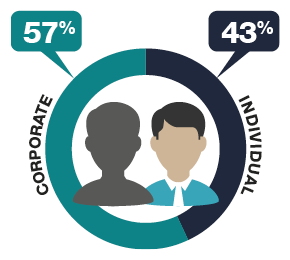
Showing 57% of SMSFs have a corporate trustee and 43% have an individual trustee in 2017 

  • At 30 June 2017, 57% of all SMSFs had a corporate trustee rather than individual trustees.
  • Of newly registered SMSFs in 2015 to 2017, on average 81% were established with a corporate trustee.

A few times over the last 5 years I have run polls asking professionals in the SMSF industry whether they would recommend individual or corporate trustees. Every time the overwhelming result is in favour of Corporate Trustees.

SMSF Individual v Corporate Trustee

So over 90% of professionals who deal day in day out with SMSF issues and like myself deal with some of the fallout when approached by grieving widows(ers), recommend a Corporate trustee for an SMSF.

Costs

Costs should not be a deterrent as a sole Purpose Trustee company only costs about $600-$880 to set up and the ASIC review fee is only $48 per year and you can lock that in and get a discount for up to 10 years. See here for more detail on that discount.

I have set out my arguments for a Corporate Trustee in this previous article Why Self Managed Super Funds Should Have A Corporate Trustee. If you are considering an SMSF the I would encourage you to read through that article and feel free to pass it on to your friends, family or advisors.

Finally if you are considering trying to save some costs by using the same company as your Business or Family Discretionary Trust then I would recommend you read this article first: Trading Company as SMSF Trustee or Sole Purpose SMSF Trustee Company?

Are you looking for an advisor that will keep you up to date and provide guidance and tips like in this blog? Then why now contact me at our Castle Hill or Windsor office in Northwest Sydney to arrange a one on one consultation. Just click the Schedule Now button up on the left to find the appointment options.

Liam Shorte B.Bus SSA™ AFP

Financial Planner & SMSF Specialist Advisor™

SMSF Specialist Adviser 

 Follow SMSFCoach on Twitter Liam Shorte on Linkedin NextGen Wealth on Facebook   

Verante Financial Planning


Tel: 02 98941844, Mobile: 0413 936 299

PO Box 6002 BHBC, Baulkham Hills NSW 2153

5/15 Terminus St. Castle Hill NSW 2154

Corporate Authorised Representative of Viridian Select Pty Ltd ABN 41 621 447 345, AFSL 51572

This information has been prepared without taking account of your objectives, financial situation or needs. Because of this you should, before acting on this information, consider its appropriateness, having regard to your objectives, financial situation and needs. This website provides an overview or summary only and it should not be considered a comprehensive statement on any matter or relied upon as such.

Share this:

  • Click to email a link to a friend (Opens in new window) Email
  • Click to print (Opens in new window) Print
  • Tweet
  • Pocket
  • Click to share on Reddit (Opens in new window) Reddit
Like Loading...
Leave a comment
by SMSF Coach - Liam Shorte on January 23, 2018  •  Permalink
Posted in News & Stats, SMSF Management, Trustee
Tagged Account Based Pension, Baulkham Hills, Cash rate, Castle Hill, Change of trustee, Check-list, Checkllist, commercial lease, commercial property, company trustee, corporate trustee, DIY Super, Dural, Government, Hawkesbury, income, income planning, Interest Rates, Investment, leasing, Office of State Revenue, OSR, rate cuts, RBA, RBA cash rate, renting, retail lease, retail property, Retirement, Retirement Planning, Self Managed Superannuation Fund, SMSF, smsf company trustee, sole purpose corporate trustee, SRO, Stamp Duty, Strategy, superannuation, Trustee

Posted by SMSF Coach - Liam Shorte on January 23, 2018

https://smsfcoach.com.au/2018/01/23/smsf-corporate-trustee-structure-finally-outnumbering-individual-trustees/

Don’t Rush in to Downsizing Your Home


I love working on strategies for clients but sometimes you just need a true expert or excellent software to crunch the numbers. I was looking for some ideas on downsizing as it had become clear to me that is was not the panacea to retirement funding that client’s often believe it would be. So I was looking for an in-depth article working through the numbers and Rob van Dalen of  Optimo Financial has kindly stepped up to provide the required analysis in our latest guest blog. Rob’s main warning is to do your sums on your own particular situation before leaping in to a downsizing strategy.

Rob van Dalen | General Manager

T 02 8622 2296
rvandalen@optimofinancial.com.au | www.optimofinancial.com.au

Optimo Financial
Suite 204, 10-12 Clarke Street, Crows Nest NSW 2065
PO Box 931, Crows Nest NSW 1585

Do Your Sums Before Downsizing

A popular subject often talked about at family barbecues is; “should mum and dad downsize when they get older?” Often it’s assumed that downsizing is the best option moving forward. To test and possibly challenge this we decided to run a few scenarios through our Pathfinder Financial Optimisation Platform to find out. Read our findings below;

1.1 The Clients

In this example, we look at the case of David and Alice who have recently retired and who will soon both be eligible for the age pension. David was born on 11 April 1953 while Alice was born on 15 November 1952. They have a modest $400,000 in super. Their other assets are the family home valued at $900,000 and personal assets valued at $40,000. They have no debt. They would like to have $50,000pa (increasing at CPI) for living expenses. They are worried that their super is not sufficient to maintain their desired income. Consequently, they have contemplated selling the family home and moving to a cheaper area where they could buy a new home for $500,000. Will downsizing leave them better off?

1.2 Assumptions

We have assumed in the analysis:

· Pension fund returns 5.7%pa;

· House selling costs 2.5%;

· House purchase costs 6% (including stamp duty);

· House prices in the long term increase at 3%pa;

· CPI 2.5%p.a.

1.3 Scenario 1: Retain Current Home

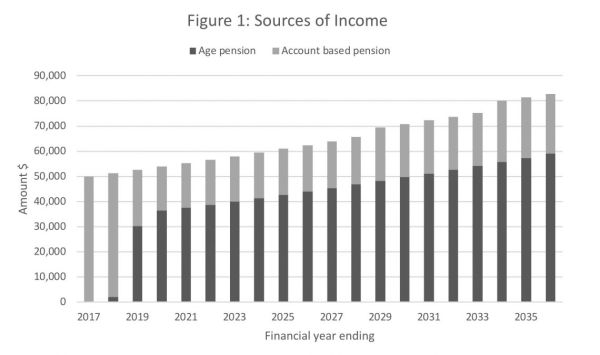
We first examine the scenario where David and Alice retain their current home. In this case, they will receive income from the government pension as well as drawing a pension from their own super. Figure 1 shows the sources of their income over a 20 year period.

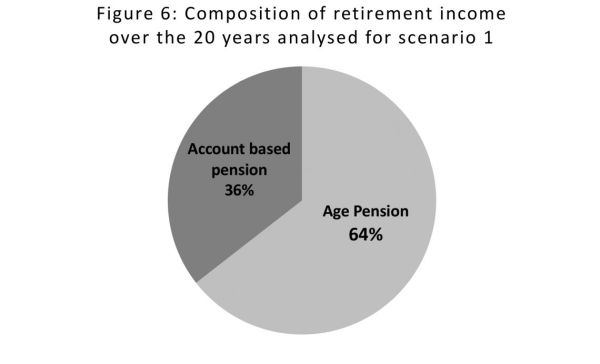
David and Alice receive approximately 64% of their income from the age pension and associated benefits (see also Figure 6 below). The remainder is withdrawn from their pension account through withdrawing the minimum amount each year (plus some extra for the first few years until they become eligible for the age pension).

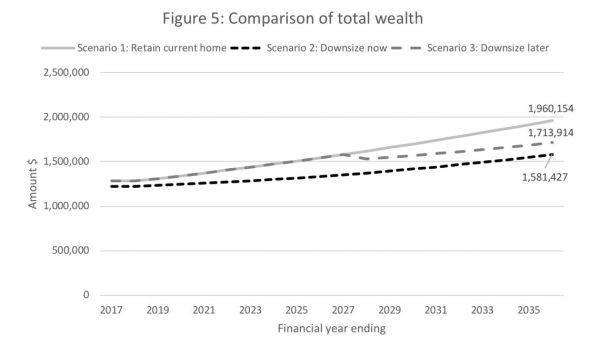
Their age pensions are limited approximately equally by the income and assets tests. After 20 years, David and Alice have a combined wealth of $1,960,000 most of which is from the family home.

1.4 Scenario 2: Downsizing Family Home in 2016/17

The next scenario sees David and Alice downsizing their family home from $900,000 to $500,000 in 2016/17. Their ages enable them to deposit the excess funds generated from the house sale into super as non-concessional contributions. However, a Pathfinder® analysis shows that increasing their superannuation balance reduces their age pension because, unlike the family home, super counts towards the age pension assets test and is deemed for the income test. Figure 2 shows the results of the age pension assets and income tests for David and Alice and we can see that their pension is now limited by the assets test. For a home owning couple, the age pension reduces at a rate of $3 per fortnight for each $1,000 of assets in excess of $575,000. This taper rate was doubled from 1 January 2017, so now has a much larger impact on the pension received.

So in 2019/20, for example, their age pension reduces from $36,337 to $9,004 and they must draw more from their pension account to make up the difference. Their wealth after 20 years is now projected at $1,581,000 or about $379,000 less than in the first scenario.

1.5 Scenario 3: Downsizing Family Home in 2027/28

In the third scenario, we examine the possibility that David and Alice defer the downsizing for ten years, say in 2027/28. Their age pension is initially unaffected until they downsize the family home, but after that time their age pension payments are severely curtailed. Their projected wealth after 20 years is now $1,714,000. This is a better outcome than in the second scenario but is still $246,000 less than if they keep their existing home.

1.6 Comparing the Scenarios

Figure 3 gives a comparison of the annual age pension received in the three scenarios. You can see that the scenario where they retain their current home, yields a higher pension and that their pension drops sharply after the sale of their house in the other two scenarios.

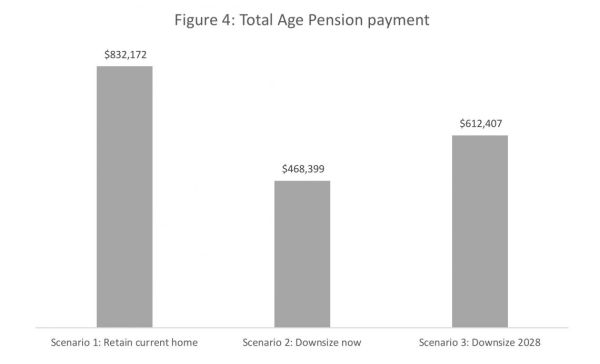
Figure 4 shows the total age pension payments over the 20 years. You can see that by keeping their original family home, their total pension entitlement is significantly higher than either of the downsizing options we analysed.

Figure 5 shows the total wealth over the 20 year period analysed.

The first point to note is the importance of the age pension towards retirement income, depending, of course, on the particular circumstances. Figure 6 shows the composition of retirement income over the 20 years analysed for Scenario 1.

1.7 Conclusions

In this example, the age pension plus estimated concession card benefits contribute about 64% to income while the account based pensions contribute about 36%. The second point is that downsizing the family home may not result in improving the overall situation as an increase in payments from a private pension may be more or less offset by a decrease in the age pension.

1.8 Pathfinder Learnings

In our Pathfinder® analysis, we find, perhaps surprisingly, that a couple could be considerably worse off by downsizing the family home. Any funds added to super by the income generated from downsizing could be dissipated by a reduction in the age pension. In addition, the costs of sale and repurchase of a family home are significant.

The age pension can provide a buffer between retirement savings and lifestyle expenses.

For persons eligible for the age pension, downsizing the family home may leave you worse off financially because of the impact of the age pension income and assets test.

Thank you Robby

Are you looking for an advisor that will keep you up to date and provide guidance and tips like in this blog? Then why now contact me at our Castle Hill or Windsor office in Northwest Sydney to arrange a one on one consultation. Just click the Schedule Now button up on the left to find the appointment options.

Liam Shorte B.Bus SSA™ AFP

Financial Planner & SMSF Specialist Advisor™

SMSF Specialist Adviser 

 Follow SMSFCoach on Twitter Liam Shorte on Linkedin NextGen Wealth on Facebook   

Verante Financial Planning

Tel: 02 98941844, Mobile: 0413 936 299

PO Box 6002 BHBC, Baulkham Hills NSW 2153

5/15 Terminus St. Castle Hill NSW 2154

Corporate Authorised Representative of Viridian Select Pty Ltd ABN 41 621 447 345, AFSL 51572

This information has been prepared without taking account of your objectives, financial situation or needs. Because of this you should, before acting on this information, consider its appropriateness, having regard to your objectives, financial situation and needs. This website provides an overview or summary only and it should not be considered a comprehensive statement on any matter or relied upon as such.

Image courtesy of Stuart Miles at FreeDigitalPhotos.net

Share this:

  • Click to email a link to a friend (Opens in new window) Email
  • Click to print (Opens in new window) Print
  • Tweet
  • Pocket
  • Click to share on Reddit (Opens in new window) Reddit
Like Loading...
2 Comments
by SMSF Coach - Liam Shorte on September 12, 2017  •  Permalink
Posted in Centrelink, Contribution Strategies, Downsizing, Pension Strategies, Property, Retirement Planning
Tagged Account Based Pension, Baulkham Hills, Cash rate, Castle Hill, Change of trustee, commercial lease, commercial property, DIY Super, downsizing, downsizing your home, Dural, Government, Hawkesbury, income, income planning, Interest Rates, Investment, leasing, Office of State Revenue, OSR, property downsize, rate cuts, RBA, RBA cash rate, renting, retail lease, retail property, Retirement, Retirement Planning, Self Managed Superannuation Fund, SMSF, SRO, Stamp Duty, Strategy, superannuation

Posted by SMSF Coach - Liam Shorte on September 12, 2017

https://smsfcoach.com.au/2017/09/12/dont-rush-in-to-downsizing-your-home/

How the Centrelink Gifting rules work


There are many rumours and well-intentioned but wrong advice out here on the internet about how to maximise Centrelink or DVA pension by “gifting assets” before applying. I want to clear up some of those misunderstandings

The gifting and deprivation rules prevent you from giving away assets or income over a certain level in order to increase age pension and allowance entitlements. For Centrelink and Department of Veteran’s Affairs (DVA) purposes, gifts made in excess of certain amounts are treated as an asset and subject to the deeming provisions for a period of 5 years from disposal.

Acknowledgement: I have relied on the excellent guidance of the AMP TAPin team for the majority of the content in this article. They write great technical articles for advisors and I try and make them SMSF trustee friendly.

What is considered a gift for Centrelink purposes?

For deprivation provisions to apply, it must be shown that a person has destroyed or diminished the value of an asset, income or a source of income.

A person disposes of an asset or income when they:
− engage in a course of conduct that destroys, disposes of or diminishes the value of their assets or income, and
− do not receive adequate financial consideration in exchange for the asset or income.

Adequate financial consideration can be accepted when the amount received reasonably equates to the market value of the asset. It may be necessary to obtain an independent  market valuation to support your estimated value or transferred value or Centrelink may use their own resources to do so..

Deprivation also applies where the asset gifted does not actually count under the assets test. For example, unless the ‘granny flat’ provisions apply, deprivation is assessed if a person does not receive adequate financial consideration when they:

− transfer the legal title of their principal home to another person, or
− buy a new principal home in another person’s name.

What are the gifting limits?

The gifting rules do not prevent a person from making a gift to another person. Rather, they cap the amount by which a gift will reduce a person’s assessable income and assets, thereby increasing social security entitlements.

There are two gifting limits.

  1. A person or a couple can dispose of assets of up to $10 000 each financial year. This $10, 000 limit applies to a single person or to the combined amounts gifted by a couple, and
  2. An additional disposal limit of $30 000 over a five financial years rolling period.

The $10,000 and $30,000 limits apply together. That is, although people can continue to gift assets of up to $10 000 per financial year without penalty, they need to take care not to exceed the gifting free limit of $30 000 in a rolling five-year period.

What happens if the gifting limits are exceeded?
If the gifting limits are breached, the amount in excess of the gifting limit is considered to be a deprived asset of the person and/or their spouse.

The deprived amount is then assessed as an asset for 5 anniversary years from the date of gift. It is assessed as an asset for asset test purposes and subject to deeming under the income test.
After the expiration of the 5 year period, the deprived amount is neither considered to be a person’s asset nor deemed.

Example 1: Single pensioner – gifts not impacted by deprivation rules

Sally, a single pensioner, has financial assets valued at $275,000. She has decided to gift some money to her son to improve his financial situation. Her plan for gifting is as follows:

Financial year 2017/18 2018/19 2019/20 2020/21 2021/22 2022/23
Amount gifted $6,000 $6,000 $6,000 $6,000 $6,000 $6,000

With this gifting plan, Sally is not affected by either gifting rule. This is because she has kept under the $10,000 in a single year rule and also within the $30,000 per rolling five-year period.

Example 2: Single pension – Gifts impacted by both gifting rules

Peter is eligible for the Age Pension. He has given away the following amounts:

Financial year Amount gifted Deprived asset assessed using the $10,000 in a financial year free area rule Deprived asset assessed using the $30,000 five-year free area rule
2017/18 $33,000 $23,000 $0
2018/19 $2,000 $0 $0

In this case, $23,000 of the $33,000 given away in 2017/18 exceeds the gifting limit (the first limit of $10,000) for that financial year, so it will continue to be treated as an asset and subject to deeming for five years.
In 2018/19, while gifts totalling $35,000 have been made, no deprived asset is assessed under the five-year rule after taking into account the deprived assets already assessed, ie $33,000 + $2,000 – $23,000 = $12,000, which is less than the relevant limit of $30,000.

Example 3: Couple impacted by both gifting rules

Ted and Alice are eligible for the Age Pension. They give away the following amounts:

Financial year Amount gifted Deprived asset assessed using the $10,000 in a financial year free area rule Deprived asset assessed using the $30,000 five-year free area rule
2017/18 $10,000 $0 $0
2018/19 $13,000 $3,000 $0
2019/20 $10,000 $0 $0
2020/21 $10,000 $0 $10,000
2021/22 Any gifts in 2014/15 will be assessed as deprived assets under the five-year rule

In this case, $3,000 of the $13,000 given away in 2018/19 exceeds the gifting limit for that year, so it will continue to be treated as an asset and subject to deeming for five years. The $10,000 given away in 2020/21 exceeds the $30,000 limit for the five-year period commencing on 1 July 2017, so it will also continue to be treated as an asset and subject to deeming for five years.

Are some gifts exempt from the rules?

Certain gifts can be made without triggering the gifting provisions. Broadly speaking, these include:
− Assets transferred between the members of a couple. A common example is where a person who has reached Age Pension age withdraws money from their superannuation and contributes it to a superannuation account in the name of the spouse who has not yet reached age pension age.
− Certain gifts made by a family member or a certain close relative to a Special Disability Trust. For more information on Special Disability Trusts, refer to Department of Human Services – Special Disability Trusts.
− Assets given or construction costs paid for a ‘granny flat’ interest. See Department of Human Services  – Granny Flat Interest for further detail.

Trying to be too smart – Gifting prior to claim

Contrary to what many read on the internet any amounts gifted in the five years prior to accessing the Age Pension or other allowance are subject to the gifting rules

Deprivation provisions do not apply when a person has disposed of an asset within the five years prior to accessing the Age Pension or other allowance but could not reasonably have expected to become qualified for payment. For example, a person qualifies for a social security entitlement after unexpected death of a partner or job loss.

Gifting and deceased estates

The gifting rules apply to a person’s interest in a deceased estate if the person does any of the following:

− Gives away their right to their interest in a deceased estate for no/inadequate consideration,
− Directs the executor to distribute their interest in a deceased estate for no/inadequate consideration, or
− After the estate has been finalised, gives away their interest in a deceased estate to a third-party for no/inadequate consideration.
The above rules apply even if the deceased died without a will.

Gifting and death of a partner
In some circumstances, couples in receipt of a social security benefit may give away assets prior to death of one of them. Prior to death, any deprived assets would have been assessed against the pensioner couple for five years from the date of the disposal. Now that a member of the couple has passed away, how will the deprived assets be assessed for the surviving partner?
The amount of deprivation that continues to be held against a surviving partner depends on who legally owned the assets prior to death.

Table 1: Gifting and death of a partner

Legal owner of the deprived asset Assessment of deprived assets
jointly, does not change.
by the deceased partner, is reduced to zero.
by the surviving partner, increases by the amount held against the deceased partner by the outstanding balance held against the deceased partner.

Example 4: Death of a partner

Daryl (age 84) and Gail (age 78) gifted an apartment worth $260,000 to their son Ethan on 1 July 2019. At the time the gift was made, Centrelink assessed $250,000 as a deprived asset. Daryl passed away on 1 July 2020.
The treatment of the deprived assets for Gail will depend on who legally owned the assets prior to Daryl’s death. The impact of different ownership options is shown below:

Legal owner of the deprived asset Assessment of deprived assets
jointly, Half of the asset value of the deprived asset will be assessed against the surviving spouse. As the amount of the deprived asset is $250,000, only $125,000 will be assessed against Gail
by the deceased partner, No amount will be assessed against the surviving partner. As the amount of the deprived asset is $250,000, the amount assessable to Gail is $0.
by the surviving partner, The full amount will continue to be assessed against the surviving partner. As the amount of the deprived asset is $250,000, the amount assessable to Gail remains at $250,000.

Want a Centrelink Review or are you just looking for an adviser that will keep you up to date and provide guidance and tips like in this blog? Then why not contact me at our Castle Hill or Windsor office in Northwest Sydney to arrange a one on one consultation. Just click the Schedule Now button up on the left to find the appointment options. Do it! make this the year to get organised or it will be 2028 before you know it.

Please consider passing on this article to family or friends. Pay it forward!

Liam Shorte B.Bus SSA™ AFP

Financial Planner & SMSF Specialist Advisor™

SMSF Specialist Adviser 

 Follow SMSFCoach on Twitter Liam Shorte on Linkedin NextGen Wealth on Facebook   

Top 50 Logo 12% Verante Financial Planning


Tel: 02 98941844, Mobile: 0413 936 299

PO Box 6002 BHBC, Baulkham Hills NSW 2153

5/15 Terminus St. Castle Hill NSW 2154

Corporate Authorised Representative of Viridian Select Pty Ltd ABN 41 621 447 345, AFSL 51572

This information has been prepared without taking account of your objectives, financial situation or needs. Because of this you should, before acting on this information, consider its appropriateness, having regard to your objectives, financial situation and needs. This website provides an overview or summary only and it should not be considered a comprehensive statement on any matter or relied upon as such.

Share this:

  • Click to email a link to a friend (Opens in new window) Email
  • Click to print (Opens in new window) Print
  • Tweet
  • Pocket
  • Click to share on Reddit (Opens in new window) Reddit
Like Loading...
31 Comments
by SMSF Coach - Liam Shorte on September 6, 2017  •  Permalink
Posted in Age Pension, Centrelink, Financial Planning, Pension Strategies
Tagged Account Based Pension, ASFA, Asset Allocation, Backup, Baulkham Hills, budget, Castle Hill, Centrelink, Centtrelink gifting, Cost of Living, DIY Super, Dural, DVA, DVA gifting, gifting rules, Government, Hawkesbury, income planning, Interest Rates, Investment, Investment Strategy, Pensions, private company valuations, property, protection, rate cuts, RBA, reset pensions, Retire, rules, Self MAnaged Super, Self Managed Superannuation Fund, SMSF, Strategy, superannuation, Tax Planning, Transition to Retirement, Trustee, Trusts asset valuations, Windsor

Posted by SMSF Coach - Liam Shorte on September 6, 2017

https://smsfcoach.com.au/2017/09/06/how-the-centrelink-gifting-rules-work/

Hit by the $1.6m Transfer Balance Cap – Maybe you can get the CSHC


There are all sorts of unexpected consequences coming out of the changes to the superannuation rules. As a result of moving funds over $1.6m back to accumulation to meet the Transfer Balance Cap (TBC), you may in fact now qualify for the Commonwealth Seniors Health Care card.

How?

There may be a silver lining to the new $1.6 million transfer balance cap (TBC) for some SMSF members. Having less money in an account based pension and more money in accumulation or other assets may result in some SMSF members being entitled to receive the Commonwealth Seniors Health Card (CSHC). This is because amounts held in accumulation phase are not deemed for the CSHC and are not included in a member’s personal taxable income.

Now if the excess over the $1.6m is/was withdrawn out of superannuation, whether it will count as income for the CHSC will depend on how the client invests it. for example financial investments such as shares, rented investment property and interest will be deemed but a Holiday home not rented out will not be deemed towards the CSHC income test.

Older pensions may be even more forgiving!

Income from an account based pension is deemed under the usual Centrelink deeming rates unless the account based pension commenced before 1 January 2015, and the client was entitled to the card before 1 January 2015 and continues to hold the card. This is known as the grandfathering rules.

For SMSF members who are not eligible for the grandfathering rules, holding a significant amount of money in an account based pension means that they have a lower likelihood of being eligible for a CSHC. Prior to 1 July 2017, for most SMSF members it was more beneficial to hold as much as possible in an account based pension for tax purposes even if this meant they were ineligible for the CSHC. The tax savings on the excess would have outstripped the CSHC benefit.

However, from 1 July 2017, SMSF members can only hold up to $1.6 million in an account based pension and if they are also receiving defined benefit pension income the amount which can be held in account based pensions will be lower. Depending on other income the member receives, this may result in them now being entitled to the CSHC.

You don’t believe me? The following example explains how this works in a simple scenario:

Example – single person

James is single and is age 67. In the 2016 -2017 financial year, he had $2 million in his account based pension, and no other income.

The deemed income from his account based pension is calculated as $64,247 based on deeming rates and thresholds as at 1 July 2017. His deemed income exceeds the income threshold of $52,796 for the CSHC and therefore he is not entitled to a CSHC.

On 30 June 2017, he rolls $400,000 back to accumulation leaving $1.6million in his account based pension.

The deemed income on $1.6 million is $51,247 and is under the income threshold of $52,796 (20 March 2017) meaning that James is entitled to a CSHC after rolling back money from his account based pension to accumulation.

Are you looking for an advisor that will keep you up to date and provide guidance and tips like in this blog? then why now contact me at our Castle Hill or Windsor office in Northwest Sydney to arrange a one on one consultation. Just click the Schedule Now button up on the left to find the appointment options.

Liam Shorte B.Bus SSA™ AFP

Financial Planner & SMSF Specialist Advisor™

Verante Financial Planning

Tel: 02 98941844, Mobile: 0413 936 299

PO Box 6002 BHBC, Baulkham Hills NSW 2153

5/15 Terminus St. Castle Hill NSW 2154

Corporate Authorised Representative of Viridian Select Pty Ltd ABN 41 621 447 345, AFSL 51572

This information has been prepared without taking account of your objectives, financial situation or needs. Because of this you should, before acting on this information, consider its appropriateness, having regard to your objectives, financial situation and needs. This website provides an overview or summary only and it should not be considered a comprehensive statement on any matter or relied upon as such.

Share this:

  • Click to email a link to a friend (Opens in new window) Email
  • Click to print (Opens in new window) Print
  • Tweet
  • Pocket
  • Click to share on Reddit (Opens in new window) Reddit
Like Loading...
Leave a comment
by SMSF Coach - Liam Shorte on July 25, 2017  •  Permalink
Posted in Centrelink, CHSC, Financial Planning, Pension Strategies, Retirement Planning
Tagged Account Based Pension, ASFA, Asset Allocation, audit, Baulkham Hills, budget, Cash rate, Castle Hill, CHSC card, Commonwealth Seniors Heath Card, Cost of Living, DIY Super, Dural, Government, Hawkesbury, income, income planning, Interest Rates, Investment, Investment Strategy, pension phase, Pensions, private company valuations, property, protection, rate cuts, RBA, reset pensions, Retire, Retirement, Retirement Planning, Self MAnaged Super, Self Managed Superannuation Fund, SMSF Strategy, superannuation, Tax Free Pensions, Tax Planning, Transition, Transition to Retirement, Trustee, Trusts asset valuations, TTRAP, valuations, Windsor

Posted by SMSF Coach - Liam Shorte on July 25, 2017

https://smsfcoach.com.au/2017/07/25/hit-by-the-1-6m-transfer-balance-cap-maybe-you-can-get-the-cshc/

How Much Can I Earn Tax Free Outside of my SMSF


Client Question : My next question is about the threshold income level at which my wife and I will start to pay personal tax in 2017-18.  I read “about $28,000” in the paper the other day for my situation (age >65), but my wife does not turn 65 until 2018, so her tax-free level may be different.  It would be useful to know these numbers in the case we decide to take some lump sums out of super because of the new limits. We are considering investing some money tax-free in our personal names, free of SMSF red tape.

Personal Tax-free Thresholds
The amount you can earn before you have to pay tax, actually depends on your age.

Under 65

For those people under age 65, the effective tax-free threshold is currently $20,542. How do we calculate this amount? Well, if you look at the ATO’s  current Individual income tax rate table, you pay no tax on the first $18,200 you earn in a year.

However, you also get the benefit of the full low income tax offset if you earn below $37,000. That means the tax office will offset up to $445 from the tax you would normally have to pay. So you can earn another couple of thousand dollars before you have to pay tax.

How much can I earn before paying taxes after age 65

For those who have reached age pension age, they can earn even more without paying tax. If you are over 65, you get access to the Seniors and Pensioners Tax Offset (SAPTO). This reduces or eliminates the tax that would normally be liable to pay on some additional income

Using the  SAPTO benefit, the amount you can earn each year as a pensioner before having to pay tax, is:

  • $32,279 for single people,
  • $28,974 each for members of a couple or $57,948 combined.

The beauty of this benefit is that for clients in SMSF Pension phase any income drawn from a super fund income stream once over 60 is tax-free and non-assessable, meaning it doesn’t count towards the above thresholds.

Based on an earnings rate of 5% this means that a couple could have over $500,000 in each of their names and not pay any tax. But be careful as if you are investing in growth assets then triggering capital gains in the future may mean exceeding these thresholds where as within the SMSF the CGT on pension assets is NIL and 10-15% in accumulation.

Also consider the tax position if you are likely:

  • to receive an inheritance
  • large capital gain on an asset he’d outside super
  • to have one parter live significantly longer (they may end up with large amounts outside the super system)

Are you looking for an advisor that will keep you up to date and provide guidance and tips like in this blog? then why now contact me at our Castle Hill or Windsor office in Northwest Sydney to arrange a one on one consultation. Just click the Schedule Now button up on the left to find the appointment options.

Liam Shorte B.Bus SSA™ AFP

Financial Planner & SMSF Specialist Advisor™

Verante Financial Planning

Tel: 02 98941844, Mobile: 0413 936 299

PO Box 6002 BHBC, Baulkham Hills NSW 2153

5/15 Terminus St. Castle Hill NSW 2154

Corporate Authorised Representative of Viridian Select Pty Ltd ABN 41 621 447 345, AFSL 51572

This information has been prepared without taking account of your objectives, financial situation or needs. Because of this you should, before acting on this information, consider its appropriateness, having regard to your objectives, financial situation and needs. This website provides an overview or summary only and it should not be considered a comprehensive statement on any matter or relied upon as such.

Tax free Image courtesy of Stuart Miles /FreeDigitalPhotos.net

Share this:

  • Click to email a link to a friend (Opens in new window) Email
  • Click to print (Opens in new window) Print
  • Tweet
  • Pocket
  • Click to share on Reddit (Opens in new window) Reddit
Like Loading...
1 Comment
by SMSF Coach - Liam Shorte on May 30, 2017  •  Permalink
Posted in Tax Planning
Tagged Account Based Pension, Baulkham Hills, budget, Cash rate, Castle Hill, Cost of Living, DIY Super, Dural, Government, Hawkesbury, Investment, Investment Strategy, Low income, lump sum, pension phase, Pensions, personal tax, private company valuations, protection, RBA, reset pensions, Retirement, Retirement Planning, Self MAnaged Super, Self Managed Superannuation Fund, Tax Free Pensions, tax free threshold, Transition to Retirement, Trustee, Trusts asset valuations, TTRAP, valuations, Windsor

Posted by SMSF Coach - Liam Shorte on May 30, 2017

https://smsfcoach.com.au/2017/05/30/how-much-can-i-earn-tax-free-outside-of-my-smsf/

Superannuation changes for Self-Managed Super Funds – useful ATO links


The changes to the superannuation system, announced by the Australian Government in the 2016–17 Budget, have now received royal assent and the finer details of how to implement them have been released. While the government claim these changes were designed to improve the sustainability, flexibility and integrity of Australia’s superannuation system, they did not work with industry or the ATO before announcing them and as such it has been a nightmare to try to get your head around what the actual changes are and how strategies need to be implemented to manage them.

As a result we are getting last-minute guidance from the ATO and software providers as well as SMSF, Industry and Retail Super providers. The government have back-flipped on some measures, amended others because of collateral damage and tightened other measures for obscure reasons.  With most of these changes commencing from 1 July 2017 I have tried to put some useful links together.

A short video overview of the changes is provided below. I have provided more detailed information links and will update these as they are progressively published to help you understand the changes, how they may affect you, and what you may need to know and do now, or in the future as a trustee of a self-managed super fund (SMSF). Even more detailed information is available to help you understand the changes, including for some topics, law companion guidelines (see below) to provide certainty about how the changes will be administered.

Overview of super changes

  • Spouse tax offset
  • Personal super contributions deduction
  • Low income super tax offset
  • Introducing a transfer balance cap of $1.6M for pension phase accounts
  • Reduction of Division 293 income threshold to $250,000
  • Lowering the non-concessional (post-tax) contributions cap to $100,000 per annum
  • Reduction of concessional (pre-tax) contributions cap to $25,000 per annum
  • Carry-forward concessional contributions of unused caps over five years
  • Improve the integrity of retirement income streams
  • Removal of anti-detriment payment
  • Innovative retirement income stream products
  • Co-contributions

Law Companion Guides

For those who wish to dive in to the detail please view the Law Companion Guides below. A law companion guideline is a type of public ruling. It gives the ATO view on how recently enacted law applies. It is usually developed at the same time as the drafting of the Bill.

The ATO normally release a law companion guideline in draft form for comment when the Bill is introduced into Parliament. It is finalised after the Bill receives Royal Assent. It provides early certainty in the application of the new law. Please make sure to look for updates before relying on this information.

LCG 2016/8 – Superannuation reform: transfer balance cap and transition-to-retirement reforms: transitional CGT relief for superannuation funds
LCG 2016/9 – Superannuation reform: transfer balance cap
LCG 2016/D10 – Superannuation reform: defined benefit income streams – non commutable, lifetime pensions and lifetime annuities
LCG 2016/11 – Superannuation reform: concessional contributions – defined benefit interests and constitutionally protected funds
LCG 2016/12 – Superannuation reform: total superannuation balance
LCG 2017/D1 – Superannuation reform: defined benefit income streams – pensions or annuities paid from non-commutable, life expectancy or market-linked products
LCG 2017/D3 – Superannuation reform: Transfer Balance Cap – Superannuation death benefits

Super changes Q&As

The ATO have also released access to answers to some frequently asked questions and they can be found in this document Super Changes Q & As

Example: Q. How are my pensions and annuities valued for transfer balance cap purposes?

ANSWER : You need to contact your fund about the value of your pensions and annuities.

The value of your pension or annuity will generally be the value of your pension account for an account-based pension.

Special rules apply to calculate the value of: • lifetime pensions • lifetime annuities that existed on 30 June 2017, and • life expectancy and market linked pensions and annuities where the income stream existed on 30 June 2017

Lifetime pension and annuities These are valued by multiplying the annual entitlement by a factor of 16.This provides a simple valuation rule based on general actuarial considerations. Your annual entitlement to a superannuation income stream is worked out by reference to the first payment entitlement for the year. The first payment is annualised based on the number of days in the period to which the payment refers. (I.e. the first payment divided by the number of days the payment relates to multiplied by 365).

This means that a lifetime pension that pays $100,000 per annum will have a special value of $1.6 million which counts towards your transfer balance cap in the 2017-18 financial year.

For a lifetime pension or annuity already being paid on 1 July 2017, the special value will be based on annualising the first payment in the 2017-18 financial year. This may include indexation, so may be slightly higher than your current annual lifetime pension payments.

Life expectancy and market linked pensions and annuities being paid on or before 30 June 2017 are valued by multiplying the annual entitlement by the number of years remaining on the term of the product (rounded up to the nearest year).

I hope this guidance has been helpful and please take the time to comment. Feedback always appreciated. Please reblog, retweet, like on Facebook etc to make sure we get the news out there. As always please contact me if you want to look at your own options. We have offices in Castle Hill and Windsor but can meet clients anywhere in Sydney or via Skype. Just click the Schedule Now button up on the left to find the appointment options.

Liam Shorte B.Bus SSA™ AFP

Financial Planner & SMSF Specialist Advisor™

SMSF Specialist Adviser 

 Follow SMSFCoach on Twitter Liam Shorte on Linkedin NextGen Wealth on Facebook   

Verante Financial Planning

Tel: 02 98941844, Mobile: 0413 936 299

PO Box 6002 BHBC, Baulkham Hills NSW 2153

5/15 Terminus St. Castle Hill NSW 2154

Corporate Authorised Representative of Viridian Select Pty Ltd ABN 41 621 447 345, AFSL 51572

This information has been prepared without taking account of your objectives, financial situation or needs. Because of this you should, before acting on this information, consider its appropriateness, having regard to your objectives, financial situation and needs. This website provides an overview or summary only and it should not be considered a comprehensive statement on any matter or relied upon as such.

Share this:

  • Click to email a link to a friend (Opens in new window) Email
  • Click to print (Opens in new window) Print
  • Tweet
  • Pocket
  • Click to share on Reddit (Opens in new window) Reddit
Like Loading...
2 Comments
by SMSF Coach - Liam Shorte on April 21, 2017  •  Permalink
Posted in Checklists, Contribution Strategies, Estate Planning, News & Stats, Pension Strategies, Pensions, Retirement Planning, Salary Sacrifice, Small Business CGT, SMSF, SMSF Management, Superannuation, Superannuation Splitting, Tax Planning, Trustee
Tagged Account Based Pension, Age Pension, Alzheimer's, Asset Allocation, assets test, Baulkham Hills, budget, Castle Hill, Cost of Living, dementia, DIY Super, Dural, Enduring Power of Attorney, EPoA, Estate Planning, Hawkesbury, Incapacity, income planning, Interest Rates, Investment, Investment Strategy, pension phase, Pension Strategies, Pensions, powers of attorney, private company valuations, property, protection, RBA, reset pensions, Retire, Retirement, Retirement Planning, Self MAnaged Super, Self Managed Superannuation Fund, SMSF, Strategy, superannuation, Tax Free Pensions, Tax Planning, Transition, Transition to Retirement, Trustee, Trusts asset valuations, Windsor

Posted by SMSF Coach - Liam Shorte on April 21, 2017

https://smsfcoach.com.au/2017/04/21/superannuation-changes-for-self-managed-super-funds-useful-ato-links/

Using CGT Relief for your Transition to Retirement Pension


This is part of series on the necessary changes to strategies and opportunities that have resulted from the pending 1 July 2017 changes which will see earnings on transition to retirement (TTR) pensions subject to 15% tax in the fund.

I know this has created concerns with many trustees and advisers around the question of should you access the relief and if so how to actually access the CGT relief provisions. People want to know what factors  they must take in to consideration.

Some of the concerns have been clarified by the ATO. One concern was that trustees would need to commute their TTR pensions and roll back into accumulation before 1 July to access the CGT relief provisions. Those relief provisions would allow the cost base of all or selected  eligible assets to be reset to the current market value on a date chosen by the trustees between now and 30 June. This CGT relief allows trustees to in effect, retain the tax-free status of unrealised capital gains accumulated prior to 30 June 2017.

The newly issued ATO issued Law Companion Guideline (LCG) 2016/8 has provided some excellent clarification. If your SMSF is operating as an unsegregated fund, the LCG states that member will not need to commute back to accumulation phase to be able to elect to reset the cost base of assets the wish to elect to apply the CGT relief.

It is intended that the same basis should be available for segregated funds, but the ATO has indicated is still reviewing options for how to make this work in practice. I will try to keep this blog updated with any guidance from the ATO on this matter but please make sure you adviser/administrator is on top of these matters. An SMSF that only has TTR or account-based pensions (and no accumulation phase) is automatically classified as a segregated fund. However if you put in a new contribution, as many are, this year then that money goes in to accumulation and the fund becomes automatically unsegregated. So look at your contribution intentions.

All is not lost as the fund would still have been segregated until that contribution was made and you may elect for that date to be the new CGT cost base valuation date.

Conversations need to start with YOUR advisers and administrators to check whether:

  1. you should to continue a TTR pension after 1 July 2017 or to commute back to accumulation phase.
  2. you may have already or can trigger a further condition of release such as  leaving any one employment position after age 60. To move from Accumulation or TTR to Account Based Pension

Why are TTR pensions still relevant and for whom

The tax advantages of a TTR pension will reduce when the earnings in the fund start to be taxed on 1 July, but advantages may still arise for members who:

  • Are over age 60 and can draw tax-free income from the TTR
  • Wish to start accessing super to top-up income or increase income to pay off debts
  • Want to be able to nominate an automatic reversionary for estate planning purposes
  • Can use salary sacrifice or personal deductions to contribute a higher net amount into super than they need to withdraw.

If the TTR pension is no longer required, care should be taken with the commutation and timing of the commutation to ensure the CGT relief provisions can be accessed on any assets they wish to claim the relief for.

Looking for an adviser that will keep you up to date and provide guidance and tips like in this blog? Then why now contact me at our Castle Hill or Windsor office in Northwest Sydney to arrange a one on one consultation. Just click the Schedule Now button up on the left to find the appointment options. Do it! make 2016 the year to get organised or it will be 2026 before you know it.

Please consider passing on this article to family or friends. Pay it forward!

Liam Shorte B.Bus SSA™ AFP

Financial Planner & SMSF Specialist Advisor™

SMSF Specialist Adviser 

 Follow SMSFCoach on Twitter Liam Shorte on Linkedin NextGen Wealth on Facebook   

Verante Financial Planning

Tel: 02 98941844, Mobile: 0413 936 299

PO Box 6002 BHBC, Baulkham Hills NSW 2153

5/15 Terminus St. Castle Hill NSW 2154

Corporate Authorised Representative of Viridian Select Pty Ltd ABN 41 621 447 345, AFSL 51572

This information has been prepared without taking account of your objectives, financial situation or needs. Because of this you should, before acting on this information, consider its appropriateness, having regard to your objectives, financial situation and needs. This website provides an overview or summary only and it should not be considered a comprehensive statement on any matter or relied upon as such

Share this:

  • Click to email a link to a friend (Opens in new window) Email
  • Click to print (Opens in new window) Print
  • Tweet
  • Pocket
  • Click to share on Reddit (Opens in new window) Reddit
Like Loading...
5 Comments
by SMSF Coach - Liam Shorte on March 22, 2017  •  Permalink
Posted in Pension Strategies, SMSF, Tax Planning, Trustee
Tagged Account Based Pension, Asset Allocation, Baulkham Hills, Cash rate, CGT, CGT relief, Cost of Living, DIY Super, Dural, Hawkesbury, income planning, Interest Rates, Investment, Investment Strategy, pension phase, private company valuations, RBA, reset CGT cost base, reset pensions, Retire, Retirement Planning, Self Managed Superannuation Fund, SMSF, superannuation, Tax Planning, Trustee, valuations, Windsor

Posted by SMSF Coach - Liam Shorte on March 22, 2017

https://smsfcoach.com.au/2017/03/22/using-cgt-relief-for-your-transition-to-retirement-pension/

Explainer: how company versus personal tax cuts boost the economy


Tax cuts v debt management

Suppose the government had about A$10 billion a year to fund lower income tax. It could reduce personal income tax by about 6%, or lower each marginal rate by about 1.5 percentage points. Alternatively it could reduce company tax by about 15%, or reduce the current 30% rate to 24%. Which option has more merit?

The government is currently making the economic case for a company tax cut, after Treasurer Scott Morrison backed away from the personal income tax cut he had been previously hinting at.

But the answer as to which is more likely to drive the “jobs and growth” the government has been promising is not that simple. And it is difficult if not impossible to comprehensively model which option is better.

Income tax affects households differently

The two lower income tax options have different implications for the distribution of the tax burden over time. They also impact changes in incentives and rewards to promote a larger economy and higher future living standards, and how much can be clawed back after the first round revenue loss.

A reduction of personal income tax rates provides a more direct and explicit increase in household income, and a quicker gain, when compared with a reduction of the corporate tax rate. Also, lower personal tax rates allow greater government discretion in the distribution of the benefits across households with different incomes, demographic and other characteristics.

Company tax cuts can impact wages and investment

Individuals benefit from lower corporate tax rates with higher market wages. But the higher wage rates will take some years to materialise, and the magnitude of increase attributed to the lower corporate tax rate, versus other factors, is open to debate.

Benefits of a lower corporate tax rate, and in time the flow of these benefits as higher wage rates, involves a chain of decision changes. Australian corporations depend on the savings of international investors for an important share of their investment funds. They use this money to invest in machinery, buildings technology and so forth. But to get it they must show investors they will get a superior return, after Australian corporate income tax is paid, compared to alternative investments in other countries.

If Australia’s company tax rate was cut, this would lower the bar on the required return to attract investment. In the end the lower corporate tax rate induces an increase in investment, resulting in a larger stock of capital and associated technology and expertise. But, this capital accumulation process takes many years.

The enlarged stock of capital, technology and expertise per worker becomes a key driver of increased worker productivity. In time, more productive workers are able to negotiate higher wages. Via this chain of decision changes, employees benefit from the lower corporate tax rate.

Personal tax cuts promote productivity

Lower personal income tax rates provide incentives for a more productive economy and higher living standards through two main mechanisms. Lower marginal income tax rates increase the incentive for, and the rewards from, joining the workforce, working more hours, and putting more into education and skill acquisition. These incentives are especially important for women with children and older workers.

Also, lower personal income tax rates reduce distortions to household decisions on how much to save and where to invest savings in owner occupied homes, other property, financial deposits, shares, superannuation and other options.

The current income tax system imposes different forms of income tax on the different options with very different effective tax rates. For example, income earned on owner occupied housing (of imputed rent and capital gains) is exempt from income tax while the nominal interest on financial deposits (associated with offsetting inflation as well as the returns for delayed consumption) faces the personal rate. Lower personal income tax rates reduce the magnitudes of the distortions caused by different effective tax rates on different saving and investment options.

The difference is in the timing

Lowering the rate of corporate or personal income tax will generate a larger and more productive economy. A larger economy means larger tax bases, and not just income tax, but also GST, payroll and excise. The enlarged tax bases generate larger tax revenues and a partial recapture over time of the first round revenue cost of the income tax rate reductions.

The revenue recapture is expected to be larger for the corporate income tax rate reduction option. With the imputation system, for domestic shareholders a reduction in corporate income tax and less franking credits would be offset by a larger direct personal income tax payment on dividend income.

The greater price sensitivity of the international supply of funds to Australia enticed by a lower corporate tax rate is expected to boost the size of the Australian economy, and tax bases, more than the labour supply response to lower personal tax rates.

Models don’t have the answer

Ultimately, quantifying the relative national productivity, distribution and revenue effects of the lower corporate tax and personal income tax options requires detailed computable general equilibrium models.

Arguably, available models, including those used by government, lack the detail of progressive personal income tax rates for different households, and details of household choices among different investment options with different effective tax rates, to confidently measure the relative effects of the two options.

The ConversationJohn Freebairn, Professor, Department of Economics , University of Melbourne

This article was originally published on The Conversation. Read the original article.

Are you looking for an advisor that will keep you up to date and provide guidance and tips like in this blog? Then why now contact me at our Castle Hill or Windsor office in Northwest Sydney to arrange a one on one consultation. Just click the Schedule Now button up on the left to find the appointment options.

Liam Shorte B.Bus SSA™ AFP

Financial Planner & SMSF Specialist Advisor™

SMSF Specialist Adviser 

 Follow SMSFCoach on Twitter Liam Shorte on Linkedin NextGen Wealth on Facebook   

Verante Financial Planning

Tel: 02 98941844, Mobile: 0413 936 299

PO Box 6002 BHBC, Baulkham Hills NSW 2153

5/15 Terminus St. Castle Hill NSW 2154

Corporate Authorised Representative of Viridian Select Pty Ltd ABN 41 621 447 345, AFSL 51572

This information has been prepared without taking account of your objectives, financial situation or needs. Because of this you should, before acting on this information, consider its appropriateness, having regard to your objectives, financial situation and needs. This website provides an overview or summary only and it should not be considered a comprehensive statement on any matter or relied upon as such.
Image courtesy of Sira Anamwong at FreeDigitalPhotos.net

Share this:

  • Click to email a link to a friend (Opens in new window) Email
  • Click to print (Opens in new window) Print
  • Tweet
  • Pocket
  • Click to share on Reddit (Opens in new window) Reddit
Like Loading...
Leave a comment
by SMSF Coach - Liam Shorte on April 11, 2016  •  Permalink
Posted in News & Stats, SMSF
Tagged Account Based Pension, Aussie Tax Haven, Baulkham Hills, Cash rate, Castle Hill, Cayman Islands, Change of trustee, Check-list, Checkllist, commercial lease, commercial property, company tax, DIY Super, Dural, Government, Hawkesbury, income, income planning, Interest Rates, Investment, leasing, Office of State Revenue, OSR, rate cuts, RBA, RBA cash rate, renting, retail lease, retail property, Retirement, Retirement Planning, Self Managed Superannuation Fund, SMSF, SRO, Stamp Duty, Strategy, superannuation, tax, tax cuts, Tax Free investing, Tax Free Pensions, Tax haven, taxation

Posted by SMSF Coach - Liam Shorte on April 11, 2016

https://smsfcoach.com.au/2016/04/11/explainer-how-company-versus-personal-tax-cuts-boost-the-economy/

« Older Posts
  • Search for specific topics

  • Liam is a Fellow of the SMSF Association, their highest Specialist rating
  • Recent Posts

    • Age Pension & Deeming Changes September 2025
    • Could an Unsigned Will Be Valid? What about your BDBN in the SMSF?
    • Important Changes to Pension Commencement Rules Now in Effect from 1 July 2025
    • The Ultimate SMSF End of Financial Year Checklist 2025
    • Superannuation – General Transfer Balance Cap Increases to $2.0 Million from 1 July 2025
    • SMSF Business Real Property: It’s not what type of property that counts, it’s the use that matters.
    • The Ultimate SMSF End of Financial Year Checklist 2024
    • How to check your Superannuation data via myGov online
    • The Ultimate SMSF End of Financial Year Checklist 2023
    • So How Much Can I Contribute to my SMSF Using the Bring Forward Rule from 1 July 2025
  • Previous Posts by Topic

    • Contribution Strategies (83)
      • In Specie transfers (5)
      • Salary Sacrifice (15)
      • Small Business CGT (2)
      • Superannuation Splitting (18)
      • Tax Planning (64)
    • education (15)
    • Education costs (2)
    • Estate Planning (39)
      • Anti-Detriment (2)
      • Binding Death Nominations (15)
      • Enduring Power of Attorney (7)
      • Reversionary Pension (13)
      • testamentary trust (1)
    • Financial Planning (62)
      • Bankruptcy Protection (1)
      • Contributions (10)
      • Divorce (5)
      • downsizing (6)
      • Superannuation (27)
    • Insurance Strategies (14)
      • Income Protection (3)
      • Life Insurance (7)
      • Salary Continuance (3)
      • Total & Permanent Disability (4)
    • Investment Strategies (73)
      • Asset Allocation (22)
      • Behavioural Finance (3)
      • Bonds (5)
      • Borrowing (21)
        • Loans (12)
        • LRBA (14)
      • Botcoin (1)
      • Buy-backs (1)
      • Franking Credits (14)
      • Hybrids (3)
      • International Investing (7)
      • Investor Education (6)
      • Property (25)
      • Results Season (2)
      • Term Deposits (7)
    • Retirement Planning (91)
      • Age Pension (7)
      • Centrelink (19)
        • CHSC (2)
      • Downsizing (1)
      • Lifestyle (4)
      • Pension Strategies (36)
      • Pensions (33)
    • SMSF (102)
      • News & Stats (47)
    • SMSF alternatives (2)
    • SMSF Management (122)
      • Audit (18)
      • Checklists (23)
      • Deeds (1)
      • Scam Alert (2)
      • SMSF Exit Strategies (2)
      • TBAR reporting (4)
      • Trustee (70)
  • Like us on Facebook

    Like us on Facebook
  • Blog Stats

    • 863,245 hits
Blog at WordPress.com.
<div data-adviser-id="278214">

<a href="https://www.adviserratings.com.au/adviser/278214/William-Shorte">
View William Shorte's Adviser Ratings profile
</a>
</div>

https://www.adviserratings.com.au/widget/278214/profile.js
  • Subscribe Subscribed
    • The SMSF Coach
    • Join 297 other subscribers
    • Already have a WordPress.com account? Log in now.
    • The SMSF Coach
    • Subscribe Subscribed
    • Sign up
    • Log in
    • Report this content
    • View site in Reader
    • Manage subscriptions
    • Collapse this bar
 

Loading Comments...
 

    %d