

ASIC Releases CHECKLIST for those giving SMSF Advice


The latest ASIC REPORT 337: SMSFs: Improving the quality of advice given to investors includes a useful checklist for those dealing with SMSF advice to the normal person in the street or in technical terms “retail clients”. It also includes some useful examples. Here is the Checklist and I would suggest all those  including Licensed Accountants, Financial Planners, Lawyers, Mortgage Brokers, Property Developers and Share Brokers be prepared to ensure your clients have considered all 32 issues raised or you leave yourself open for scrutiny and litigation if you have been involved in the recommendation of the structure.

Have you considered a SMSF and sought advice? Did your “adviser” mention these issues?

Appendix: Tips for advice providers

Table 6: Some tips for advice providers giving advice to retail clients on SMSFs

Issue: Role and obligations of SMSF trustees

What you should do or consider

C1      The ATO regulates SMSFs and provides a number of useful publications on its website about the obligations and duties of trustees in managing an SMSF. As good practice, you should:

(a)  direct investors to the relevant pages on the ATO website; or

(b)  provide investors with a copy of key ATO publications with their SOA to ensure investors understand their obligations.

C2      You should explain to investors that, by law, each trustee has duties and obligations to:

(a)    act honestly in all matters concerning the SMSF;

(b)    exercise skill, care and diligence in managing the SMSF;

(c)     act in the best interests of all SMSF members;

(d)    take appropriate action to protect SMSF assets and manage them separately from the trustee’s own affairs;

(e)    comply with the SMSF trust deed and review and update it as required;

(f)     be responsible for and control the SMSF, even where the trustees outsource the required expertise or one trustee is more actively involved in the day-to-day running of the SMSF;

(g)    have a documented investment strategy that considers all the circumstances of the fund, and review and update the investment strategy as the members’ financial situation, needs and objectives require;

(h)    consider insurance for fund members as part of the fund’s investment strategy;

(i)      understand which investments are restricted and that SMSF investments must be made solely to pay retirement benefits to members or the members’ dependants if a member dies;

(j)     accept and document contributions in accordance with the superannuation laws;

(k)    ensure the SMSF’s money is invested appropriately (even if the trustee outsources the investment to an advice provider);

(l)      keep proper and accurate tax and superannuation records (e.g. minutes of all investment decisions) and allow members to have access to such information and records;

(m)   comply with the superannuation and tax laws (and the Corporations Act for corporate trustees);

(n)    value the fund’s assets at market value for the purposes of preparing financial accounts and statements;

(o)    have the SMSF audited annually by an independently approved auditor;

(p)    comply with the reporting obligations to the ATO (e.g. report contributions from members, lodge annual returns, report on any changes to trustees, directors or members of the SMSF; lodge a business activity statement if the SMSF is registered for Goods and Services Tax (GST));

(q)   pay the supervisory levy and the SMSF’s income tax liability when due;

(r)    refrain from entering into contracts or behaving in a way that hinders trustees from performing or exercising functions or powers;

(s)   refrain from entering into transactions that circumvent restrictions on the payment of benefits; and

(t)    ensure that the money in the SMSF is only accessed by members when the trust deed and law allow it.

C3      You should explain to investors that, within 21 days of becoming an SMSF trustee, they will need to complete the ATO’s trustee declaration.

C4      You should walk investors through the ATO’s trustee declaration, explain each obligation and duty, and allow investors to ask any questions about their obligations.

C5      If you do not adequately understand the role and obligations of SMSF trustees, it is inappropriate for you to advise investors about SMSFs.

ISSUE: Suitability of an SMSF structure

What you should do or consider

 C6      You should discuss the investor’s fund balance size and whether it is likely to be cost-effective for the investor to set up an SMSF. Cost is just one factor to  consider and does not mean by itself that an SMSF will be appropriate or   inappropriate for the investor.

C7      You should discuss the likely costs associated with running an SMSF, including the costs of establishment, ongoing investment management, compliance and advice,

and explain these costs to the investor before making a recommendation to  establish an SMSF.

C8      Before recommending an SMSF, you should consider the investor’s ability and

willingness to manage the fund and meet their trustee obligations on an ongoing basis.

C9      Be aware of ‘red flag’ indicators that may suggest an SMSF will not be suitable for an investor, including, but not limited to:

(a) a low fund balance where the members have a limited ability to make future contributions;

(b) the investor wants a simple, low-touch superannuation solution;

(c) the investor wants to delegate decision-making to someone else;

(d) the investor does not have a lot of time to devote to managing their financial affairs;

(e) the investor has little investment decision-making experience;

(f) the investor, or suggested trustee, is an undischarged bankrupt or has been convicted of an offence involving dishonesty (as such, persons are prohibited from acting as a trustee); and

(g) the investor has a low level of financial literacy.

C10     You should explain to investors approaching the pension phase that there may be a point at which the SMSF may cease to be cost-effective because fixed costs will remain constant or increase while the balance of the fund diminishes.

C11     Where appropriate, you should discuss SMSF succession planning issues with investors (this will be more relevant for older investors). Some key questions to discuss include:

(a) For investors who are individual trustees, what will happen if one of the     trustees dies?

(b) If one trustee (the controlling trustee) is more actively involved in the day-to-day management of the SMSF, what will the less active trustee do if the  controlling trustee is unable to manage the SMSF?

ISSUE: Risks of an SMSF structure

What you should do or consider

 C12     You should warn investors looking to set up an SMSF about the lack of Government compensation available to SMSFs. This information will help investors properly weigh up whether an SMSF structure is right for them.

C13     You should warn investors that SMSF trustees and members do not have access to the Superannuation Complaints Tribunal (SCT) to resolve complaints.

C14     You should explain the advantages and disadvantages of establishing an SMSF with a corporate trustee versus individual trustees, and provide investors with relevant ATO publications via hard copy or web-links.

C15     If the investor’s proposed membership structure of an SMSF is unusual, you may need to spend more time discussing the duties and obligations of trustees, the risks associated with the membership structure, and the importance of having a    well documented, specific investment strategy and a trust deed that contains  dispute resolution clauses.

C16     You should reiterate the role and responsibilities of trustees, and explain that, even if one trustee is less actively involved, they are equally liable for the SMSF’s compliance with the superannuation and tax laws.

C17     When you recommend an SMSF to an investor, you will need to discuss their insurance needs. This will often involve discussing:

(a) their existing insurance coverage;

(b) the level of insurance coverage they will need in future;

(c) the cost and options for maintaining, increasing or decreasing (as appropriate)

their existing insurance coverage through an SMSF;

(d) whether the investor has any health issues that may affect their ability to get

insurance coverage;

(e) the advantages and disadvantages of retaining a portion of their APRA- regulated superannuation for insurance purposes (if considered appropriate); and

(f) the impact of the insurance recommendation on the investor’s SMSF balance.

C18     If you identify an investor needs advice on insurance, you must consider and   advise the investor on their insurance needs before recommending an SMSF be established. If you do not have the necessary expertise to provide insurance   advice, you should notify the investor and refer the investor to an advice provider who has the expertise to provide the advice.

Issue Investment strategy

What you should do or consider

C19     You should explain to investors the sole purpose test and the requirement for investments to be made and maintained on an arm’s length basis.

C20     When you are advising investors on their SMSF investment strategy, you should explain the benefits of asset diversification and investing across a number of   asset classes (e.g. shares, real property and fixed interest products) in a long-term investment strategy.

C21     You should explain to investors that some investments are restricted and that it is the trustee’s obligation to ensure that the SMSF does not make restricted Investments: see tip C2(i).

C22     You should explain to trustees that they are required to regularly review the    fund’s documented investment strategy to ensure that it suits the needs of fund members.

C23     If you are recommending that an SMSF be established to invest in a single asset, you should ensure that the SOA adequately documents the basis for the advice in

light of the investor’s financial situation, needs and objectives. In particular, you should set out why the investment is appropriate, rather than a diversified investment portfolio, and whether the investment will generate a sufficient return      to fund the investor’s retirement needs and, if not, what the exit strategy is and any costs or risks associated with this exit strategy.

C24     You should explain to investors that the SMSF investment strategy is likely to change as members approach the retirement phase and their needs and circumstances change.

C25     If an investor has a preference towards a real property investment, you should consider whether the real property investment is appropriate.

C26     If you are recommending a real property investment, you should discuss with the investor:

(a) the needs and circumstances of the fund members (e.g. their age and retirement needs);

(b) if the recommendation involves an investment loan, how long it will take for the investor to repay the loan;

(c) the investor’s ability to repay the loan if an unexpected event occurs (e.g. the investor becomes unemployed for a period);

(d) how the investor’s retirement will be funded by the real property investment (i.e. through the sale of property or through rental income);

(e) how likely the property can be sold quickly (i.e. whether it is in a high-demand area); and

(f) what the investor will do if the property is not rented for a period.

Note: If the investment property is not the SMSF’s sole asset, you may need to spend less time discussing the above issues.

Issue: Switching from an APRA-regulated superannuation fund

What you should do or consider

C27     When recommending an SMSF, you will need to explain the charges and significant consequences the investor will, or may, incur as a result of changing (fully or partially) from an APRA-regulated fund to an SMSF.

C28     When discussing the consequences of a switch, you will need to use language and concepts that the investor will understand.

C29     If you assess an investor has a low level of financial literacy; an SMSF will not be an appropriate retirement savings vehicle for the investor.

Issue: Alternatives to an SMSF structure

What you should do or consider

C30     Before recommending an SMSF to an investor, you should consider whether an APRA-regulated fund will meet the financial situation, needs and objectives of the investor. Many APRA-regulated funds now offer a DIY investment option.

C31     APRA-regulated funds may be more cost-effective for investors than an SMSF, depending on the size of the investor’s superannuation balance, and the extent to which the SMSF trustee(s) would engage external professionals to undertake administrative and other functions.

C32     Setting up an SMSF, which then invests through an investment platform, may not be as cost-effective for investors as becoming a member of a public offer investment

 Thoughts:

As a licensed Financial Planner and Accredited SMSF Specialist Advisor™ I can and do assess these 32 points with my clients and under my license I am required to put the recommendations in writing after considering and high lighting the above points.

There is therefore less chance of me recommending a SMSF to a person not suited to running one but if that should happen they may have recourse to my Professional Indemnity Insurance. However if they have received the advice to set up a SMSF from an unlicensed person then they may have no recourse to PI as that person’s cover would most likely exclude such claims.

As always please contact me if you want to look at your own options. We have offices in Castle Hill and Windsor but can meet clients anywhere in Sydney or online via Skype.

Liam Shorte B.Bus SSA™ AFP

Financial Planner & SMSF Specialist Advisor™

SMSF Specialist Adviser 

 Follow SMSFCoach on Twitter Liam Shorte on Linkedin NextGen Wealth on Facebook   

Verante Financial Planning

Tel: 02 98941844, Mobile: 0413 936 299

PO Box 6002 BHBC, Baulkham Hills NSW 2153

5/15 Terminus St. Castle Hill NSW 2154

Corporate Authorised Representative of Viridian Select Pty Ltd ABN 41 621 447 345, AFSL 51572

This information has been prepared without taking account of your objectives, financial situation or needs. Because of this you should, before acting on this information, consider its appropriateness, having regard to your objectives, financial situation and needs. This website provides an overview or summary only and it should not be considered a comprehensive statement on any matter or relied upon as such.

SMSF End of Financial Year Checklist 2013


OK so here we are already in the last quarter and with only 3 months to the end of the financial year to get our fund in order and ensure we are making the most of the strategies available SMSF 2013 Checklistto us. Here is a check-list of the most important issues that you should address with your advisers well before the year-end.

1.       It’s all about timing!

First thing to note is that June 30th falls on a Sunday this year so forget about doing anything for your fund after the 27th as funds transferred from Friday the 28th are unlikely to hit an account before the 1st July.

2.       Review  Your Concessional Contributions – 25K!, yes only 25K,  yes 25K max

Maximise contributions up to concessional contribution cap but do not exceed the 25 K Concession Limits that applies to everyone who is eligible to contribute this year.  Excess contributions tax is nasty and should always be avoided. So check employer contributions on normal pay and bonuses, salary sacrifice and premiums for insurance in super as they may all be included in the limit.

3.        Review your Non-Concessional Contributions

Have you considered making non-concessional contributions to move investments in to super and out of your personal, company or trust name.  May you have proceeds from and inheritance or sale of a property sitting in cash. As shares and cash have increased in value you may find that personal tax provisions are increasing and moving some assets to super may help control your tax bill.  Are you nearing 65, then consider your contribution timing strategy to take advantage of the “bring forward” provisions before turning age 65 to contribute up to $450,000.

4.       Co-Contribution

Check your eligibility for the co-contribution and if you are eligible take advantage.  Note that the rules have changed and are very different from previous years. To calculate the super co-contribution you could be eligible to receive based on your income and personal super contributions, use the Super co-contribution calculator.

5.       Spouse Contribution

If your spouse has assessable income plus reportable fringe benefits totalling less than $10,800 then consider making a spouse contribution. Check out the ATO guidance here

6.       Over 65? Do you meet the work test? (The 40 hours in any 30 days rule)

You should review your ability to make contributions as if you If you have reached age 65 you must pass the work test of 40 hours in any 30 day period, in order to continue to make contributions to super. Check out ATO Age Related contribution guidance

7.       Check any payments you may have made on behalf of the fund.

It is important that you check for amounts that may form a superannuation contribution in accordance with TR 2010/1 (ask your advisor), such as expenses paid for on behalf of the fund, debt forgiveness or in-specie contributions, insurance premiums for cover via super paid from outside the fund.

8.       Notice Of Intent To Claim A Deduction

If you are planning on claiming a tax deduction for personal concessional contributions you must have a valid ‘notice of intent to claim a tax deduction’.  If you intend to start a pension this notice must be made before you commence the pension.

9.        Contributions Splitting

Consider splitting contributions with your spouse, especially if your family has one main income earner with a substantially higher balance. This is a simple no cost strategy I recommend everyone look at especially with the Government moving on taxing higher balance accounts. See my blog about this strategy here.

10.   Off Market Share Transfers (selling shares from your own name to your fund)

The proposed ban on Off-Market transfer of shares into a SMSF has been dropped. YEAH!  If you want to move any shareholdings into super you should still act early. Here is the Standard Form for Computershare and here is the Link Market Services Form

11.   Pension Payments

If you are in pension phase, ensure the minimum pension has been taken.  For transition to retirement pensions, ensure you have not taken more than 10% of your opening account balance this financial year.

The minimum payment amounts have been by 25% for the 2012-13 years. The following table shows the minimum percentage factor (indicative only) for each age group.

Age Minimum % withdrawal 2012-13 year for certain pensions and annuities Minimum % withdrawal (in all other cases)
Under 65 3% 4%
65-74 3.75% 5%
75-79 4.5% 6%
80-84 5.25% 7%
85-89 6.75% 9%
90-94 8.25% 11%
95 or more 10.5% 14%

Sacrificial Lamb

Think about having a sacrificial lamb, a second lower value pension that can sacrificed if minimum not taken. In this way if you pay only a small amount less than the minimum you only have to lose the smaller pensions concession rather than the concession on your full balance. When combined with the ATO relief discussed in the following article “What-happens-if-i-don’t-take-the-minimum-pension”  you will have a buffer for mistakes.

12.    Reversionary Pension is often the preferred option to pass funds to a spouse or dependent child.

You should Review your pension documentation and check if you have nominated a reversionary pension.  If not, consider your family situation and options to have a reversionary pension. This is especially important with blended families and children from previous marriages that may contest your current spouse’s rights to your assets. Also consider reversionary pensions for dependent disabled children

13.   Review Capital Gains Tax Position of each investment

Review any capital gains made during the year and over the term you have held the asset and consider disposing of investments with unrealised losses to offset the gains made. If in pension phase then consider triggering some capital gains regularly to avoid building up an unrealised gain that may be at risk to government changes in legislation like those proposed this year.

14.   Review and Update the Investment Strategy not forgetting to include Insurance of Members

Review your investment strategy and ensure all investments have been made in accordance with it, and the funds deed.  Also, make sure your investment strategy has been updated to include consideration of insurances for members. See my article of this subject here. Don’t know what to do..call us.

15.    Collate and Document records of all asset movements and decisions

Ensure all the funds activities have been appropriately documented with minutes, and that all copies of all statements and schedules are on file for your accountant/administrator and auditor.

16.   June Contributions Deductible this year but can be allocated across 2 years.

For those who may have a large taxable income this year and are expecting a lower taxable next year you should consider a contribution allocation strategy to maximise deductions for the current financial year. This strategy is also known as a “Contributions Reserving” strategy but the ATO are not fans of Reserves so best to avoid that wording!

17.   Market Valuations

Regulations now require assets to be valued at market value each year, ensure that you have re-valued assets such as property and collectables. Here is a good article by Liz Westover of the Institute of Chartered Accountants on the subject.

18.   In-House Assets

If your fund has any investments in in-house assets you must make sure that at all times the market value of these investments is less than 5% of the value of the fund. Do not take this rule lightly as the new penalty regime will make it easier for the ATO to apply fines for smaller misdemeanours.

19.   TPD Insurance (Total Permanent Disability – basically “never work again” insurance)

Have you reviewed your insurances inside and outside of super? Check your TPD policies owned by the fund for own occupation definition as the rules about deductibility for these policies have changed. Here is a link to a good article about this subject from Money Management

  • 20.   Do you need to update to a Corporate Trustee  

We recommend a corporate trustee to all clients.  To understand why please read this article on Why SMSFs should have a Corporate Trustee

21.   Check the ownership details of all SMSF Investments

Make sure the assets of the fund are held in the name of the trustees on behalf of the fund and that means all of them. Check carefully any online accounts you may have set up without checking the exact ownership details.  You have to ensure all SMSF assets are kept separate from your other assets.

22. Review Estate Planning and Loss of Mental Capacity Strategies.

Review any Binding Death Benefit Nominations (BDN) to ensure they are valid and still in accordance with your wishes.  Also ensure you have appropriate Enduring Power of Attorney’s (EPOA) in place allow someone to step in to your place as Trustee in the event of mental incapacity or death. Do you know what your Deed says on the subject?

23. Review any SMSF Loans

Have you made all the payments on your internal or third-party loans, have you looked at options on prepaying interest or fixing the rates while low. Have you made sure all payments in regards to Limited Recourse Borrowing Arrangements (LRBA) for the year were made through the SMSF Trustee. If you bought a property using borrowing , has the Holding Trust been stamped by your state’s Office of State Revenue.

Don’t leave it until June, review your Self Managed Super Fund now and seek advice if in doubt about any matter.

As always please contact me if you want to look at your own options as we are currently taking on new clients. We have offices in Castle Hill and Windsor but can meet clients anywhere in Sydney or online via Skype.

Liam Shorte B.Bus SSA™ AFP

Financial Planner & SMSF Specialist Advisor™

SMSF Specialist Adviser 

 Follow SMSFCoach on Twitter Liam Shorte on Linkedin NextGen Wealth on Facebook   

Verante Financial Planning

Tel: 02 98941844, Mobile: 0413 936 299

PO Box 6002 BHBC, Baulkham Hills NSW 2153

5/15 Terminus St. Castle Hill NSW 2154

Corporate Authorised Representative of Viridian Select Pty Ltd ABN 41 621 447 345, AFSL 51572

This information has been prepared without taking account of your objectives, financial situation or needs. Because of this you should, before acting on this information, consider its appropriateness, having regard to your objectives, financial situation and needs. This website provides an overview or summary only and it should not be considered a comprehensive statement on any matter or relied upon as such.

SMSF Borrowing: What Can I Do With An Investment Property Within The Rules.


We constantly have people contacting us with ideas of what they want to do with an investment property once they have borrowed to purchase one in their SMSF. Some are sensible but some show no grasp of the regulations at all and include moving the whole family in to save on their home mortgage or knocking it down to build a multi-storey unit development. If you run a self managed superannuation fund, you have the ability to invest in residential property or commercial property and under certain circumstances a farm. (Note: ability to do something does not mean you should).

Repairs v Improvements

Repairs v Improvements

Borrowing to purchase a property in an SMSF or in the industry jargon a “limited recourse borrowing arrangement (LRBA)” has been legal since 2007 and is becoming increasingly popular with SMSF owners seeking to leverage their funds.

In May 2012, the ATO released a ruling SMSFR 2012/1, “Self Managed Superannuation Funds: limited recourse borrowing arrangements – application of key concepts.” To clarify its understanding of the legislation.

It should be noted that the ATO focused on borrowing to invest in property as it saw this as the most likely area people would encounter problem scenarios. They key issues that the ruling addresses are:

–   defining a single acquirable asset

–   property development and off-the-plan purchases.

–   distinguishing between improvements vs repairs or maintenance.

–   improving an asset to the extent if becomes a replacement asset.

In this article I will concentrate on the latter 2 issues as it is ok to use borrowed funds for most repairs or maintenance but you can’t use borrowed money to finance improvements. You can use your other funds in your SMSF to fund improvements so it is a matter of getting the strategy right.

The ATO has given specific meanings to the following words:

‘Maintaining’ an asset typically involves work done to prevent or anticipate defects, damage or deterioration (in a mechanical or physical sense). For example, repainting a timber house to prevent deterioration is typically maintenance

‘Repair’ ordinarily means the remedying or making good of defects in, damage to, or deterioration of, property to be repaired and contemplates the continued existence of the property.  A repair replaces a part of something or corrects something that is already there and that is damaged, has become worn out or dilapidated or has deteriorated. Repair may be necessitated through ordinary wear and tear, accidental or deliberate damage or by the operation of natural causes (whether expected or unexpected) during the passage of time.

‘Improvement’ the guidance is that they mean work that:

  • provides something new
  • generally furthers the income-producing ability or expected life of the property
  • generally changes the character of the item you have improved
  • goes beyond just restoring the efficient functioning of the property

So what can you do and what can’t you do?

The following scenarios outline when an existing LRBA will continue to apply to an asset, based on the ATO’s SMSF ruling.

1. Using Borrowed Money : Repairs and Maintenance (Yes You Can) v Improvement (No You Can’t)

Work to be carried out Repair or maintenance (Yes you Can under an LRBA) Improvement (No you Can’t under an LRBA)
Residential property
A fire damages part of the kitchen (cooktop, benches, walls and ceiling). Restoring the damaged part of kitchen, including addition of a dishwasher, even if there wasn’t one there before (considered minor). Yes you can If as well as restoring the damaged part of the internal kitchen (a repair) a new external kitchen was added to the entertainment area of the house the external kitchen would be an improvement. No you can’t
Replace guttering Yes you can
Replace fence Yes you can
Replace house destroyed by fire Rebuild comparable house. Yes you can Rebuild house not comparable (although if built from insurance proceeds does not affect LRBA) No you can’t
A pergola is built to create an outdoor entertaining area. No you can’t
The addition of a swimming pool or a garage. No you can’t
A house extension to add another bathroom. No you can’t
Cyclone damage to a roof Replace roof: Yes you can Add a second storey at the same time as replacing roof.  No you can’t

Source: ATO SMSFR 2012/1


2. Development while under a LRBA: Retains Same Attributes (Yes You Can) v Creates a different asset (No You Can’t)

Asset and Action Result
1.  Vacant block of land on single title. A vacant block of land is subsequently subdivided resulting in multiple titles. One asset has been replaced by several different assets as a result of the subdivision.  Different asset created No You Can’t
2. Vacant block of land on single title. A residential house is built on vacant land which is on a single title. The character of the asset has fundamentally changed from vacant land to residential premises. This is a different asset. Different asset created No You Can’t
3. Residential house and land. A house is demolished following a fire and is replaced by three strata titled units. The character of the asset has fundamentally changed along with the underlying proprietary rights. This has created three different assets. Different asset created No You Can’t
4. Residential house and land. A residential house is converted into a restaurant by renovations which include fitting out a fully functioning commercial kitchen. As a result of the renovation the character of the asset has fundamentally changed from residential premises to restaurant premises. This is a different asset. Different asset created No You Can’t
5. Residential house and land. One bedroom of a residential house is converted to a home office. This would not ordinarily result in a change in the overall character of the asset as a residential house. The conversion of the bedroom into an office does not result in a different asset.  Same asset – Yes You Can
6. Residential house and land. A fire destroys a four bedroom house and a new superior residential house is constructed on that land using both insurance proceeds and additional SMSF funds. Rebuilding another residential house (whether of the same size or larger) does not fundamentally change the character of the asset held under the LRBA. The addition of a garage, for example, would also not change the character of the asset. Same asset – Yes You Can
7. Residential house and land. While each of the following changes would be improvements each (or all) of the changes would not result in a different asset:

  • · an extension to add two bedrooms;
  • · the addition of a swimming pool;
  • · an extension consisting of an outdoor entertainment area;
  • · the addition of a garage shed and driveway;
  • · the addition of a garden shed.
Same asset – Yes You Can
8. Residential house and land. To allow a road to be widened, a local government authority undertakes the compulsory resumption of a minor portion of the frontage of a property which has a residence on it. While the resumption results in the existing property title being replaced, the minor extent of the resumption is such that the fundamental character of the asset, taking account of not only the proprietary rights but also the object of those proprietary rights, remains that of being the residential property. Same asset – Yes You Can
9. Residential house and land. A ‘granny flat’ is to be constructed in the backyard of a property which already has a four bedroom residence established on it. The granny flat will have two bedrooms, a family room, a kitchen and a bathroom and will be connected to utilities such as electricity, water and sewage. The character of the asset would remain residential premises and thus the construction of the granny flat would not result in there being a different asset. Same asset – Yes You Can

Source: ATO SMSFR 2012/1

Conclusion

There is no doubt that this ATO ruling and the examples given are good news, and much appreciated by the SMSF industry who have to deal with enquiries every day. It provides a substantial amount of clarity around many issues that had previously been quite unclear. The common sense and commercial approach by the ATO has also been welcomed and was somewhat unexpected.

I always suggest that SMSF Trustees keep sufficient cash flow in the SMSF to finance repairs and maintenance or any expected improvements rather than using borrowed funds and risk running foul of the rules.

You should however carefully consider any strategy in the light of these rules and make sure you get a second opinion as often if you are too close to a project you can be blinded to its faults. That’s where a good team of advisors comes to the fore.

Checkout : Can I borrow to buy a house and land package off the plan in my SMSF?

As always please contact me if you want to look at your own options. We have offices in Castle Hill and Windsor but can meet clients anywhere in Sydney or online via Skype.

Liam Shorte B.Bus SSA™ AFP

Financial Planner & SMSF Specialist Advisor™

SMSF Specialist Adviser 

 Follow SMSFCoach on Twitter Liam Shorte on Linkedin NextGen Wealth on Facebook   

Verante Financial Planning

Tel: 02 98941844, Mobile: 0413 936 299

PO Box 6002 BHBC, Baulkham Hills NSW 2153

5/15 Terminus St. Castle Hill NSW 2154

Corporate Authorised Representative of Viridian Select Pty Ltd ABN 41 621 447 345, AFSL 51572

This information has been prepared without taking account of your objectives, financial situation or needs. Because of this you should, before acting on this information, consider its appropriateness, having regard to your objectives, financial situation and needs. This website provides an overview or summary only and it should not be considered a comprehensive statement on any matter or relied upon as such.

Why Self Managed Super Funds Should Have A Corporate Trustee


Why I believe it is essential to have a company as trustee and the options to have individual trustees is short-sighted  Time to Decide

The over-riding benefits of having a corporate trustee, rather than individual trustees, are summarised in the following comparison table:

Corporate Trustee

Individual Trustees

Time to Grieve or Adapt

The one main reason from 10 years experience with   SMSF’s for having a Corporate Trustee is respect for your spouse or family’s   needs in times of grief. Do you really want to leave them an onerous awkward   and expensive set of tasks to carry out just because it saved you $700

Paperwork at the worst time

Welcome to a nightmare. You have just passed away   and your spouse has barely had time to start grieving but they need to manage   the SMSF to administer pensions, investments and deeds. Minutes to record   death of Trustee, Deed update to add a new Trustee or move to a Corporate   Trustee, Off market transfer forms and identity forms and probate forms to   put every investment in correct name(s). Worse still, deal with the Land   & Property Management agency or Office of State Revenue and their endless   forms!

Continuous succession

A company has an indefinite life   span; in other words, it does not die. Therefore, a corporate trustee can   ensure control of an SMSF is more certain in the circumstances of the death   or mental or physical incapacity of a member.

Problems upon death

If the SMSF has individual trustees, e.g. a   husband and wife SMSF, then timely action must be taken on the death of a   member to ensure the trustee/member rules are adhered to properly. (SMSF   rules do not allow a sole individual trustee/member SMSF.)

Administrative efficiency

When members are admitted to, or cease,   membership of the SMSF, all that is required is that the person becomes, or   ceases to be, a director of the corporate trustee. The corporate trustee does   not change as a result. Therefore, title to all the assets of the SMSF   remains in the name of the corporate trustee. Especially useful when dealing   with property in an SMSF.

Extra and costly paperwork

To bring in a new member to an SMSF   with individual trustees requires that person to become a trustee. As trust   assets must be held in the names of the trustees, this will require the title   to all assets to be transferred to the new trustees when a member is admitted   to or exits the fund.

Sole member SMSF

You can have an SMSF where one individual is both   the sole member and the sole director. Likewise if you are mentally   incapacitated then your spouse can act as director under an enduring Power of   Attorney to run the fund on their own without the need for interference by   others.

Sole Member SMSF

A sole member SMSF must have two individual   trustees. Does your spouse need to rely on your children, possibly from your   first marriage! That’s really not going to work as we know what a problem   blended families are when it comes to Estate Planning.

Meets Lenders Requirements

If you want to borrow to buy a property via your   SMSF then most lenders will require a Corporate Trustee of the SMSF as that   is easier for them to deal with.

Restricts Pool of Lenders

If you do not have a corporate trustee the you   are limiting the number of lenders that will consider your SMSF for a loan

Higher LVRs accepted

With a Corporate Trustee many lenders will go to   80% on Residential loans and 70% on Commercial Real Estate

Lower LVRs commonplace

Due to legal concerns many lenders restrict the   maximum borrowing , if any, of a SMSF with Individual Trustees to 705 for Residential   Properties and 55-60% for Commercial Real Estate

Greater asset protection

As companies are subject to limited liability, a   corporate trustee will provide improved protection for the directors where a   party sues the trustee for damages. I use an electrician as an example here   when I cover this with clients. If he is comes on your property and is electrocuted because of the owners (SMSF) negligence then the SMSF may be   sued but your own personal liability is limited to your shareholding and member   balance rather than your entire wealth.

Less asset protection

If an individual trustee suffers any   liability, the trustee’s personal assets may be exposed. Be careful of hiring   a tradesman to work on a SMSF property as if they get injured they may sue   you in your capacity as Trustee of the fund as well as the SMSF itself.   Without the protection of Limited Liability provided by a Trustee Company   your other assets may be at risk.

What the ATO and ASIC think?

ASIC and the ATO prefer Corporate Trustees too. Last year, ASIC released a number of documents which outlined the advantages of having an SMSF corporate trustee.
More recently, the ATO have released a website and the following video that objectively outlined the pros and cons for corporate and individual trustees.

If the ATO’s comments are analysed in more detail, it is clear that there is an endorsement for SMSFs to have a corporate trustee.

The easiest way to comply with the ownership rules is for your fund to have a company set up solely for the purpose of being the corporate trustee of the fund.

If there is a change in directors of the company, you don’t have to change the name on the ownership documents for each fund asset as the trustee of the fund has not changed. Having a separate corporate trustee also reduces the chance of personal assets becoming intermingled with fund assets

Do you need more? Additional Advantages of a Corporate Trustee

  1. With a bit of preparation and planning combining use of your Will and Enduring Powers of Attorney, minuted resolutions and if needed clauses written into the deed a person (usually the “Executor” or “Legal Personal Representative”) can be immediately appointed as director so that the Fund can continue to operate in the event of death regardless of whether a death certificate or probate have been granted.
  2. Likewise when a person loses mental capacity (as with Alzheimer’s) that person will need to be replaced as the trustee of the fund if they were individuals but with a company the Constitution can immediately have a mechanism which allows the person holding the Enduring Power of Attorney to be appointed as a replacement director, resigning the incapacitated director at the same time.
  3. If under the new Administrative penalties rules a fine/penalty is made in relation to self managed superannuation fund that has individual trustees then each of them will be fined in their personal capacity while if it is a Corporate Trustee then only the one fine amount is payable. This means that if you have 2 individual trustee then you may pay double the fine of a fund with a corporate trustee and remember the fine is personally payable and not allowed to be reimbursed by the fund.
  4. Guaranteed compliance with SIS regulation 4.09A(2)(a)? It provides:A trustee of a regulated superannuation fund that is a self managed superannuation fund must keep the money and other assets of the fund separate from any money and assets, respectively: … (a) that are held by the trustee personally …As you will appreciate, it is easy for this regulation to be contravened where an SMSF has individual trustees (eg, if an individual trustee mixes their own assets with those of the SMSF). If however, you have taken our advice and the SMSF has a corporate trustee where the corporate trustee’s sole function is to act as trustee of the SMSF, then regulation 4.09A(2)(a) becomes almost impossible to contravene! This is because the trustee is unable to mix fund assets with its personal assets as it’s unlikely to have any personal assets.

Therefore an SMSF that has a sole purpose corporate trustee  is almost always guaranteed to comply with these rules

For further information on the issues raised in this blog please contact us at our Castle Hill or Windsor office or send an email.

I hope this guidance  has been helpful and please take the time to comment. Feedback always appreciated. Please reblog, retweet, put on your Facebook page etc. to make sure we get the news out there to those setting up new funds.

Liam Shorte B.Bus SSA™ AFP

Financial Planner & SMSF Specialist Advisor™

SMSF Specialist Adviser 

 Follow SMSFCoach on Twitter Liam Shorte on Linkedin NextGen Wealth on Facebook   

Verante Financial Planning

Tel: 02 98941844, Mobile: 0413 936 299

PO Box 6002 BHBC, Baulkham Hills NSW 2153

5/15 Terminus St. Castle Hill NSW 2154

Corporate Authorised Representative of  Viridian Advisory Pty Ltd (ABN 34 605 438 042) (AFSL 476223)

This information has been prepared without taking account of your objectives, financial situation or needs. Because of this you should, before acting on this information, consider its appropriateness, having regard to your objectives, financial situation and needs. This website provides an overview or summary only and it should not be considered a comprehensive statement on any matter or relied upon as such.

Image courtesy of Stuart Miles at FreeDigitalPhotos.net

What information do I need to provide for my SMSF Audit


At the end of each financial year your Self-Managed Super Fund will need to be audited by an independent third-party SMSF auditor. 

Having your SMSF audited isn’t exactly exciting, but it is an essential part of the compliance process. Looking to save money on the audit by going for a cheap service may come back to bite so I always recommend paying a decent fee to an experienced auditor is worthwhile. If they are not doing at least 25 audits a year then don’t use them as experience is crucial and it is necessary to have knowledge of what to look for and how to guide you the ultimate client.

The SMSF audit involves a review of your fund and the strategies and transactions during the year to ensure it remains a ‘complying fund’ in line with the ATO’s definition.

Who can audit my SMSF?

Your SMSF can only be audited by an approved SMSF auditor.  SMSF auditors are most commonly qualified accountants; however there are some additional requirements.

Members of the following organisations are qualified SMSF auditors:

  • SMSF Specialist Auditors, accredited by the SMSF Professionals’ Association of Australia (My personal preference)
  • CPA Australia
  • The Institute of Chartered Accountants Australia
  • National Institute of Accountants
  • Association of Taxation and Management Accountants
  • Fellows of the National Tax and Accountants Association Ltd

SMSF Specialist Auditors, as appointed by the SMSF Professionals’ Association of Australia, are also qualified to complete this important SMSF function.

SMSF Audit Check-list

The person performing the SMSF audit will require a number of documents and may seek these from your Administrator, accountant or directly from you the Trustees.  The auditor will generally have a standard SMSF audit check-list, however the following will give you some guidance on what you are generally asked to provide:

  • Financial statements of the fund.
  • Cash Management and Bank statements for all fund accounts including Cheque, Savings and Term Deposits.
  • Managed fund /Wrap annual transaction and income report.
  • Share Broker’s statement showing all transactions.
  • Holding statements for all shares held during the year and the end of year balance.
  • Buy & sell contracts for all shares held during the year including Off Market Transfers and any corporate actions.
  • Statements showing clearly the ownership of all fixed interest securities like bonds, hybrids and notes.
  • Contracts for any property purchased or sold
  • Copy of the Title deed showing evidence of ownership for any property in the correct name.
  • Property valuations and updated if starting a new pension.
  • Building & Liability insurance certificates of currency
  • Lease agreements and rental income statements
  • Documentation for any art or collectables including evidence of Insurance in the name of the SMSF.
  • Details of any debts owed by the SMSF including loan statements showing repayments
  • Documentation of any related party loans or investments
  • Confirmation of any contributions or withdrawals
  • Confirmation that the member is eligible for contributions or meets a condition of release for withdrawals
  • Pension or lump sum benefits payment details including copies of Pension Agreements and minutes.
  • Information on any  other investments not mentioned.
  • Completed SMSF Investment Strategy in writing including consideration of members’ insurance needs.

This is not an exhaustive list and your SMSF auditor may require additional documentation.

For further information on the issues raised in this blog please contact our Castle Hill SMSF Centre or Windsor Financial Planning Office. While we are not auditors we can point you in the right direction of people you can trust.

I hope this guidance  has been helpful and please take the time to comment. Feedback always appreciated. Please reblog, retweet, put on your Facebook page if you found information helpful.

Liam Shorte B.Bus SSA™ AFP

Financial Planner & SMSF Specialist Advisor™

 

 Follow SMSFCoach on Twitter Liam Shorte on Linkedin NextGen Wealth on Facebook   

Tel: 02 9899 3693, Mobile: 0413 936 299

PO Box 6002, Norwest NSW 2153

40/8 Victoria Ave, Castle Hill NSW 2154

Corporate Authorised Representative of Viridian Advisory Pty Ltd ABN 34 605 438 042, AFSL 476223

This information has been prepared without taking account of your objectives, financial situation or needs. Because of this you should, before acting on this information, consider its appropriateness, having regard to your objectives, financial situation and needs. This website provides an overview or summary only and it should not be considered a comprehensive statement on any matter or relied upon as such.

Superannuation — tax certainty for deceased estates – Government MYEFO announcement good for SMSFs


The release of draft taxation ruling TR 2011/D3 in July last year caused much concern when it suggested that the pension exemption ceases automatically upon death (unless a reversionary pension was in place).

Under those proposed rules if an SMSF member died with assets carrying unrealised Capital Gains, even if the deceased were receiving a pension, upon death the pension would cease (unless the pension qualified as an auto-reversionary pension). If SMSF assets were then sold/transferred, the SMSF would have CGT implications.  (more…)

Is your SMSF lending money to someone?


Is that loan in your SMSF’s best interest?

The Tax Office issued an information sheet on their website last November warning trustees about the perils of lending an SMSF’s funds to the wrong person. This includes your own business, someone who advises you or a family member or friend.

An all too common occurrence is the practice adopted by some people of withdrawing funds from their SMSF to “temporarily” help keep their business afloat when cash flow is tight.

Has your SMSF loaned money? If so, you need to make sure the loan terms comply with the law and are in the best interests of your funds sole purpose test which is to provide for your retirement.

The boys and girls at the ATO are rightly concerned some trustees are lending money from their fund to people who provide advice or assist in the running of the fund. This may not be in the best interest of your SMSF, and may place your retirement savings at risk. If someone is recommending you set up a SMSF and then to lend them or a related party money for a development, you have to ask yourself in who’s best interest are they working? Might be time to scrutinise the minute details of this “too good to be true one time only opportunity”.

So when would a loan agreement not be seen to be in the best interest of your SMSF ? Basically, when you have given discount loan rates or favourable terms – this could have serious consequences. Here is one example they give:

 when you have given discount loan rates or favourable terms – this could have serious consequences. In addition to putting your member’s benefits at risk, your SMSF could be found to be non-complying and would, therefore, not qualify for concessional tax rates.

They advise that before lending any money, you should consider your fund’s investment strategy and determine whether the investment is appropriate and, in particular, whether lending money to people providing you with services or advice is in the best long-term interests of your SMSF.

If you are not sure about making these types of investments choices, they recommend that you seek advice before entering into such arrangements.

If you still decide to go ahead and lend money from your SMSF, the ATO advise that “you should:

  • write an appropriate loan agreement and have it signed by all the parties involved
  • ensure the loan agreement specifies all the terms of the loan, such as:
    • what the security for the loan
    • what is the repayment period
    • when repayments will be paid
    • the amount of the repayments
    • the interest rate
  • ensure the interest and repayments are received by the fund according to the loan agreement
  • take appropriate action to protect the fund’s investment if the loan agreement is not followed
  • ensure the loan is sensible and does not put the members’ benefits at risk
  • ensure that the conditions of the loan agreement do not provide the borrower with favourable terms.

Remember that you are the one ultimately responsible for running your SMSF, and you must make sure you understand your duties, responsibilities and obligations.”

With regards to taking funds out to help your business, you need to firstly know that should the business go under that your Superannuation is in most cases protected in bankruptcy from creditors so you should be careful about accessing this protected asset.

Regardless of how much you trust a person even if they are your accountant, lawyer, financial planner, mortgage broker or best mate, you need to get independent third-party advice. Don’t be embarrassed about not completely trusting the promoters scheme as it is often too late later to get your funds back and hindsight is a cruel tormentor when facing loved ones having lost your retirement nest egg.

For further information on the issues raised in this blog please contact our Castle Hill SMSF Centre or Windsor Financial Planning Office.

I hope this guidance  has been helpful and please take the time to comment. Feedback always appreciated. Please reblog, retweet, put on your Facebook page if you found information helpful.

Liam Shorte B.Bus SSA™ AFP

Financial Planner & SMSF Specialist Advisor™

SMSF Specialist Adviser 

 Follow SMSFCoach on Twitter Liam Shorte on Linkedin NextGen Wealth on Facebook   

Verante Financial Planning

Tel: 02 98941844, Mobile: 0413 936 299

PO Box 6002 BHBC, Baulkham Hills NSW 2153

5/15 Terminus St. Castle Hill NSW 2154

Corporate Authorised Representative of Viridian Select Pty Ltd ABN 41 621 447 345, AFSL 51572

This information has been prepared without taking account of your objectives, financial situation or needs. Because of this you should, before acting on this information, consider its appropriateness, having regard to your objectives, financial situation and needs. This website provides an overview or summary only and it should not be considered a comprehensive statement on any matter or relied upon as such.
Are SMSF Investors really comparing Hybrids vs. Company Shares?


ID-100385312

Every article I  read at the moment the commentators are more and more sceptical about the recent issues of Australian listed hybrids and notes. They constantly compare the hybrid against the equity in the actual shares of the issuer.

And yes I have been saying to younger clients who wanted to invest that I personally would buy the shares of the blue chip issuers, not the hybrid, because the successful hybrid issue shifts risk from equity investors to the hybrid investors and if you are going to take long-term risk then get recompensed for it from the  issuer.

Yet the majority of people buying these hybrids are not my younger clients and they probably don’t look at the case for hybrids vs. shares. They are my SMSF Retiree and Pre Retiree clients. They look at the investment case of hybrids vs. their HISA (High Interest Savings Accounts) rates and term deposit rates. I know from these clients the majority of the demand for Australian hybrids has come from maturing term deposits and falling interest rates as the RBA cuts.

The banks and their advisers have worked out these “yield plays” seem to be in favour and hybrid issuance is increasing as term deposit and cash rates fall. They are tempting clients to put some of their “defensive portfolio” in to this sector rather than trying to grab some of the Share portfolio allocation.

Commentators say that the banks who are the main issuers are getting the best deal and yes their ratings have been improving when they finalise these issues.

They recommend that you buy the Shares in these companies rather than the “mutton dressed up as lamb” hybrids.

Christopher Joye in the SMH provided the following as an example where he compared the results using CBA PERLS IV vs. CBA Shares themselves over the period July 2007 to July 2012. Yes, with hindsight, you would be far better off owning the shares but they miss the point. Regardless of the outcome many SMSF trustees have a lower risk tolerance and they would be content with the returns from the PERLS IV (25.4% over 5 tumultuous years) during that period while they may have had a meltdown if in the CBA shares during the highlighted volatile period July 07-Mar ’09.

The other point I should make is that clients are making much smaller risk adjusted plays in these hybrids by quality issuers only and are willing to hold to maturity. When they have  a $100K Term Deposit maturing they are placing 10K-30K in to one or two of these hybrids and putting the rest back on Term Deposits. It is recognition that these hybrids do carry more risk and that they understand that risk.

Their aim is not to attain equity like returns but an average portfolio income in the 5.5-6% mark and that can no longer be achieved by cash and TDs alone. So yes they are taking on more risk to achieve their objectives but they are not being silly and getting over exposed. That is why we have avoided Crown, Caltex, Bendigo & Adelaide and even SunCorp issuances.

So yes the Banks get the benefit of cheaper finance but SMSF investors get access to that yield, in bite sized manageable chunks that they require with less volatility than the underlying share. The risks in hybrids are not to be scoffed at but if you do your home work, understand the risk, keep the allocations small and think long term, then they may have a place in your portfolio.

If you want to read more about hybrids generally, the ASX has produced a guide – Understanding hybrid securities – that you can download here.

Are you looking for an advisor that will keep you up to date and provide guidance and tips like in this blog? Then why now contact me at our Castle Hill or Windsor office in Northwest Sydney to arrange a one on one consultation. Just click the Schedule Now button up on the left to find the appointment options.

Liam Shorte B.Bus SSA™ AFP

Financial Planner & SMSF Specialist Advisor™

SMSF Specialist Adviser 

 Follow SMSFCoach on Twitter Liam Shorte on Linkedin NextGen Wealth on Facebook   

Verante Financial Planning

Tel: 02 98941844, Mobile: 0413 936 299

PO Box 6002 BHBC, Baulkham Hills NSW 2153

5/15 Terminus St. Castle Hill NSW 2154

Corporate Authorised Representative of Viridian Select Pty Ltd ABN 41 621 447 345, AFSL 51572

This information has been prepared without taking account of your objectives, financial situation or needs. Because of this you should, before acting on this information, consider its appropriateness, having regard to your objectives, financial situation and needs. This website provides an overview or summary only and it should not be considered a comprehensive statement on any matter or relied upon as such.

Image courtesy of Stuart Miles at FreeDigitalPhotos.net

2 Hits to Retirees On The Cards – Term Deposit Rates down & Swanny On The Pillage


Danger to Retirement IncomeWait until you see the news reports this week talking about how great it is for mortgage holders and first home buyers rejoicing at the drop in interest rates by the RBA on Tuesday. In reality only 1/3 of the population has a mortgage but they get the headlines.

However the self-funded retiree or those in pre-retirement looking to save for a decent income in retirement will not be rejoicing as they have to get used to a 4 in front of their Term Deposit rates and worry about the possibility of a 3 within 12 months. These are the people who often don’t have the ability to work a little extra overtime or take on part-time job to supplement their income as older workers aren’t exactly swamped with employment offers.

It may be time to bite the bullet and lock some of your funds in for 2-5 years for the best rate you can get as anything around the 5% mark is looking very attractive and not a big risk in terms of exposure to rising rates as the USA has guaranteed they will keep their rates at or near 0% until 2015. I can’t see Australia getting to far out of step with them in the coming years and it is more likely we will have to lower rates further to weaken our dollar for the economy’s sake.

Other governments are buying our Dollar to invest in what they consider stable Australian Government Bonds and Companies. A blog by my friends at Macro Business lists new countries targeting Aussie assets as reported by various media including the AFR is scary including:

Czech Republic, Kazakhstan, Switzerland, Brazil, Poland, Hong Kong Vietnam, Abu Dhabi, Kuwait,  Qatar , South Korea and of course China with possibly Peru, Malaysia and Singapore as well. All their interest means demand for our currency rises and the exchange rate goes up which the RBA has to try to manage through Interest rate strategies. All that does not bode well for your average Aussie SMSF investor seeking yield or in more simple terms income.

So time to either load up with the best long-term interest rate you can get risk free or prepare to re-enter or increase your exposure to the share market and other sources of income. Be careful chasing yield and understand the risk of any investment paying more than 1-2% above the RBA’s 3.25%.

The second possible hit is harder for me to discuss as I tend to be apolitical in my views under normal circumstances but I feel I have to say something as the leaks to the media in the last few weeks seem to be softening up the SMSF sector for some hard hits.

So on top of the interest rate cuts to your income  we have a Treasurer likely to just compound the problem because in his desperation not to give the Liberals ammunition to throw at him over budget deficits appears willing to destroy the confidence in the Australian Superannuation system by dipping his hands in to the “honey pot” that is the retirement savings of everyday Australians. He is being goaded on by the unions and industry fund sector who control a massive position of the retirement pot but mostly those with insufficient savings to fund their retirement. They seem hell-bent on making sure NO ONE can afford a comfortable retirement and all will depend on an Age Pension to some degree. They have Self Managed Super Funds (SMSF) in their sights! It may be more layers of compliance fees or reduction in tax concessions or some similar theft of your savings by stealth but we know something is coming so better to be prepared.

I urge all SMSF investors and self funded retirees in general to get on the front foot before the Half Year Budget update and be prepared to speak up to your local member of parliament and write tot he press now rather than later to try to stop this government pillaging your savings to fund a  meaningless surplus. If the opposition took the pressure off the need to bring in a surplus that would help too but I know I am dreaming with that idea. The short-term gain of accessing funding from our Superannuation will lead to a huge drop in confidence in a system that has already been hammered in the last few years by Government changes and the CFC.

For further information on the issues raised in this blog please contact our Castle Hill SMSF Centre or Windsor Financial Planning Office.

Are you looking for an advisor that will keep you up to date and provide guidance and tips like in this blog? Then why now contact me at our Castle Hill or Windsor office in Northwest Sydney to arrange a one on one consultation. Just click the Schedule Now button up on the left to find the appointment options.

Liam Shorte B.Bus SSA™ AFP

Financial Planner & SMSF Specialist Advisor™

SMSF Specialist Adviser 

 Follow SMSFCoach on Twitter Liam Shorte on Linkedin NextGen Wealth on Facebook   

Verante Financial Planning

Tel: 02 98941844, Mobile: 0413 936 299

PO Box 6002 BHBC, Baulkham Hills NSW 2153

5/15 Terminus St. Castle Hill NSW 2154

Corporate Authorised Representative of Viridian Select Pty Ltd ABN 41 621 447 345, AFSL 51572

This information has been prepared without taking account of your objectives, financial situation or needs. Because of this you should, before acting on this information, consider its appropriateness, having regard to your objectives, financial situation and needs. This website provides an overview or summary only and it should not be considered a comprehensive statement on any matter or relied upon as such.

Don’t lose your insurance cover in the haste to rollover to a SMSF.


Just because you are unhappy with your superannuation investment results is no reason to put you or your family’s future at risk by losing your insurance cover in the process of changing.

don't lose your insurance in a rollover to SMSF

A good professional like an SMSF Specialist Advisor™ will always ensure you assess your insurance needs before withdrawing.

This issue is becoming even more relevant now that the new SMSF rules require Trustees to consider the member’s insurance needs regularly. See here for more detail.

Ok, so you have decided to start your own Self Managed Super Fund or move to one that you feel better meets your needs. That is fine, but one of the things you should look at doing is protecting any cover you have in your current fund by either keeping some money in your current fund to pay for ongoing insurance premiums or taking out replacement insurance cover in the name of your new SMSF.  (more…)

Don’t depend on working longer to save for your Retirement Income


Looking to RetirementMany clients believe delaying their retirement is a solution to inadequate savings, but they often find themselves out of the workforce sooner than they’d planned. None of us has that crystal ball!

It is likely that the shortfall in retirement savings here in Australia stems in part from our “she’ll be right” attitude towards life, which leads us to believe that we do not need to start saving early and that somehow it will all work out ok.

Delaying retirement can be a powerful boost to your superannuation nest-egg. But relying on the ability to work for a few extra years to stretch retirement savings out a little longer is fraught with risk and does not reflect personal and family health or other issues that may arise. As an example I have had some clients forced to retire to look after their grandchildren due to the illness of the parent.

If you played with any retirement planning calculator or have spoken to an adviser, the “work a little longer” solution would have been investigated and many put it forward as the solution to the GFC “dip” (read plunge) in savings.

The concept is easy to grasp: By working longer then you originally planned, you get more years of concessionally taxed growth in your superannuation accounts especially if you used a Transition to Retirement Pension from 55 or 60. You can also continue to salary sacrifice and make non-concessional contributions while getting the benefit of the Senior And Pensioners Tax Offset (SAPTO) that I mentioned a few weeks ago here.

The idea is the longer you work and save and more you get into a superannuation income stream then your capital will last longer and you may also benefit from more Age Pension when required.

Back to reality with a jolt!

But there is a huge disconnect between workers’ expectations and retirement reality. Over half of the retirees surveyed in a US study last year said they left the workforce earlier than planned, and just 8% of them said that positive factors — such as the ability to afford early retirement — prompted the move. For the vast majority of early retirees, negative circumstances, such as personal or spouse health problems or company downsizing played a role.

40% of Australians will suffer a critical illness before age 65 (Cologne Life Re study). They will most likely survive but their retirement funding will be devastated.

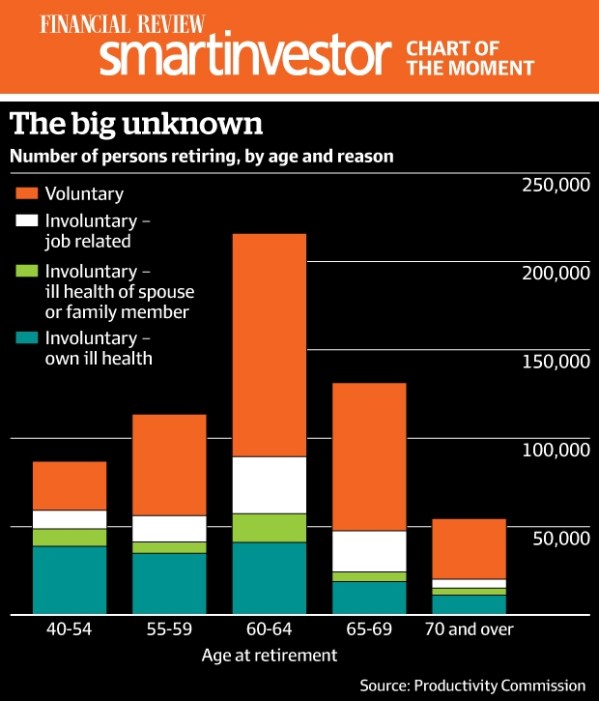
The 2015 Productivity Commission report on post-retirement shows that about 40 per cent of Australians who retire between the age of 60 and 64 do so involuntarily, either because of their own or a family member’s ill health, or redundancy.

For those aged between 65 and 69 who retire involuntarily is not that different, while for younger age groups most people who retire do so involuntarily.

Retirement ages

Clearly, workers relying on delayed retirement are rolling the dice. Yet, most people discount the future so much that they’re willing to take that gamble. May hope that an inheritance will save the day but do not realise that age care costs and parents living longer may eat heavily into any expected inheritance.

Strangely the people most likely to plan on working a few more years to boost their retirement security may actually have the least ability to postpone their retirement. People who suffer an illness or injury  are more likely than those in good health to have pushed back their expected retirement date in recent years, according to  a report from consulting firm Towers Watson. Yet health problems or disabilities were cited by more than half of retirees forced to retire earlier than planned.

Don’t put you head in the sand – start now

As psychologists are quick to point out, we all have that inner voice that loves to procrastinate who loves to put off till tomorrow what we should do today – beause its “all too hard to get your head around”. Saving more today is a sure thing, and extra years in the workforce are anything but. If you know you don’t have enough, you should start saving more today, because that’s by far the less risky alternative.

Let’s look at an example using the Retirement Planner on the MoneySmart.gov.au site for a 55-year-old pre-retiree with just $30K in superannuation. If she earns $80,000, makes $17,500 annual salary sacrifice contributions (in addition to Employers SGC contributions of 9.5%)  and earns a 7.5% return pre retirement and 6.5% after, she could be looking at an Income in retirement of $32,143 by age 67 including the Age Pension. If she’s forced to retire at that point, she’s still in better shape than most Australian’s. And if she can continue working, she  counld improve on this lifestyle with a better retirement income.

Retirement Income

A final don’t is cancelling TPD or Income Protection insurances to save money while in your most productive earning years (read here for more on that subject). The loss of 5-10 years of earnings potential is one guaranteed way to destroy your lifestyle in retirement. Your ability to earn is your biggest asset

Are you looking for an advisor that will keep you up to date and provide guidance and tips like in this blog? Then why now contact me at our Castle Hill or Windsor office in Northwest Sydney to arrange a one on one consultation. Just click the Schedule Now button up on the left to find the appointment options.

Liam Shorte B.Bus SSA™ AFP

Financial Planner & SMSF Specialist Advisor™

SMSF Specialist Adviser 

 Follow SMSFCoach on Twitter Liam Shorte on Linkedin NextGen Wealth on Facebook   

Verante Financial Planning

Tel: 02 98941844, Mobile: 0413 936 299

PO Box 6002 BHBC, Baulkham Hills NSW 2153

5/15 Terminus St. Castle Hill NSW 2154

Corporate Authorised Representative of Viridian Select Pty Ltd ABN 41 621 447 345, AFSL 51572

This information has been prepared without taking account of your objectives, financial situation or needs. Because of this you should, before acting on this information, consider its appropriateness, having regard to your objectives, financial situation and needs. This website provides an overview or summary only and it should not be considered a comprehensive statement on any matter or relied upon as such.

Skeletons in the Cupboards and Tax Man at the Door – Estate Planning Solutions for SMSF members


Here is one solution to a big problem that may become more common with blended families and increased divorce as well as de facto arrangements.     SMSF Estate Planning

Our client , lets call him , Scott (age 78) is a widower in the Hills district and he has a $652,000 account based pension (containing a 100% taxable component to keep it simple). His two adult daughters who are financially independent are noted as 50/50 beneficiaries on his non-lapsing binding death benefit nomination (see here for more details). Any lump sum death benefit they receive will be subject to 17 per cent tax. In dollar terms, this is $110,500 (calculation: $652,000 x 17%) and he wasn’t too happy about this.

Scott was advised by his specialist he has 2-3 years maximum to live due to an aggressive cancer. He threw this curly one at me to come up with a strategy as he wants to maximise his estate for his kids but also retain access to the funds while alive to fund medical and living expenses. Our strategy involves Scott taking a tax-free withdrawal from his account based pension. He then let me know about some skeletons he had in his cupboard!

Scott could retain these funds within a bank account, however the account will form part of his estate upon his death. Even though his estate will be paid predominately to his adult daughters, he is concerned about his estranged son from an affair he had in his late 50’s who might challenge the Will.

We advised that a valid alternative available to Scott is to invest into an investment bond with himself as the owner and the life insured. Since an investment bond is a non-estate asset, upon his death the funds will be paid tax-free to his adult daughters.

Both strategies will avoid the $110,500 of death benefits tax on funds paid to his daughters, however only the investment bond will ensure the funds do not become part of his estate. Scott’s two daughters need only produce a copy of his death certificate to gain access to the funds within the bond. This could also avoid lengthy delays with the administration of the estate and overcome possible estate challenges from his estranged son.

In terms of costs we were looking at foregoing the tax-free status in pension phase for the 2 years but that was far outweighed by the savings in the death benefits tax and we are actually able to wind up the SMSF  to save his children the hassle of dealing with that later.

For further information on the issues raised in this blog please contact our Castle Hill SMSF Centre or Windsor Financial Planning Office or choose an appointment option here 

I hope this guidance  has been helpful and please take the time to comment. Feedback always appreciated. Please reblog, retweet, put on your Facebook page if you found information helpful.

Liam Shorte B.Bus SSA™ AFP

Financial Planner & SMSF Specialist Advisor™

SMSF Specialist Adviser 

 Follow SMSFCoach on Twitter Liam Shorte on Linkedin NextGen Wealth on Facebook   

Verante Financial Planning

Tel: 02 98941844, Mobile: 0413 936 299

PO Box 6002 BHBC, Baulkham Hills NSW 2153

5/15 Terminus St. Castle Hill NSW 2154

Corporate Authorised Representative of Viridian Select Pty Ltd ABN 41 621 447 345, AFSL 51572

This information has been prepared without taking account of your objectives, financial situation or needs. Because of this you should, before acting on this information, consider its appropriateness, having regard to your objectives, financial situation and needs. This website provides an overview or summary only and it should not be considered a comprehensive statement on any matter or relied upon as such.

Think twice before cancelling insurances as you get older.


Do you know that the average person cancels their personal insurance about 1-2 years before an claimable illness strikes! The average age a person discontinues one or more of three types of living insurance policies – cover for disability, critical illness/trauma and income protection – is 45 years yet the average age for a claim is 46.5 years. (source TAL)

As mentioned in a previous blog the SMSF regulations now require Self Managed Superannuation Fund Trustees to consider Insurance as part of the SMSF Investment Strategy . TheRisk Management following applies to everyone regardless of the type of investor you are or the structure you use to save for retirement.

I see many clients in our Castle Hill and Windsor offices in their late 50’s who have cancelled their life and income protection insurances before they have come to see me. Usually they say it is because they have paid off their mortgage and are debt free so they didn’t feel they needed cover any longer.

Their focus now was on expense reduction and saving via salary sacrifice to superannuation and even some after tax contributions from savings.

While it is great to see them focus on saving for retirement and budgeting, what they don’t realise is that in cancelling insurances it is their retirement lifestyle or that of their spouse they are no longer insuring and not just their current needs.

With 5-15 years of focused savings towards a retirement nest egg they can substantially improve their lifestyle after retirement. However those dreams of a happy retirement can all be taken away with a diagnosis of cancer or a stroke that inhibits them working for a prolonged period.

You don’t just find yourself financing time off work and medical expenses but also lose out on the employer super contributions and salary sacrifice as well or worse for a small business owner, you face the expense of a getting someone to cover for you to keep the business afloat.

To realistically assess if you need to maintain your Life, Trauma or Income Protection insurance, you need to think through the worst-case scenario. If you were unable to work for 3 years due to an illness today, how would you and your loved ones cope financially?

  • Would you be able to meet ongoing living expenses like food, clothing, changing the car, pay for private health insurance premiums, etc? (this assumes mortgage paid off)
  • Would you have the liquid funds to cover additional expenses or loss in income (e.g., gap in your medical fees, time off work for your spouse to take care of you,
  • What would happen to your retirement plans and would you be able to save enough money to see the kids through the final college years or fund your retirement comfortably?
  • What if you were actually permanently disabled and they had all the costs of rearranging the home, medical care and transport options for you.

In all honesty, it is always a struggle when you lose your earning capacity. The last thing you need compounding the situation are financial concerns. Insurance helps make sure that you and the people you care about will be provided for financially, even if you’re not around to care for them yourself.

So whether you’re in retail, industry or a Self Managed Super Fund, take a moment to consider how insurance might fit into your retirement plans. We can look at ways to reduce the cover and costs to keep them affordable and provide that protection for you and your family.

If you think you may need to review your Insurances then you can contact us to offer you advice on your options. As well as offering advice on Insurances, Superannuation and SMSF’s our advisers can also offer you help in many other area’s you may be experiencing problems such as:

  • Financial Planning,
  • Tax Planning,
  • Debt Consolidation,
  • Investment Portfolios,
  • Estate Planning,
  • SMSF Trustee queries.

Have you found this blog helpful? Pass it on. Social media buttons beneath the article.

Are you looking for an advisor that will keep you up to date and provide guidance and tips like in this blog? Then why now contact me at our Castle Hill or Windsor office in Northwest Sydney to arrange a one on one consultation. Just click the Schedule Now button up on the left to find the appointment options.

Liam Shorte B.Bus SSA™ AFP

Financial Planner & SMSF Specialist Advisor™

SMSF Specialist Adviser 

 Follow SMSFCoach on Twitter Liam Shorte on Linkedin NextGen Wealth on Facebook   

Verante Financial Planning

Tel: 02 98941844, Mobile: 0413 936 299

PO Box 6002 BHBC, Baulkham Hills NSW 2153

5/15 Terminus St. Castle Hill NSW 2154

Corporate Authorised Representative of Viridian Select Pty Ltd ABN 41 621 447 345, AFSL 51572

This information has been prepared without taking account of your objectives, financial situation or needs. Because of this you should, before acting on this information, consider its appropriateness, having regard to your objectives, financial situation and needs. This website provides an overview or summary only and it should not be considered a comprehensive statement on any matter or relied upon as such.

10 common mistakes made by many SMSF Trustees


I run regular sessions educating Trustees in small groups on how to utilise their SMSF and to avoid common mistakes so I thought I should share the more common ones. Self managed superannuation funds can be kept simple or they can involve very complex strategies. The superannuation system has many rules and regulations that members need to adhere to.  To ensure that you avoid the traps when it comes to self managed superannuation read on! Errors happen

1.    Jumping in too early with a low balance.

Unless you expect to make regular large contributions in the coming years or expect to put a large lump sum (e.g. inheritance) in soon, the administration fees of maintaining a Self Managed Superannuation Fund will erode away any profits and may also eat into your contributions.  The general agreed rule of thumb among honest SMSF professionals for a minimum balance for a Self Managed Superannuation Fund would be $200k. This would only be on the proviso you would be making contributions at or near your concessional cap depending on your age and that you may also be adding some non-concessional funds on a regular basis so that your fund has $400-$500K within 3-5 years.

If there are 2-4 members that are contributing to the fund with frequently largely sized contributions this can justify the use of a self managed superannuation fund earlier.  Just remember that generally it costs around $2,200.00 per annum in auditing, accounting, tax agents fees and ASIC fees for the fund as well as a general 1% investment fee.

2.    Failing to educate yourself first, before you open your fund so you know the basic SMSF rules.

Self managed superannuation funds can be very complex, if you do not know the basic rules of a fund and you are not using a fund administrator like an Accountant or a specialised service, you are asking for trouble! As the number of self managed superannuation funds increase rapidly the ATO as regulators will begin to take a stronger position.  Currently non compliant funds can lose up to 46.5% of the funds assets to tax plus fines for the Trustees!

There is jargon like concessional and non=concessional contributions and tax free and taxable components so take the time to understand them.

The main reasons of funds losing their compliance status is due to providing loans members. Anyone who has just started a self managed superannuation fund whether they have a manager or not that controls the funds should know the basic rules.

Here are some places to start:

ATO central access point for information on SMSFs  http://www.ato.gov.au/super/self-managed-super-funds/

The SMSF Association is pleased to provide you with this ATO SMSF Trustee online resource. ATO approved SMSF Trustee Education Program

By the end of this course, you will have learnt;

  • The basic facts about Superannuation and Self-Managed Superannuation Funds
  • How an SMSF works
  • The investment rules for SMSFs
  • The administration process to keep your SMSF healthy.

http://www.smsftrustee.com/ The Self Managed Superannuation Fund Trustee Education Program has been released by the Joint Accounting Bodies

We run regular seminars on educational topics for SMSF Trustees in groups of 6-10 people. Contact us for more details liam@verante.com.au 

 3.    Drawing on your SMSF for business or personal needs – Read and learn to stick by the Sole Purpose Test

Always remember it is your money but not yet! You are receiving generous tax concessions for providing for your retirement. Break the rules and you will lose those concessions! Self managed superannuation funds are not to be used to fund personal or business needs of the members of the fund or their relatives.  While many may be able to justify a small loan for a short period of time there is a total restriction on lending to members of the fund or related parties which may be extended family members or entities such as Family Trusts, Companies or partnerships.

Another example would be if you invested in a holiday resort unit managed independently by a management company and as part of the arrangement, you are entitled to private use of the apartment, 2 weeks per year. This arrangement would breach of the sole purpose test if used by your or any related party.

4.    Arranging for your SMSF to own your business premises without thinking the strategy through to the end

I actually love this strategy but there are positives and negatives to this situation and you will need guidance from your legal, accounting and SMSF Specialist Advisor. Many owners of small to medium enterprises use this as an effective strategy but others do a half-baked job and leave themselves exposed.

Pros:

  • Direct control of your super investments and a real understanding of where your money is invested.
  • The fund will pay only 15% tax on commercial rent paid
  • If the premises is sold no capital gains tax may be applicable once you are in pension phase and 15% or less if earlier.
  • You can be your own landlord with secured tenancy which allows you greater certainty when fitting out or installing equipment.
  • Keeps liquidity in the business to fund other costs.

Cons:

  • There are thousands of dollars in set-up costs and there are sometimes higher fees involved in getting a loan through your SMSF.
  • If a member of the fund dies without the proper insurance in place the fund may have to pay out death benefits leading to a rushed sale of the commercial premises.
  • If sold to a third-party then there is a possible loss of tenancy to the business which could destroy it.
  • There are strategies that can be built to avoid the cons, it is best to speak to an advisor so that they can see what is best for your personal situation.

5.    Choosing the wrong type of Trustee for the job

 76% of funds in this country still have Individual Trustees or a Trading company as trustee when a Sole Purpose Corporate Trustee would be much more suitable for long-term planning.

With individuals as trustees you need to change the name on all investments if one person leaves (divorce, death, Incapacity to act) or you add a new member (bring in a child, business partner or second spouse!). The paperwork involved is time-consuming and expensive just when it usually most inconvenient.

Please see my previous blog on this subject for more detailed discussion on this topic https://smsfcoach.com.au/2012/08/09/trading-company-as-smsf-trustee-or-sole-purpose-smsf-trustee-company/


6.    Failing to plan for death or serious illness of a member

If the fund is run by a husband and wife or run predominantly by one member, if that member passes it could have devastating impact on the remaining member and the self managed superannuation fund.  Strategies should be put in place so that all members involved in the fund understand the rules and regulations as well as the funds investment strategy.

Effort should be made to ensure the “silent” member is aware of and has met the Accountant, Auditor, and Financial Advisor and is comfortable that they could deal with them in the event of needing them. What’s the use in having a city based advisor if your spouse does not feel comfortable driving into the CBD. Choose a local Advisor for your later years.

All shares should be properly Chess sponsored and all members should have access to account numbers and passwords.

Binding Death Nominations and Reversionary Pensions should be reviewed regularly to ensure they still meet your wishes. The idea of leaving 20% to a son or daughter may have been fine when the fund was doing well but is it still a good idea in 2017? Make sure you do not leave your spouse short!

7.     Rolling to a SMSF without maintaining or transferring Insurance First.

One of the most important factors is to undergo a review of current insurances and to have life insurance integrated into your self managed superannuation fund.  When transferring from retail, employer or industry superannuation fund look to get “Transfer Terms” from insurers to open a new policy in the name of the SMSF without extensive underwriting. DO NOT LEAVE THIS UNTIL AFTER YOU HAVE ROLLED OVER! Despite your own perception of your health and vigour, you may find it hard to find new cover on the same terms or any terms so preserve what you have. Often we keep a small balance in a retail or industry fund just to continue the insurances in there at the group or discounted rates available.

8.    Getting behind on paperwork

More than just filing statements, trustees are required to document every decision that is made whether this is to make an investment, take out insurance, or change bank accounts. This should come in the form of minutes with details regarding who made the decision, on what day and where the decision was made.

The record keeping requirements of an SMSF can be quite onerous and failing to meet them is an easy way to fall foul of the ATO. Business owners usually have enough paperwork as it is, so paying professionals who can look after your record keeping may make sense for you.

9.    Exceeding the contributions cap

The cap on concessional contributions has changed so often in the last decade that confusion reigns each year.

The cap on concessional contributions for 2018/19  is $25,000. The after tax contributions (non-concessional) is capped at $100,000 per annum

There are a number of ways members can get caught out and exceed the cap. For example,

  • if you are paying for life insurance held in another super fund, the insurance premium can be deemed as a contribution. This premium would then be levied at penalty tax rates.
  • If your employer made last year’s June Super contribution in July of this year.

We can show you strategies for a couple to get up to $800,000 to $1,200,000 into super in one year by using a mix of contributions and a holding account strategy.

10.  Not having a proper Cash Hub and losing interest and paying unnecessary fees

If you go to your normal bank to set up a bank account for your SMSF, they will most likely suggest that you use a business bank account. These accounts generally have high monthly fees, transaction fees and provide little to no interest.

We estimated the average cash balance of SMSFs to be between $50,000 and $80,000. Based on these figures, by using business bank accounts, trustees may be costing themselves approximately $3,000 per annum in fees and lost interest.

There are better options out there. Look at Macquarie’s Cash Management Account almost matching the RBA cash rate (noting for first $5K). Link these to an ING Direct Savings Maximiser for the Fund or a RaboDirect Notice Saver Account paying up to 1.8 to 2.35% higher for cash. Use 6, 9 and 12 month Term Deposits where funds are not needed short-term.

Make sure all accounts are opened correctly in the name of all trustees. Get it wrong and it can cost a lot to rectify.

I hope these thoughts  have been helpful and please take the time to comment if you know of others common mistakes as I know this is not an exhaustive list.

Liam Shorte B.Bus SSA™ AFP

Financial Planner & SMSF Specialist Advisor™

SMSF Specialist Adviser 

 Follow SMSFCoach on Twitter Liam Shorte on Linkedin NextGen Wealth on Facebook   

Verante Financial Planning

Tel: 02 98941844, Mobile: 0413 936 299

PO Box 6002 BHBC, Baulkham Hills NSW 2153

5/15 Terminus St. Castle Hill NSW 2154

Corporate Authorised Representative of  Viridian Advisory Pty Ltd (ABN 34 605 438 042) (AFSL 476223)

This information has been prepared without taking account of your objectives, financial situation or needs. Because of this you should, before acting on this information, consider its appropriateness, having regard to your objectives, financial situation and needs. This website provides an overview or summary only and it should not be considered a comprehensive statement on any matter or relied upon as such.