Retirement Planning Tips for 2017 onwards


ID-100407988

Retirement planning is vitally important and with the new rules it may be more important to start as early as possible. New limitations on contributions to super will mean you must be actively making additional contributions sooner. Then when you have been working hard to get money into the super environment, and have complied with all the rules and contribution caps, you want to ensure you are maximising your opportunities when you start to draw on your super savings for a retirement income stream.

What are the changes?

  • A maximum limit of $1.6 million is permitted to be transferred into retirement income stream products.
  • Excessive balances can remain in super in accumulation phase
  • Earnings on assets supporting transition to retirement income streams will be taxed within super

Limits on amounts that can be transferred into retirement income streams

There has been considerable talk in recent times about whether a limit should be placed on the amount that can be accumulated within super and afforded tax concessions. Rather than simply place an arbitrary ceiling on how much can be held inside super, the Government has instead targeted potentially excessive superannuation balances by limiting the amount that will be eligible for the nil tax on earnings concession. From 1 July 2017, the maximum amount that can be placed into retirement income streams will be $1.6 million. For anyone who has started income streams and account balances exceeding that limit, there will be a requirement to roll-back (or withdraw) amounts to bring them in line with these new maximums. The current tax free status of earnings on assets supporting superannuation income streams will only be available to the extent that the income streams are within this new limit.

Excessive balances can remain in superannuation

There is a lot of media hype and some misconceptions floating around at present. It’s important you understand that if you are in the fortunate position to have more than $1.6 million in super, you aren’t forced to withdraw the additional benefits. Amounts above the $1.6 million threshold can remain in super, but must remain in the accumulation phase. Earnings will be taxed at the standard superannuation tax rate of 15% which for many people will be better than paying their marginal tax rate on the earnings if they take the funds out of the system.

Also remember if you have $1.6m in pension then if you take the excess funds out of your SMSF then you will not have an opportunity to put the funds back in as you will be blocked form making further non-concessional (after tax) contributions.

For some, it may be worthwhile to explore taking some of the excess out in to your own names after July 2017 if you have a low level of assets outside in your personal names or through family trusts. But remember if you’re minimum pensions from  the remaining money in superannuation pensions is more than you need to live on then these funds can build up quickly outside of the system and you could be come taxable now or when the first spouse passes.

Earnings on assets supporting transition to retirement income streams will be taxed within super

Despite considerable speculation, the Government has not removed the ability to commence and run transition to retirement (TTR) income streams. TTR income streams are available to you once you reach your preservation age. They allow you to access your super in the form of an income stream without the need to retire or alter your employment arrangements. However, the Government has opted to reduce the concessions available for these income streams. From 1 July 2017, instead of earnings on assets supporting these income streams being exempt from tax within the super environment (as would apply to all other income streams within the new $1.6 million threshold), earnings will instead remain subject to the standard 15% tax rate that applies to funds in accumulation phase.

So for those accessing their super via a TTR so they can salary sacrifice more of their wages back to super within the new $25,000 limit from 1 July 2017, then this is still a very valid strategy. How ever if you have the savings and can manage without accessing your super balance then it may be better to move your fund to accumulation phase.

Look for opportunities to change from a transition to retirement income streams to a full account based pension

If you retire before 60 or leave any one employer after age 60 then you can switch your TTR to a full tax free pension. So think about your situation and do you or can you do marking of exams, AEC electoral role work, stocktaking, Christmas short term employment, part-time survey work, bar work, filling in for family in a business while they go on holidays. If you can document a work arrangement and it genuinely ceases then you can meet that further condition of release which could move your fund in to tax free earnings phase again.

Summary

What hasn’t changed is the tax treatment of superannuation benefits received by individuals from their retirement savings. Payments received after reaching age 60 will continue to be received tax free. To ensure you get the right advice for your situation give us a call on 02 9984 1844 or click here to schedule an appointment

We have offices in Castle Hill and Windsor but can meet clients anywhere in Sydney or via Skype.

Liam Shorte B.Bus SSA™ AFP

Financial Planner & SMSF Specialist Advisor™

SMSF Specialist Adviser 

 Follow SMSFCoach on Twitter Liam Shorte on Linkedin NextGen Wealth on Facebook   

Verante Financial Planning

Tel: 02 98941844, Mobile: 0413 936 299

PO Box 6002 BHBC, Baulkham Hills NSW 2153

5/15 Terminus St. Castle Hill NSW 2154

Corporate Authorised Representative of Viridian Select Pty Ltd ABN 41 621 447 345, AFSL 51572

This information has been prepared without taking account of your objectives, financial situation or needs. Because of this you should, before acting on this information, consider its appropriateness, having regard to your objectives, financial situation and needs. This website provides an overview or summary only and it should not be considered a comprehensive statement on any matter or relied upon as such.

Image courtesy of Stuart Miles at FreeDigitalPhotos.net

Services I Provide as a Professional Financial Planner and SMSF Specialist Advisor


Finding a Professional Adviser

I recently had my 17-year-old son do some work experience in the office and after a few days he asked “what do you do for your clients dad?” I rattled off my elevator speech about my core belief that “I put people back in control of their finances and empower them to plan for a brighter future.” He looked at me as if I had two heads and said “yeah but what do you actually do?” Well that hit me like a brick and I realised that many people do not know what I actually do as a Professional Financial Planner. No not just a Financial Planner but a professional who lives and breathes his work and is building a business around the clients he takes care of and not around the amount of funds under management.

When I sat down with my business partner, Michael Rambaldini, and our team and we looked at what we have done for clients over the last few decades. We split the role in to 5 parts:

  • The financial plan designer who deals with the big picture of your goals and dreams and strategies to achieve them from a financial perspective. As part of this we help get back control by ensuring you are more organised.
  • The relationship builder – someone who earns your trust, becomes your financial coach and guides you through your financial journey with confidence. We deal with many clients so understand the changes in lifestyle and monetary needs as you age.
  • The investment strategist who chooses how to build wealth to fund those objectives. We bring that third-party view to help you avoid emotionally driven investment.
  • The insurance adviser who makes sense of the options available and make an assessment of the needs of the family in terms of risk management and protecting the family’s financial future.
  • The tax consultant (often with an accountant) to minimise the leakage from those returns and ensure compliance.

Now to actually show how that is done and the actual services provided I have made some lists and while not exhaustive they encompass 99% of what I can do for my clients.

A Professional Financial Planner:

  1. Guides you to think about areas of your financial life you may not have considered.
  2. Formalises your goals and puts them in writing.
  3. Helps you prioritise your financial objectives in the right order not what’s easy first.
  4. Helps you determine realistic benchmarks.
  5. Makes you accountable for your own strategies through regular reviews.
  6. Studies possible alternatives that could meet your goals.
  7. Helps you work out your best Salary Sacrifice strategy
  8. Prepares a “big picture” financial plan called a Statement of Advice for you. This should be a reference document for the detailed strategy.
  9. Suggests creative alternatives that you may not have considered including the best way to maximise Centrelink benefits.
  10. Assists you in setting up a Superannuation plan and maybe even an SMSF when the time is right.
  11. Reviews your children’s educational cost funding strategy.
  12. Provides reminders about updates to key financial planning data.
  13. Checks with you before the end of the year to identify any last-minute financial planning needs.
  14. Guides you on ways to fund health care and other lump sum expenses in retirement.
  15. Assists in preparing an estate plan for you.
  16. Cares more about you and your money than anyone who doesn’t share your last name.

A PERSONAL FINANCIAL COACH:

  1. Monitors changes in your life, career and family situation.
  2. Proactively keeps in touch with you with news and ideas, educating you along the way.
  3. Serves as a human glossary of financial terms such as alpha, P/E ratio, and franking credits.
  4. Provides referrals to other professionals, such as accountants, auditors and lawyers.
  5. Shares the experience of dozens of his clients who have also faced circumstances similar to yours. (I’m Irish so I love a story to relay a solution)
  6. Helps with the continuity of your family’s financial plan through generations.
  7. Keeps you on track with reviews to achieve your objectives.
  8. Identifies your savings shortfalls and strategies to plug the gap.
  9. Develops and monitors a strategy for debt reduction.
  10. Is a wise sounding board for ideas you are considering.
  11. I provide the necessary resources to facilitate your decisions, and explaining the opportunities and risks associated with each option.
  12. Provides “the sleep factor” so you are not stressed about money
  13. Is there for your spouse and family should anything happen to you.
  14. Is honest with you, always, even when it means saying NO!

AN INVESTMENT STRATEGIST:

  1. Prepares an asset allocation for you so you can achieve the best rate of return for a given level of risk tolerance.
  2. Stays up to date on changes in the investment world.
  3. Monitors your investments.
  4. Reviews your investments in your company superannuation plans.
  5. Reviews the costs of your existing plan to ensure it is value for money
  6. Helps transition your investments from Accumulation phase to providing a retirement income.
  7. Refers you to mortgage broker for loan and debt financing.
  8. Suggests alternative strategies to increase your income during retirement.
  9. Researches and keeps records of your cost basis on shares and property
  10. Provides you with reliable investment research and often differing views from a range of sources.
  11. Provides you with personal investment analysis.
  12. Determines the risk level of your existing portfolio.
  13. Helps you consolidate and simplify your superannuation and investments.
  14. Can provide you with technical, fundamental, and quantitative investment analysis.
  15. Provides introductions to new investment opportunities.
  16. Shows you how to access your statements and other information online.

AN INSURANCE ADVISER:

  1. Reviews and recommends life, TPD, Trauma and Income Protection insurance policies to protect your family.
  2. Advises on the best structure in terms of within or outside of superannuation to hold the policies
  3. Advises on which entity should own these policies to achieve the desired outcome in the event of a claim.
  4. Looks at Keyman and Business Expenses Insurance for professional and small business clients.
  5. Holding your hand or if the worst happens, your family’s hand while we process a claim with you in the event of illness, injury or death.

A TAX CONSULTANT (within the limits of my licence):

  1. Suggests alternatives to manage income streams and  lower your taxes during retirement.
  2. Reviews your tax strategies/returns with an eye to possible savings in the future.
  3. Stays up to-date on tax law changes.
  4. Helps you reduce your current taxes.
  5. Helps you determine and fund your desired income in retirement and minimum pension payments.
  6. Re-positions investments to take full advantage of tax law provisions.
  7. Facilitates the transfer of investments from individual names to trust(s), or from an owner through to beneficiaries.
  8. Works with your  accountant, tax agent and legal advisers to help you meet your financial goals.

I can’t live your life for you but I can smooth the way!

Are you looking to build that sort of relationship? Do you want a professional advisor that will take the time to build that trusted relationship with you. Please contact me if you want to look at your own options. We have offices in Castle Hill and Windsor but can meet clients anywhere in Sydney or via Skype. Just click the Schedule Now button up on the left to find the appointment options.

Liam Shorte B.Bus SSA™ AFP

Financial Planner & SMSF Specialist Advisor™

SMSF Specialist Adviser 

 Follow SMSFCoach on Twitter Liam Shorte on Linkedin NextGen Wealth on Facebook   

Verante Financial Planning

Tel: 02 98941844, Mobile: 0413 936 299

PO Box 6002 BHBC, Baulkham Hills NSW 2153

5/15 Terminus St. Castle Hill NSW 2154

Corporate Authorised Representative of Viridian Select Pty Ltd ABN 41 621 447 345, AFSL 51572

This information has been prepared without taking account of your objectives, financial situation or needs. Because of this you should, before acting on this information, consider its appropriateness, having regard to your objectives, financial situation and needs. This website provides an overview or summary only and it should not be considered a comprehensive statement on any matter or relied upon as such.

Understanding Currency Exposure When Investing Overseas in your SMSF


Investing-Globally

Recent swings in global currencies have brought exchange-rate risk back to the forefront for investors with overseas exposure in different currencies. Currency risks are risks that arise from changes in the relative valuation of different currencies. These changes can create unpredictable gains and losses when the profits or dividends from an investment are converted from a foreign currency back into Australian dollars.

Any investor who holds stocks, ETFs with the likes of iShares, Vanguard or SPDR or managed funds such as  Magellan Global Fund in their SMSF portfolio that invest outside Australia will have some exposure to foreign currency, and where the Aussie dollar exchange rate goes will have an effect on these SMSF portfolios. For instance, a strengthening dollar could negatively impact foreign stock market returns and you should consider this risk in portfolio design.

Interest rates are critical, because when a country’s rate rises, in many cases, so does its currency. Or in our case if the US interest rate rises or at the moment is being held unexpectedly lower by the Us Federal Reserve, our currency’s exchange rate can fluctuate wildly in response to another government’s actions.

Up until recently, this wasn’t much of a worry for Australian investors. Rates were low, the Aussie dollar was getting weaker coming down fro its peak near $1.10 to the US$, and people made money by investing in foreign assets.

Going forward that may not be so easy so its is important for Self Managed Super Fund investors to understand currency exchange risk.

Here is a good video from Blackrock iShares explaining how currency exposure affects returns on international investments.

Now you should note you can also find Currency Hedged ETFs and Hedged Managed funds (as opposed to a Hedge Fund which is totally different) that can help you easily manage the effect of currency on your investments and can be paired with their unhedged counterparts to tailor currency risk while maintaining consistent equity exposure. Of course there is a cost to implementing this protection but that is what good portfolio risk management is all about.

Do you want some more education on why you should consider international investments as part of your SMSF portfolio? then please check out this previous blog about investing internationally via your SMSF.

Are you looking for an advisor that will keep you up to date and provide guidance and tips like in this blog? Then why now contact me at our Castle Hill or Windsor office in Northwest Sydney to arrange a one on one consultation. Just click the Schedule Now button up on the left to find the appointment options.

Liam Shorte B.Bus SSA™ AFP

Financial Planner & SMSF Specialist Advisor™

SMSF Specialist Adviser 

 Follow SMSFCoach on Twitter Liam Shorte on Linkedin NextGen Wealth on Facebook   

Verante Financial Planning

Tel: 02 98941844, Mobile: 0413 936 299

PO Box 6002 BHBC, Baulkham Hills NSW 2153

5/15 Terminus St. Castle Hill NSW 2154

Corporate Authorised Representative of Viridian Select Pty Ltd ABN 41 621 447 345, AFSL 51572

This information has been prepared without taking account of your objectives, financial situation or needs. Because of this you should, before acting on this information, consider its appropriateness, having regard to your objectives, financial situation and needs. This website provides an overview or summary only and it should not be considered a comprehensive statement on any matter or relied upon as such.

When your Husband Retires and the Nightmare Comes True


Nightmare for Older Women

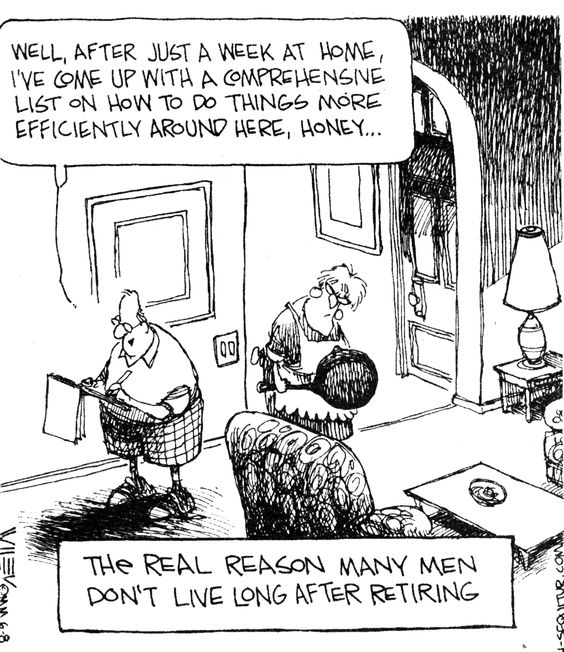
I deal with a lot of couples where one spouse has retired well in advance of the other and has established a routine or habits they are comfortable with and enjoy. The working spouse is often totally engrossed in their career or business with little else in the way of interests or hobbies. When they do eventually retire they can not only struggle to make the most of the free time, but they can also destroy the lifestyle their parter has come to enjoy.

This letter printed in Newsweek in 2004 sums it up better than I ever could and should be a warning to you to ensure your spouse or partner regardless of gender, has interests that extend beyond their working life.

THE ‘GOLDEN YEARS’ ARE BEGINNING TO TARNISH

My worst nightmare has become reality. My husband retired. As the CEO of his own software company, he used to make important decisions daily. Now he decides when to take a nap and for how long. He does not play golf, tennis or bridge, which means he is at home for what seems like 48 hours a day. That’s a lot of togetherness.

Much has changed since he stopped working. My husband now defines “sleeping in” as staying in bed until 6 a.m. He often walks in the morning for exercise but says he can’t walk if he gets up late. Late is 5:30. His morning routine is to take out the dog, plug in the coffee and await the morning paper. (And it had better not be late!) When the paper finally arrives, his favorite section is the obits. He reads each and every one–often aloud–and becomes angry if the deceased’s age is not listed. I’d like to work on my crossword puzzle in peace. When I bring this to his attention, he stops briefly–but he soon finds another article that must be shared.

Some retirement couples enjoy this time of life together. Usually these are couples who are not dependent on their spouse for their happiness and well-being. My husband is not one of these individuals. Many wives I’ve spoken to identify with my experience and are happy to know that they’re not alone. One friend told me that when her husband retired, he grew a strip of Velcro on his side and attached himself to her. They were married 43 years and she hinted they may not make it to 44. Another woman said her husband not only takes her to the beauty shop, but goes in with her and waits! Another said her husband follows her everywhere but to the bathroom… and that’s only because she locks the bathroom door.

When I leave the house, my husband asks: “Where are you going?” followed by “When will you be back?” Even when I’m at home he needs to know where I am every moment. “Where’s Jan?” he asks the dog. This is bad enough, but at least he hasn’t Velcroed himself to me–yet.

I often see retired couples shopping together in the grocery store. Usually they are arguing. I hate it when my husband goes shopping with me. He takes charge of the cart and disappears. With my arms full of cans, I have to search the aisles until I locate him and the cart, which is now loaded with strange-smelling cheeses, high-fat snacks and greasy sausages–none of which was on the shopping list.

Putting up with annoying habits is easier when hubby is at work all day and at home only in the evening and on weekends. But little annoying habits become big annoying habits when done on a daily basis. Hearing my husband yell and curse at the TV during the evening news was bad enough when he was working, and it was just once a day. Now he has all day to get riled up watching Fox News. Sometimes leaving the house isn’t even a satisfying reprieve. When I went out of town for a week and put him in charge of the house and animals, I returned to have my parrot greet me with a mouthful of expletives and deep-bellied belches. It wasn’t hard to figure out what had been going on in my absence.

Not that my husband has any problem acting out while I’m around. He recently noticed that our cat had been climbing the palm trees, causing their leaves to bend. His solution? Buy a huge roll of barbed wire and wrap the trunks. After wrapping 10 palms, he looked like he had been in a fight with a tiger and the house took on the appearance of a high-security prison. Neighbors stopped midstride while on their daily walks to stare. I stayed out of sight. In the meantime, the cat learned to negotiate the barbed wire and climbed the palms anyway.

It is now another hot, dry summer, and the leaves on our trees are starting to fall. Yesterday my husband decided to take the dog out for some fresh air. They stood in the driveway while he counted the leaves falling from the ash tree. Aloud. Another meaningful retirement activity.

I think my husband enjoys being at home with me. I am the one with the problem. I am a person who needs a lot of “alone time,” and I get crazy when someone is following me around or wanting to know my every move. My husband is full of questions and comments when I am on the phone, working on my computer or taking time out to read. It is his way of telling me he wants to be included, wanted and needed. I love that he cares–but he still drives me up the wall.

I receive a lot of catalogs. In one there is a pillow advertised that says grow old with me. the best is yet to be. Another catalog has a different pillow. It reads screw the golden years. Right now it’s a tossup as to which pillow will best describe our retirement years together. Just don’t ask me while I’m working on my crossword puzzle.

Zeh lives in Houston.

Do you get the point I am trying to get across? Retirement takes as much planning as working years. You still have to fill all those waking hours previously filled with commuting and work. If you don’t plan ahead and ensure your partner does too then you could end up destroying both of your retirements and often your relationship. It is no surprise that their has been a rise in what is term “grey divorce as couples find themselves with an empty nest and only each other for company. We start planning the transition to retirement with clients 5-10 years out to ensure they have covered off all facets of their retirement needs. That’s what a professional planner covers rather than just an investment advisor.

retirement

For some ideas and a list of organisation for retirees to suit all interests you should visit The Seniors Information Service here . They also have some great ideas on Leisure, Lifestyle and Travel

I hope this guidance has been helpful and please take the time to comment. Feedback always appreciated. Please reblog, retweet, like on Facebook etc to make sure we get the news out there. As always please contact me if you want to look at your own options. We have offices in Castle Hill and Windsor but can meet clients anywhere in Sydney or via Skype.

Liam Shorte B.Bus SSA™ AFP

Financial Planner & SMSF Specialist Advisor™

SMSF Specialist Adviser 

 Follow SMSFCoach on Twitter Liam Shorte on Linkedin NextGen Wealth on Facebook   

Verante Financial Planning

Tel: 02 98941844, Mobile: 0413 936 299

PO Box 6002 BHBC, Baulkham Hills NSW 2153

5/15 Terminus St. Castle Hill NSW 2154

Corporate Authorised Representative of Viridian Select Pty Ltd ABN 41 621 447 345, AFSL 51572

This information has been prepared without taking account of your objectives, financial situation or needs. Because of this you should, before acting on this information, consider its appropriateness, having regard to your objectives, financial situation and needs. This website provides an overview or summary only and it should not be considered a comprehensive statement on any matter or relied upon as such.
Image courtesy of stockimages at FreeDigitalPhotos.net