Government bonds arrive for retail investors but may not jump out of the gate


Legislation passed through parliament yesterday that followed through on a promise by “the world’s greatest treasurer” Wayne Swan that Government bonds will be listed for the retail market (I nearly said the ASX but now we have to be generic as we have Chi-X as well). the Treasurer took his time getting the legislation together but now we have it in place.

Click the link below to read more of this article

http://www.smh.com.au/business/government-bonds-set-to-fail-with-retail-investors-20121102-28nqj.html

Are you looking for an advisor that will keep you up to date and provide guidance and tips like in this blog? Then why now contact me at our Castle Hill or Windsor office in Northwest Sydney to arrange a one on one consultation. Just click the Schedule Now button up on the left to find the appointment options.

Liam Shorte B.Bus SSA™ AFP

Financial Planner & SMSF Specialist Advisor™

SMSF Specialist Adviser 

 Follow SMSFCoach on Twitter Liam Shorte on Linkedin NextGen Wealth on Facebook   

Verante Financial Planning

Tel: 02 98941844, Mobile: 0413 936 299

PO Box 6002 BHBC, Baulkham Hills NSW 2153

5/15 Terminus St. Castle Hill NSW 2154

Corporate Authorised Representative of Viridian Select Pty Ltd ABN 41 621 447 345, AFSL 51572

This information has been prepared without taking account of your objectives, financial situation or needs. Because of this you should, before acting on this information, consider its appropriateness, having regard to your objectives, financial situation and needs. This website provides an overview or summary only and it should not be considered a comprehensive statement on any matter or relied upon as such.

What information do I need to provide for my SMSF Audit


At the end of each financial year your Self-Managed Super Fund will need to be audited by an independent third-party SMSF auditor. 

Having your SMSF audited isn’t exactly exciting, but it is an essential part of the compliance process. Looking to save money on the audit by going for a cheap service may come back to bite so I always recommend paying a decent fee to an experienced auditor is worthwhile. If they are not doing at least 25 audits a year then don’t use them as experience is crucial and it is necessary to have knowledge of what to look for and how to guide you the ultimate client.

The SMSF audit involves a review of your fund and the strategies and transactions during the year to ensure it remains a ‘complying fund’ in line with the ATO’s definition.

Who can audit my SMSF?

Your SMSF can only be audited by an approved SMSF auditor.  SMSF auditors are most commonly qualified accountants; however there are some additional requirements.

Members of the following organisations are qualified SMSF auditors:

  • SMSF Specialist Auditors, accredited by the SMSF Professionals’ Association of Australia (My personal preference)
  • CPA Australia
  • The Institute of Chartered Accountants Australia
  • National Institute of Accountants
  • Association of Taxation and Management Accountants
  • Fellows of the National Tax and Accountants Association Ltd

SMSF Specialist Auditors, as appointed by the SMSF Professionals’ Association of Australia, are also qualified to complete this important SMSF function.

SMSF Audit Check-list

The person performing the SMSF audit will require a number of documents and may seek these from your Administrator, accountant or directly from you the Trustees.  The auditor will generally have a standard SMSF audit check-list, however the following will give you some guidance on what you are generally asked to provide:

  • Financial statements of the fund.
  • Cash Management and Bank statements for all fund accounts including Cheque, Savings and Term Deposits.
  • Managed fund /Wrap annual transaction and income report.
  • Share Broker’s statement showing all transactions.
  • Holding statements for all shares held during the year and the end of year balance.
  • Buy & sell contracts for all shares held during the year including Off Market Transfers and any corporate actions.
  • Statements showing clearly the ownership of all fixed interest securities like bonds, hybrids and notes.
  • Contracts for any property purchased or sold
  • Copy of the Title deed showing evidence of ownership for any property in the correct name.
  • Property valuations and updated if starting a new pension.
  • Building & Liability insurance certificates of currency
  • Lease agreements and rental income statements
  • Documentation for any art or collectables including evidence of Insurance in the name of the SMSF.
  • Details of any debts owed by the SMSF including loan statements showing repayments
  • Documentation of any related party loans or investments
  • Confirmation of any contributions or withdrawals
  • Confirmation that the member is eligible for contributions or meets a condition of release for withdrawals
  • Pension or lump sum benefits payment details including copies of Pension Agreements and minutes.
  • Information on any  other investments not mentioned.
  • Completed SMSF Investment Strategy in writing including consideration of members’ insurance needs.

This is not an exhaustive list and your SMSF auditor may require additional documentation.

For further information on the issues raised in this blog please contact our Castle Hill SMSF Centre or Windsor Financial Planning Office. While we are not auditors we can point you in the right direction of people you can trust.

I hope this guidance  has been helpful and please take the time to comment. Feedback always appreciated. Please reblog, retweet, put on your Facebook page if you found information helpful.

Liam Shorte B.Bus SSA™ AFP

Financial Planner & SMSF Specialist Advisor™


 Follow SMSFCoach on Twitter Liam Shorte on Linkedin NextGen Wealth on Facebook   

Tel: 02 9899 3693, Mobile: 0413 936 299

PO Box 6002, Norwest NSW 2153

40/8 Victoria Ave, Castle Hill NSW 2154

Corporate Authorised Representative of Viridian Advisory Pty Ltd ABN 34 605 438 042, AFSL 476223

This information has been prepared without taking account of your objectives, financial situation or needs. Because of this you should, before acting on this information, consider its appropriateness, having regard to your objectives, financial situation and needs. This website provides an overview or summary only and it should not be considered a comprehensive statement on any matter or relied upon as such.

Superannuation — tax certainty for deceased estates – Government MYEFO announcement good for SMSFs


The release of draft taxation ruling TR 2011/D3 in July last year caused much concern when it suggested that the pension exemption ceases automatically upon death (unless a reversionary pension was in place).

Under those proposed rules if an SMSF member died with assets carrying unrealised Capital Gains, even if the deceased were receiving a pension, upon death the pension would cease (unless the pension qualified as an auto-reversionary pension). If SMSF assets were then sold/transferred, the SMSF would have CGT implications.  (more…)

Is your SMSF lending money to someone?


Is that loan in your SMSF’s best interest?

The Tax Office issued an information sheet on their website last November warning trustees about the perils of lending an SMSF’s funds to the wrong person. This includes your own business, someone who advises you or a family member or friend.

An all too common occurrence is the practice adopted by some people of withdrawing funds from their SMSF to “temporarily” help keep their business afloat when cash flow is tight.

Has your SMSF loaned money? If so, you need to make sure the loan terms comply with the law and are in the best interests of your funds sole purpose test which is to provide for your retirement.

The boys and girls at the ATO are rightly concerned some trustees are lending money from their fund to people who provide advice or assist in the running of the fund. This may not be in the best interest of your SMSF, and may place your retirement savings at risk. If someone is recommending you set up a SMSF and then to lend them or a related party money for a development, you have to ask yourself in who’s best interest are they working? Might be time to scrutinise the minute details of this “too good to be true one time only opportunity”.

So when would a loan agreement not be seen to be in the best interest of your SMSF ? Basically, when you have given discount loan rates or favourable terms – this could have serious consequences. Here is one example they give:

 when you have given discount loan rates or favourable terms – this could have serious consequences. In addition to putting your member’s benefits at risk, your SMSF could be found to be non-complying and would, therefore, not qualify for concessional tax rates.

They advise that before lending any money, you should consider your fund’s investment strategy and determine whether the investment is appropriate and, in particular, whether lending money to people providing you with services or advice is in the best long-term interests of your SMSF.

If you are not sure about making these types of investments choices, they recommend that you seek advice before entering into such arrangements.

If you still decide to go ahead and lend money from your SMSF, the ATO advise that “you should:

  • write an appropriate loan agreement and have it signed by all the parties involved
  • ensure the loan agreement specifies all the terms of the loan, such as:
    • what the security for the loan
    • what is the repayment period
    • when repayments will be paid
    • the amount of the repayments
    • the interest rate
  • ensure the interest and repayments are received by the fund according to the loan agreement
  • take appropriate action to protect the fund’s investment if the loan agreement is not followed
  • ensure the loan is sensible and does not put the members’ benefits at risk
  • ensure that the conditions of the loan agreement do not provide the borrower with favourable terms.

Remember that you are the one ultimately responsible for running your SMSF, and you must make sure you understand your duties, responsibilities and obligations.”

With regards to taking funds out to help your business, you need to firstly know that should the business go under that your Superannuation is in most cases protected in bankruptcy from creditors so you should be careful about accessing this protected asset.

Regardless of how much you trust a person even if they are your accountant, lawyer, financial planner, mortgage broker or best mate, you need to get independent third-party advice. Don’t be embarrassed about not completely trusting the promoters scheme as it is often too late later to get your funds back and hindsight is a cruel tormentor when facing loved ones having lost your retirement nest egg.

For further information on the issues raised in this blog please contact our Castle Hill SMSF Centre or Windsor Financial Planning Office.

I hope this guidance  has been helpful and please take the time to comment. Feedback always appreciated. Please reblog, retweet, put on your Facebook page if you found information helpful.

Liam Shorte B.Bus SSA™ AFP

Financial Planner & SMSF Specialist Advisor™

SMSF Specialist Adviser 

 Follow SMSFCoach on Twitter Liam Shorte on Linkedin NextGen Wealth on Facebook   

Verante Financial Planning

Tel: 02 98941844, Mobile: 0413 936 299

PO Box 6002 BHBC, Baulkham Hills NSW 2153

5/15 Terminus St. Castle Hill NSW 2154

Corporate Authorised Representative of Viridian Select Pty Ltd ABN 41 621 447 345, AFSL 51572

This information has been prepared without taking account of your objectives, financial situation or needs. Because of this you should, before acting on this information, consider its appropriateness, having regard to your objectives, financial situation and needs. This website provides an overview or summary only and it should not be considered a comprehensive statement on any matter or relied upon as such.

Are SMSF Investors really comparing Hybrids vs. Company Shares?


ID-100385312

Every article I  read at the moment the commentators are more and more sceptical about the recent issues of Australian listed hybrids and notes. They constantly compare the hybrid against the equity in the actual shares of the issuer.

And yes I have been saying to younger clients who wanted to invest that I personally would buy the shares of the blue chip issuers, not the hybrid, because the successful hybrid issue shifts risk from equity investors to the hybrid investors and if you are going to take long-term risk then get recompensed for it from the  issuer.

Yet the majority of people buying these hybrids are not my younger clients and they probably don’t look at the case for hybrids vs. shares. They are my SMSF Retiree and Pre Retiree clients. They look at the investment case of hybrids vs. their HISA (High Interest Savings Accounts) rates and term deposit rates. I know from these clients the majority of the demand for Australian hybrids has come from maturing term deposits and falling interest rates as the RBA cuts.

The banks and their advisers have worked out these “yield plays” seem to be in favour and hybrid issuance is increasing as term deposit and cash rates fall. They are tempting clients to put some of their “defensive portfolio” in to this sector rather than trying to grab some of the Share portfolio allocation.

Commentators say that the banks who are the main issuers are getting the best deal and yes their ratings have been improving when they finalise these issues.

They recommend that you buy the Shares in these companies rather than the “mutton dressed up as lamb” hybrids.

Christopher Joye in the SMH provided the following as an example where he compared the results using CBA PERLS IV vs. CBA Shares themselves over the period July 2007 to July 2012. Yes, with hindsight, you would be far better off owning the shares but they miss the point. Regardless of the outcome many SMSF trustees have a lower risk tolerance and they would be content with the returns from the PERLS IV (25.4% over 5 tumultuous years) during that period while they may have had a meltdown if in the CBA shares during the highlighted volatile period July 07-Mar ’09.

The other point I should make is that clients are making much smaller risk adjusted plays in these hybrids by quality issuers only and are willing to hold to maturity. When they have  a $100K Term Deposit maturing they are placing 10K-30K in to one or two of these hybrids and putting the rest back on Term Deposits. It is recognition that these hybrids do carry more risk and that they understand that risk.

Their aim is not to attain equity like returns but an average portfolio income in the 5.5-6% mark and that can no longer be achieved by cash and TDs alone. So yes they are taking on more risk to achieve their objectives but they are not being silly and getting over exposed. That is why we have avoided Crown, Caltex, Bendigo & Adelaide and even SunCorp issuances.

So yes the Banks get the benefit of cheaper finance but SMSF investors get access to that yield, in bite sized manageable chunks that they require with less volatility than the underlying share. The risks in hybrids are not to be scoffed at but if you do your home work, understand the risk, keep the allocations small and think long term, then they may have a place in your portfolio.

If you want to read more about hybrids generally, the ASX has produced a guide – Understanding hybrid securities – that you can download here.

Are you looking for an advisor that will keep you up to date and provide guidance and tips like in this blog? Then why now contact me at our Castle Hill or Windsor office in Northwest Sydney to arrange a one on one consultation. Just click the Schedule Now button up on the left to find the appointment options.

Liam Shorte B.Bus SSA™ AFP

Financial Planner & SMSF Specialist Advisor™

SMSF Specialist Adviser 

 Follow SMSFCoach on Twitter Liam Shorte on Linkedin NextGen Wealth on Facebook   

Verante Financial Planning

Tel: 02 98941844, Mobile: 0413 936 299

PO Box 6002 BHBC, Baulkham Hills NSW 2153

5/15 Terminus St. Castle Hill NSW 2154

Corporate Authorised Representative of Viridian Select Pty Ltd ABN 41 621 447 345, AFSL 51572

This information has been prepared without taking account of your objectives, financial situation or needs. Because of this you should, before acting on this information, consider its appropriateness, having regard to your objectives, financial situation and needs. This website provides an overview or summary only and it should not be considered a comprehensive statement on any matter or relied upon as such.

Image courtesy of Stuart Miles at FreeDigitalPhotos.net

2 Hits to Retirees On The Cards – Term Deposit Rates down & Swanny On The Pillage


Danger to Retirement IncomeWait until you see the news reports this week talking about how great it is for mortgage holders and first home buyers rejoicing at the drop in interest rates by the RBA on Tuesday. In reality only 1/3 of the population has a mortgage but they get the headlines.

However the self-funded retiree or those in pre-retirement looking to save for a decent income in retirement will not be rejoicing as they have to get used to a 4 in front of their Term Deposit rates and worry about the possibility of a 3 within 12 months. These are the people who often don’t have the ability to work a little extra overtime or take on part-time job to supplement their income as older workers aren’t exactly swamped with employment offers.

It may be time to bite the bullet and lock some of your funds in for 2-5 years for the best rate you can get as anything around the 5% mark is looking very attractive and not a big risk in terms of exposure to rising rates as the USA has guaranteed they will keep their rates at or near 0% until 2015. I can’t see Australia getting to far out of step with them in the coming years and it is more likely we will have to lower rates further to weaken our dollar for the economy’s sake.

Other governments are buying our Dollar to invest in what they consider stable Australian Government Bonds and Companies. A blog by my friends at Macro Business lists new countries targeting Aussie assets as reported by various media including the AFR is scary including:

Czech Republic, Kazakhstan, Switzerland, Brazil, Poland, Hong Kong Vietnam, Abu Dhabi, Kuwait,  Qatar , South Korea and of course China with possibly Peru, Malaysia and Singapore as well. All their interest means demand for our currency rises and the exchange rate goes up which the RBA has to try to manage through Interest rate strategies. All that does not bode well for your average Aussie SMSF investor seeking yield or in more simple terms income.

So time to either load up with the best long-term interest rate you can get risk free or prepare to re-enter or increase your exposure to the share market and other sources of income. Be careful chasing yield and understand the risk of any investment paying more than 1-2% above the RBA’s 3.25%.

The second possible hit is harder for me to discuss as I tend to be apolitical in my views under normal circumstances but I feel I have to say something as the leaks to the media in the last few weeks seem to be softening up the SMSF sector for some hard hits.

So on top of the interest rate cuts to your income  we have a Treasurer likely to just compound the problem because in his desperation not to give the Liberals ammunition to throw at him over budget deficits appears willing to destroy the confidence in the Australian Superannuation system by dipping his hands in to the “honey pot” that is the retirement savings of everyday Australians. He is being goaded on by the unions and industry fund sector who control a massive position of the retirement pot but mostly those with insufficient savings to fund their retirement. They seem hell-bent on making sure NO ONE can afford a comfortable retirement and all will depend on an Age Pension to some degree. They have Self Managed Super Funds (SMSF) in their sights! It may be more layers of compliance fees or reduction in tax concessions or some similar theft of your savings by stealth but we know something is coming so better to be prepared.

I urge all SMSF investors and self funded retirees in general to get on the front foot before the Half Year Budget update and be prepared to speak up to your local member of parliament and write tot he press now rather than later to try to stop this government pillaging your savings to fund a  meaningless surplus. If the opposition took the pressure off the need to bring in a surplus that would help too but I know I am dreaming with that idea. The short-term gain of accessing funding from our Superannuation will lead to a huge drop in confidence in a system that has already been hammered in the last few years by Government changes and the CFC.

For further information on the issues raised in this blog please contact our Castle Hill SMSF Centre or Windsor Financial Planning Office.

Are you looking for an advisor that will keep you up to date and provide guidance and tips like in this blog? Then why now contact me at our Castle Hill or Windsor office in Northwest Sydney to arrange a one on one consultation. Just click the Schedule Now button up on the left to find the appointment options.

Liam Shorte B.Bus SSA™ AFP

Financial Planner & SMSF Specialist Advisor™

SMSF Specialist Adviser 

 Follow SMSFCoach on Twitter Liam Shorte on Linkedin NextGen Wealth on Facebook   

Verante Financial Planning

Tel: 02 98941844, Mobile: 0413 936 299

PO Box 6002 BHBC, Baulkham Hills NSW 2153

5/15 Terminus St. Castle Hill NSW 2154

Corporate Authorised Representative of Viridian Select Pty Ltd ABN 41 621 447 345, AFSL 51572

This information has been prepared without taking account of your objectives, financial situation or needs. Because of this you should, before acting on this information, consider its appropriateness, having regard to your objectives, financial situation and needs. This website provides an overview or summary only and it should not be considered a comprehensive statement on any matter or relied upon as such.

Don’t depend on working longer to save for your Retirement Income


Looking to RetirementMany clients believe delaying their retirement is a solution to inadequate savings, but they often find themselves out of the workforce sooner than they’d planned. None of us has that crystal ball!

It is likely that the shortfall in retirement savings here in Australia stems in part from our “she’ll be right” attitude towards life, which leads us to believe that we do not need to start saving early and that somehow it will all work out ok.

Delaying retirement can be a powerful boost to your superannuation nest-egg. But relying on the ability to work for a few extra years to stretch retirement savings out a little longer is fraught with risk and does not reflect personal and family health or other issues that may arise. As an example I have had some clients forced to retire to look after their grandchildren due to the illness of the parent.

If you played with any retirement planning calculator or have spoken to an adviser, the “work a little longer” solution would have been investigated and many put it forward as the solution to the GFC “dip” (read plunge) in savings.

The concept is easy to grasp: By working longer then you originally planned, you get more years of concessionally taxed growth in your superannuation accounts especially if you used a Transition to Retirement Pension from 55 or 60. You can also continue to salary sacrifice and make non-concessional contributions while getting the benefit of the Senior And Pensioners Tax Offset (SAPTO) that I mentioned a few weeks ago here.

The idea is the longer you work and save and more you get into a superannuation income stream then your capital will last longer and you may also benefit from more Age Pension when required.

Back to reality with a jolt!

But there is a huge disconnect between workers’ expectations and retirement reality. Over half of the retirees surveyed in a US study last year said they left the workforce earlier than planned, and just 8% of them said that positive factors — such as the ability to afford early retirement — prompted the move. For the vast majority of early retirees, negative circumstances, such as personal or spouse health problems or company downsizing played a role.

40% of Australians will suffer a critical illness before age 65 (Cologne Life Re study). They will most likely survive but their retirement funding will be devastated.

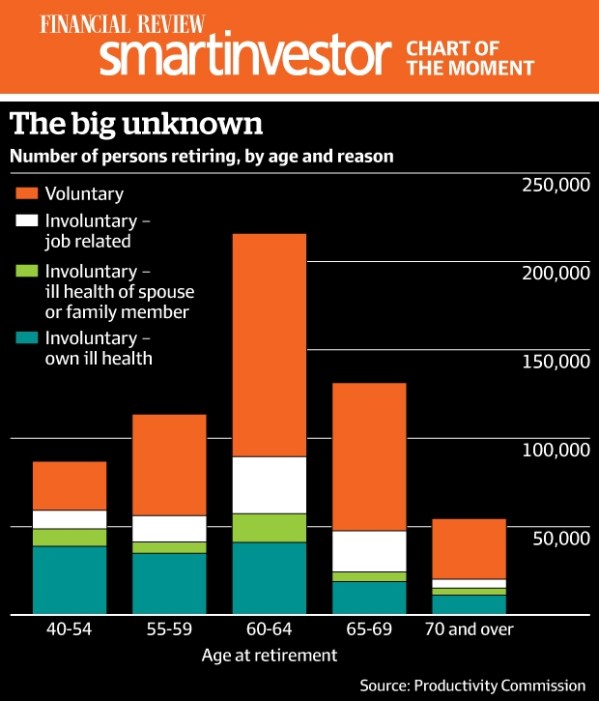
The 2015 Productivity Commission report on post-retirement shows that about 40 per cent of Australians who retire between the age of 60 and 64 do so involuntarily, either because of their own or a family member’s ill health, or redundancy.

For those aged between 65 and 69 who retire involuntarily is not that different, while for younger age groups most people who retire do so involuntarily.

Retirement ages

Clearly, workers relying on delayed retirement are rolling the dice. Yet, most people discount the future so much that they’re willing to take that gamble. May hope that an inheritance will save the day but do not realise that age care costs and parents living longer may eat heavily into any expected inheritance.

Strangely the people most likely to plan on working a few more years to boost their retirement security may actually have the least ability to postpone their retirement. People who suffer an illness or injury  are more likely than those in good health to have pushed back their expected retirement date in recent years, according to  a report from consulting firm Towers Watson. Yet health problems or disabilities were cited by more than half of retirees forced to retire earlier than planned.

Don’t put you head in the sand – start now

As psychologists are quick to point out, we all have that inner voice that loves to procrastinate who loves to put off till tomorrow what we should do today – beause its “all too hard to get your head around”. Saving more today is a sure thing, and extra years in the workforce are anything but. If you know you don’t have enough, you should start saving more today, because that’s by far the less risky alternative.

Let’s look at an example using the Retirement Planner on the MoneySmart.gov.au site for a 55-year-old pre-retiree with just $30K in superannuation. If she earns $80,000, makes $17,500 annual salary sacrifice contributions (in addition to Employers SGC contributions of 9.5%)  and earns a 7.5% return pre retirement and 6.5% after, she could be looking at an Income in retirement of $32,143 by age 67 including the Age Pension. If she’s forced to retire at that point, she’s still in better shape than most Australian’s. And if she can continue working, she  counld improve on this lifestyle with a better retirement income.

Retirement Income

A final don’t is cancelling TPD or Income Protection insurances to save money while in your most productive earning years (read here for more on that subject). The loss of 5-10 years of earnings potential is one guaranteed way to destroy your lifestyle in retirement. Your ability to earn is your biggest asset

Are you looking for an advisor that will keep you up to date and provide guidance and tips like in this blog? Then why now contact me at our Castle Hill or Windsor office in Northwest Sydney to arrange a one on one consultation. Just click the Schedule Now button up on the left to find the appointment options.

Liam Shorte B.Bus SSA™ AFP

Financial Planner & SMSF Specialist Advisor™

SMSF Specialist Adviser 

 Follow SMSFCoach on Twitter Liam Shorte on Linkedin NextGen Wealth on Facebook   

Verante Financial Planning

Tel: 02 98941844, Mobile: 0413 936 299

PO Box 6002 BHBC, Baulkham Hills NSW 2153

5/15 Terminus St. Castle Hill NSW 2154

Corporate Authorised Representative of Viridian Select Pty Ltd ABN 41 621 447 345, AFSL 51572

This information has been prepared without taking account of your objectives, financial situation or needs. Because of this you should, before acting on this information, consider its appropriateness, having regard to your objectives, financial situation and needs. This website provides an overview or summary only and it should not be considered a comprehensive statement on any matter or relied upon as such.

Seeking advice makes people proactive on super – SMSF clients even more so.


According to new research released by Mercer, superannuation fund members who obtain advice are twice as likely to make additional contributions,.

The research – released in August 2012 – said those receiving advice were also twice as likely to make a beneficiary update and five times more likely to make an insurance underwriting enquiry. (source: Money Management article on Mercer study 07/08/2012)

I will go a step further and say that of all superannuation sectors it is SMSF members and trustees who take the bull by the horns and make the most of the strategies available to them after receiving competent advice from a SMSF Specialist Advisor™. they start an SMSF to have control and flexibility but after taking advice :

  1. They are more likely to use a Transition to retirement strategy earlier after getting advice
  2. They consider retaining insurance in a separate fund to save fees or transfer the cover rather than simply letting it lapse on rollover.
  3. They are more proactive about seeking out lost super funds
  4. They are more likely to have multiple pensions segregating tax free amounts for estate planning.
  5. They are focused on maximising the potential of the concessionally tax structure by investing in high yield and highly franked investments.
  6. They are more likely to adjust their portfolios tactically to take advantage of the change in market cycles.
  7. They are more focused on getting the best rate for their cash and fixed interest investments rather than accepting the offer from the current provider.
  8. More likely to use Super Splitting to even up accoutn balances and protect against future legislative change
  9. They can learn the benefits of recontribution strategies for Estate Planning.

So if you have an SMSF or indeed a retail or industry superannuation fund go and take some advice as it opens your eyes to the potential strategies available to you no matter your age, assets or experience.

For those who have benefited from advice or are advisors, I challenge you to add other benefits to this list (leave a comment) so others can learn.

Feedback always appreciated. Please reblog, retweet, put on your Facebook page etc to make sure we get the news out there to seek advice.

Liam Shorte B.Bus SSA™ AFP

Financial Planner & SMSF Specialist Advisor™

SMSF Specialist Adviser 

 Follow SMSFCoach on Twitter Liam Shorte on Linkedin NextGen Wealth on Facebook   

Verante Financial Planning

Tel: 02 98941844, Mobile: 0413 936 299

PO Box 6002 BHBC, Baulkham Hills NSW 2153

5/15 Terminus St. Castle Hill NSW 2154

Corporate Authorised Representative of Viridian Select Pty Ltd ABN 41 621 447 345, AFSL 51572

This information has been prepared without taking account of your objectives, financial situation or needs. Because of this you should, before acting on this information, consider its appropriateness, having regard to your objectives, financial situation and needs. This website provides an overview or summary only and it should not be considered a comprehensive statement on any matter or relied upon as such.

How is your SMSF protected in the event of bankruptcy?


If you or your business is experiencing financial difficulty and bankruptcy is the likely outcome, you should consider carefully what impact this may have on your self-managed super fund and superannuation accounts before accessing them under any condition fo release.

How does bankruptcy affect your SMSF?

Should you become an insolvent under administration, such as an undischarged bankrupt or have entered a personal insolvency agreement with your creditors, the super laws consider you to be a ‘disqualified person’. This has ramifications for your self managed super fund because a disqualified person can’t act as, or become, a trustee of an SMSF or a director of an SMSF’s corporate trustee.

Steps to take before entering bankruptcy:

We know in circumstances like this you may be under a weight of paperwork and pressure but you should take action to preserve what you can.

  1. If you’re an existing trustee/director of an SMSF, the best option would be to resign from this role before becoming a “disqualified person”. If you don’t, and continue to act in this role, you and your SMSF may be liable for penalties or  your SMSF could lose its complying status which would  result in lost tax concessions and a harsh tax bill for your fund. You may also be liable for a fine and up to two years’ imprisonment.
  1. You must take action to ensure your SMSF continues to meet the basic condition that all fund members are also trustees/directors. You have a grace period of six months to consider your options, which include :
  • rolling your benefits to a retail or industry super fund or
  • converting your SMSF to a small APRA fund whereby an “approved trustee” takes over the running of the fund.

The best option for you will depend on your particular circumstances such as the investment mix within your fund, the liquidity of the assets in that portfolio as well as the potential capital gains tax payable on realising assets and the wishes of other fund members such as your spouse.

Are your SMSF assets protected?

A bankrupt’s entire interest in a regulated super fund is potentially protected from creditors.

This protection has a couple of important limitations. Bankruptcy legislation states that a contribution made after 27 July 2006 to a super fund can be ‘clawed back’ if the main purpose was either to prevent the transferred property being available to creditors or to hinder or delay the process of making property available for division among creditors.

Under the rules, a transaction is assumed to be made for this purpose if at the time of the transfer, you were, or were about to become, insolvent. It is therefore critical that you make, and keep, records to prove that you’re solvent at the time of making a contribution to prevent your contributions being clawed back.

Any transactions that are ‘out of character’ may also be seen to be made for the main purpose of defeating creditors. For example, if you salary sacrificed $1,000 per month for the past 5 years, it would be unlikely that the $1,000 contributed in each of the final months before becoming bankrupt would be considered out of character and clawed back. In contrast, if you made a once-off contribution of $100,000 in the week before declaring bankruptcy, it’s likely you would have to prove why this amount should not be made available to creditors.

Case Law Example:

Official Trustee in Bankruptcy v Trevor Newton Small Superannuation Fund Pty (an SMSF fund)

In the Official Trustee in Bankruptcy v Trevor Newton Small Superannuation Fund Pty Ltd (2001) 114 FCR 160; [2001] FCA 1267, Madgwick J determined that the potential for a payment to a superannuation fund to be caught by the relation back or avoidance provisions of the Act was not excluded by the protection provided to the bankrupt’s interest in a superannuation fund even though such a payment might give rise to an interest in the fund.

It could be said that the protection operates in favour of any lawful interest in a regulated superannuation fund.

In this case one payment was made by the debtor after the deemed commencement of his bankruptcy and as such was recoverable. This is because the money had already vested in the hands of the bankruptcy trustee and accordingly the debtor did not have the authority to deal with it. The SMSF trustee (keeping in mind it was an SMSF and the bankrupt was a director of the SMSF trustee) was taken to be aware of that lack of authority and therefore did not derive title to the moneys paid.

Two earlier payments prior to the commencement of bankruptcy were voidable by reason of the operation of section 121 (transfers to defeat creditors). It assisted this recovery that at the time of both earlier transfers the debtor was or was about to become insolvent, and the superannuation fund trustee (the bankrupt being a director of the SMSF trustee) was also aware of this.

In summary an SMSF trustee is unlikely not to know the purposes or intent of the member (or third party) making the contributions. In addition the SMSF trustee is likely to know the solvency or otherwise of the relevant member.

Recovery of void contributions

A bankruptcy trustee is able to make an application to the Court directly under section 128B or 128C of the Bankruptcy Legislation Amendment (Superannuation Contributions) Act 2007 to recover a void superannuation contribution. In addition, a bankruptcy trustee can request the Official Receiver to issue a notice under section 139ZQ for the recovery of a void contribution on the same basis as these notices are available to recover other void transfers of property.

The Act also includes provisions enabling some tracing, by the Court, of superannuation contributions through the superannuation system. This is important particularly where the contribution may have been rolled-over and is no longer in the plan which originally received it.

Can you access your Superannuation early because you are a bankrupt?

Funds held in and payments made from your superannuation are protected from your creditors under the Bankruptcy Act. In certain limited circumstances you may be able to access your superannuation early, such as severe financial hardship.

However, the fact you are bankrupt does not mean that you will automatically be entitled to get early access to your superannuation. Bankruptcy is not on its own a ground for the early release of your super. It is up to your superannuation provider or APRA to decide whether to grant early access to your super and they should be consulted if you believe you have grounds for early release of your funds.

If you are granted early access to your super the lump sum payments from your superannuation fund made on or after the date of bankruptcy will be protected from your creditors.

What about pension payments? Are they protected?

If your total annual income exceeds a certain amount, half the excess will typically becomes available to pay your creditors. The relevant income thresholds are shown in the table below:

Actual Income Threshold Amount (AITA) With dependants Used when calculating a bankrupt’s income contributions which vary according to the number of dependants
Number of Dependents

 Income Limit

0

$56,674.80

1

$66,876.26

2

 $71,977.00

 3

 $74,810.74

 4

 $75,944.23

 Over 4

$77,077.73

Limits updated twice a year: 20 March and 20 September. 

Source: Insolvency & Trustee Service Australia. INDEXED AMOUNTS as of  09/07/2018

Income counted towards these thresholds includes salary and wages, salary sacrifice, fringe benefits from your employer and income which you earn which is paid to someone else. Pension income from a superannuation fund is also counted as income. In contrast, lump sum payments mentioned earlier from your superannuation fund are not counted as income and are protected even if you’re bankrupt.

STRATEGY TIP:

Given this protection in respect to lump sums, it may often be more beneficial to keep your super balance in the “accumulation phase” during the bankruptcy period and only make lump sum withdrawals if additional cash is required.

So as you can see while In cases where bankruptcy is unavoidable, most of your assets will be divisible among your creditors, fortunately, your superannuation balance and lump sum withdrawals are generally protected. Taking pre-emptive action and seeking expert advice if you’re facing financial troubles may help protect your Self Managed Super Fund and preserve some of your wealth for retirement.

Me on My High Horse! This protection should also act as a solid reason for all business owners to regularly contribute to superannuation throughout their working lives as circumstances can change rapidly. While your business may in your mind be your idea of your retirement savings, it may offer no protection in difficult times so put money away outside of your business structure to protect you and your family.

What about circumstances where the asset of the SMSF is in the wrong name because we made an error when setting up an account or used a Trading company as the Trustee of our SMSF (Idiot, kick yourself in the ass first):

See my blog on Trading Company as SMSF Trustee or Sole Purpose SMSF Trustee Company? To see why you never should use a Trading company.

Now back to the issue. Let’s consider the situations where a business has become bankrupt (wound up?) and the court tries to link assets held in the name of the business entity in its/their capacity as Trustee of the SMSF to the bankruptcy action?

Example:  Property is purchased by the SMSF but for whatever reason is held in the name of the trading company or individual trustees; or

Possible solution in most cases: A Declaration of Trust outlining beneficial ownership should be prepared contemporaneously with the purchase of the property or asset. You must seek legal advice on how to word this document but it should include:

Declaration as to who is the beneficial owner

Who provided the funds for the investment.

That the beneficial owner is entitled to any benefits and always has been

The Beneficial owner has the right to transfer ownership to any other entity

All actions are taken on the instructions of the SMSF

As I said above seek legal advice on how to word this and do not attempt any half baked efforts from Googling!

Looking for an adviser that will keep you up to date and provide guidance and tips like in this blog? Then why now contact me at our Castle Hill or Windsor office in Northwest Sydney to arrange a one on one consultation. Just click the Schedule Now button up on the left to find the appointment options. Do it! make 2016 the year to get organised or it will be 2026 before you know it.

Please consider passing on this article to family or friends. Pay it forward!

Liam Shorte B.Bus SSA™ AFP

Financial Planner & SMSF Specialist Advisor™

SMSF Specialist Adviser 

 Follow SMSFCoach on Twitter Liam Shorte on Linkedin NextGen Wealth on Facebook   

Verante Financial Planning

Tel: 02 98941844, Mobile: 0413 936 299

PO Box 6002 BHBC, Baulkham Hills NSW 2153

5/15 Terminus St. Castle Hill NSW 2154

Corporate Authorised Representative of Viridian Select Pty Ltd ABN 41 621 447 345, AFSL 51572

This information has been prepared without taking account of your objectives, financial situation or needs. Because of this you should, before acting on this information, consider its appropriateness, having regard to your objectives, financial situation and needs. This website provides an overview or summary only and it should not be considered a comprehensive statement on any matter or relied upon as such.