



How you can Fund Children’s Education in your Will


Education Funding

Well this blog is not about Self Managed Super Funds but is about a matter close to the hearts of many of my clients. As a parent or grandparent, ensuring that children receive a good education is one of the most common concerns raised with us at Verante. Many people want to leave provision in their wills for such costs so here is one of our preferred strategies.

You can establish a dedicated education fund through a testamentary trust in your Will. This is a tax-effective and flexible way to provide for the education of your children or grandchildren. It can also help to ensure that the funds you want to be applied for their education are preserved and not misused by young beneficiaries or caught up in the complications caused by the rise of complicated blended families (his, hers and ours issues).

If you are a grandparent, leaving bequests via a testamentary trust for payment of education fees and related costs for your grandchildren is a more tax effective method of providing for their education rather than leaving additional bequests to their parents that may be caught up in marriage breakdowns, business bankruptcy or litigation.

What is a testamentary trust?

In general, a trust describes an ownership structure where the assets of the trust are held by a person or organisation (the trustee) for the benefit of other individuals or organisations (the beneficiaries).

A testamentary trust is a trust that is created within and by your Will. You need to arrange it as part of your Will making but it only comes in to effect on your death.

A testamentary trust may be created using specified assets, a designated portion of your estate or the entire remaining balance of your estate. Multiple trusts may be created by the one Will.

Normally the Trustee of this trust will be the executor of your estate, a surviving spouse or sibling of the deceased. You also have the option of appointing an Independent trustee company. Often this trustee will step down when the beneficiary reaches a target age or completes their education.

What is an education fund?

Assets inherited directly by your beneficiaries become part of their personal assets and are under their control. The future of these assets depends on the beneficiary’s ability to manage their own financial affairs, with no guarantee that the assets will be applied for any particular purpose, such as their education.

An education fund is a trust which focuses on funding the education of a particular beneficiary (the ‘primary beneficiary’). It gives you assurance that the income of the trust will be directed to the educational and other purposes you have specified in your Will.

You set the terms of the testamentary trust in your will. These terms can restrict the ability of any of the beneficiaries to control the activities and investments of the trust or give them complete control. You are in effect choosing to ‘rule from the grave’ to ensure that the inherited assets are protected and used sensibly for the benefit of the primary beneficiary

How does an education fund operate?

The typical features included in an education fund are:

  • The trust can be funded by your some or all of your assets and by payments in consequence of your death such as superannuation death benefits or insurance proceeds paid to your estate.
  • A proportion of your estate is held on trust until the primary beneficiary (child/children) achieves a particular level of education or satisfies other conditions established in your Will. Many of our clients choose age 25.
  • The trustee has the power to apply the income and capital of the trust for a variety of purposes specified in your Will for the benefit of the primary beneficiary, with the emphasis being on the educational needs of the primary beneficiary.
  • During the financial year, income and capital are distributed to the primary beneficiary to the extent required for the approved purposes. Any remaining income is either accumulated within the trust or distributed to other beneficiaries, as directed by the Will.
  • When the primary beneficiary has satisfied the conditions specified in the Will (such as attaining a particular level of education or age), they gain control of the remaining balance in the education fund and may either continue the trust or vest it (end it) at any time.
  • If the primary beneficiary fails to satisfy the conditions within a specified period, the trustee may determine that the remaining balance in the education fund be distributed to other beneficiaries named in the Will or held on trust for the education of those beneficiaries (or their descendants).

An education fund will normally be a mandatory trust imposed upon the beneficiary due to your desire that they continue their education to a specified level. The beneficiary will not normally be given the option of terminating the trust or eventually inheriting the trust without satisfying specified conditions.

Example

George and Helen have a combined estate worth $1,500,000. They have three young grandchildren whom they wish to make their beneficiaries as they had already helped their children to set themselves up as financially secure.

George and Helen are concerned that, in the event of their deaths, their grandchildren will not be sufficiently mature to use their inheritance responsibly. They wish to establish an education fund to ensure that the grandchildren are encouraged to further their education, but are also adequately provided for during their developing years.

As a result, George and Helen’s Wills provide that 50 per cent of the inheritance received by a child ($250,000 each) will be held in testamentary trust funds on the following terms:

  • Until the beneficiary turns 25, their access to the income and capital of the trust is limited to specified purposes, such as:
    • education expenses, including HECS liabilities
    • hospital and medical expenses
    • rent or accommodation charges
    • electricity, gas and other utility payments
    • maintenance and income support at the discretion of the trustee.
  • If a specified level of tertiary education has been completed by the age of 25, the beneficiary will be given full control of the trust at the time of attaining that educational level, with the ability to either continue the trust for tax planning purposes (as a tax-effective vehicle for supporting the education of their own children) or terminate it.
  • If the beneficiary does not attain the required level of education by the age of 25, the remaining balance of the education fund will be distributed amongst charities specified in the Wills.

beneficiaries-flow-chart

The education funds will ensure that each child is adequately supported, but also given an incentive to further their education. If all children were from the one family you could use just one Trust.

Additional issues to discuss with your legal expert

Common areas which require further thought are:-

  • Whether to have one or several Trusts established under the Will
  • The selection of the appropriate trustee or trustees
  • The method of appointing replacement trustees
  • Whether some classes of beneficiaries are restricted to income and some to capital

Back-up Strategy

There is a second chance for your family to establish a testamentary trust after you die but this second chance must be taken advantage of within three years of your death. This enables a trust to be established from your assets and for the income to enjoy the same tax advantages as income derived through a testamentary trust. However, the assets used to establish the trust cannot exceed the amount which the beneficiary would have received under the law, if you died without a Will.

I hope this guidance has been helpful and please take the time to comment. Feedback always appreciated. Please reblog, retweet, like on Facebook etc to make sure we get the news out there. As always please contact me if you want to look at your own options or get a referral do a recommended Estate Planning solicitor. We have offices in Castle Hill and Windsor but can meet clients anywhere in Sydney or via Skype. Just click the Schedule Now button up on the left to find the appointment options.

Liam Shorte B.Bus SSA™ AFP

Financial Planner & SMSF Specialist Advisor™

SMSF Specialist Adviser 

 Follow SMSFCoach on Twitter Liam Shorte on Linkedin NextGen Wealth on Facebook   

Verante Financial Planning

Tel: 02 98941844, Mobile: 0413 936 299

PO Box 6002 BHBC, Baulkham Hills NSW 2153

5/15 Terminus St. Castle Hill NSW 2154

Corporate Authorised Representative of Viridian Select Pty Ltd ABN 41 621 447 345, AFSL 51572

This information has been prepared without taking account of your objectives, financial situation or needs. Because of this you should, before acting on this information, consider its appropriateness, having regard to your objectives, financial situation and needs. This website provides an overview or summary only and it should not be considered a comprehensive statement on any matter or relied upon as such.

Image courtesy of Stuart Miles at FreeDigitalPhotos.net

Reminder: Minimum annual payments for Superannuation Income Streams in 2014 / 15 including SMSF Pensions.


Yes the Government have been messing about with the system so much over the last few years that many clients have been totally confused and had to confirm their minimum pension payments for last year so I thought I would just remind everyone of this years limits so they can put their payment plans in place.

How much to take to stay compliant with your pension

How much to take to stay compliant with your pension

If you started a pension or annuity on or after 1 July 2007, a minimum pension amount is required to be paid each year. There is no maximum amount other than the balance of your super account, unless it is a transition to retirement pension in which case the maximum amount is 10% of the account balance.

The minimum payment amounts will not be reduced for the  2014-15 year. The following table shows the minimum percentage factor (indicative only) for each age group.

Age

Minimum % withdrawal (2014-15)

Under 65

4%

65-74

5%

75-79

6%

80-84

7%

85-89

9%

90-94

11%

95 or more

14%

Note that these withdrawal factors are indicative only. To determine the precise minimum annual payment (especially for market linked income streams), see the pro-rating, rounding and other rules in the Superannuation Industry (Supervision) Regulations 1994.

For rules and limits on other Payments from super here are the relevant links to the ATO site.

Low rate cap amount

Untaxed plan cap amount

Minimum annual payments for super income streams

Preservation age

Super lump sum tax table

Super income stream tax tables

Are you looking for an advisor that will keep you up to date and provide guidance and tips like in this blog? Then why not contact me at our Castle Hill or Windsor office in Northwest Sydney to arrange a one on one consultation. Just click the Schedule Now button up on the left to find the appointment options. Please reblog, retweet, put on your Facebook page if you found information helpful.

Liam Shorte B.Bus SSA™ AFP

Financial Planner & SMSF Specialist Advisor™

SMSF Specialist Adviser 

 Follow SMSFCoach on Twitter Liam Shorte on Linkedin NextGen Wealth on Facebook   

Verante Financial Planning

Tel: 02 98941844, Mobile: 0413 936 299

PO Box 6002 BHBC, Baulkham Hills NSW 2153

5/15 Terminus St. Castle Hill NSW 2154

Corporate Authorised Representative of Viridian Select Pty Ltd ABN 41 621 447 345, AFSL 51572

This information has been prepared without taking account of your objectives, financial situation or needs. Because of this you should, before acting on this information, consider its appropriateness, having regard to your objectives, financial situation and needs. This website provides an overview or summary only and it should not be considered a comprehensive statement on any matter or relied upon as such.

Don’t lose your insurance cover in the haste to rollover to a SMSF.


Just because you are unhappy with your superannuation investment results is no reason to put you or your family’s future at risk by losing your insurance cover in the process of changing.

don't lose your insurance in a rollover to SMSF

A good professional like an SMSF Specialist Advisor™ will always ensure you assess your insurance needs before withdrawing.

This issue is becoming even more relevant now that the new SMSF rules require Trustees to consider the member’s insurance needs regularly. See here for more detail.

Ok, so you have decided to start your own Self Managed Super Fund or move to one that you feel better meets your needs. That is fine, but one of the things you should look at doing is protecting any cover you have in your current fund by either keeping some money in your current fund to pay for ongoing insurance premiums or taking out replacement insurance cover in the name of your new SMSF.  (more…)

Don’t depend on working longer to save for your Retirement Income


Looking to RetirementMany clients believe delaying their retirement is a solution to inadequate savings, but they often find themselves out of the workforce sooner than they’d planned. None of us has that crystal ball!

It is likely that the shortfall in retirement savings here in Australia stems in part from our “she’ll be right” attitude towards life, which leads us to believe that we do not need to start saving early and that somehow it will all work out ok.

Delaying retirement can be a powerful boost to your superannuation nest-egg. But relying on the ability to work for a few extra years to stretch retirement savings out a little longer is fraught with risk and does not reflect personal and family health or other issues that may arise. As an example I have had some clients forced to retire to look after their grandchildren due to the illness of the parent.

If you played with any retirement planning calculator or have spoken to an adviser, the “work a little longer” solution would have been investigated and many put it forward as the solution to the GFC “dip” (read plunge) in savings.

The concept is easy to grasp: By working longer then you originally planned, you get more years of concessionally taxed growth in your superannuation accounts especially if you used a Transition to Retirement Pension from 55 or 60. You can also continue to salary sacrifice and make non-concessional contributions while getting the benefit of the Senior And Pensioners Tax Offset (SAPTO) that I mentioned a few weeks ago here.

The idea is the longer you work and save and more you get into a superannuation income stream then your capital will last longer and you may also benefit from more Age Pension when required.

Back to reality with a jolt!

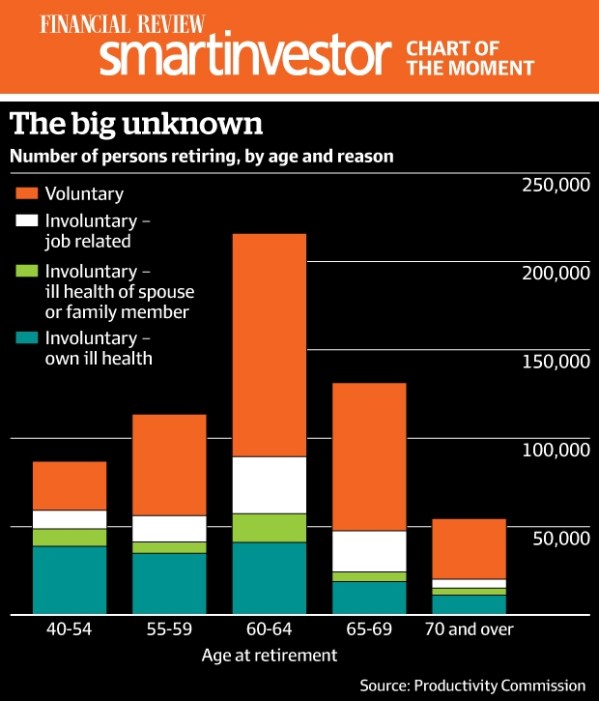
But there is a huge disconnect between workers’ expectations and retirement reality. Over half of the retirees surveyed in a US study last year said they left the workforce earlier than planned, and just 8% of them said that positive factors — such as the ability to afford early retirement — prompted the move. For the vast majority of early retirees, negative circumstances, such as personal or spouse health problems or company downsizing played a role.

40% of Australians will suffer a critical illness before age 65 (Cologne Life Re study). They will most likely survive but their retirement funding will be devastated.

The 2015 Productivity Commission report on post-retirement shows that about 40 per cent of Australians who retire between the age of 60 and 64 do so involuntarily, either because of their own or a family member’s ill health, or redundancy.

For those aged between 65 and 69 who retire involuntarily is not that different, while for younger age groups most people who retire do so involuntarily.

Retirement ages

Clearly, workers relying on delayed retirement are rolling the dice. Yet, most people discount the future so much that they’re willing to take that gamble. May hope that an inheritance will save the day but do not realise that age care costs and parents living longer may eat heavily into any expected inheritance.

Strangely the people most likely to plan on working a few more years to boost their retirement security may actually have the least ability to postpone their retirement. People who suffer an illness or injury  are more likely than those in good health to have pushed back their expected retirement date in recent years, according to  a report from consulting firm Towers Watson. Yet health problems or disabilities were cited by more than half of retirees forced to retire earlier than planned.

Don’t put you head in the sand – start now

As psychologists are quick to point out, we all have that inner voice that loves to procrastinate who loves to put off till tomorrow what we should do today – beause its “all too hard to get your head around”. Saving more today is a sure thing, and extra years in the workforce are anything but. If you know you don’t have enough, you should start saving more today, because that’s by far the less risky alternative.

Let’s look at an example using the Retirement Planner on the MoneySmart.gov.au site for a 55-year-old pre-retiree with just $30K in superannuation. If she earns $80,000, makes $17,500 annual salary sacrifice contributions (in addition to Employers SGC contributions of 9.5%)  and earns a 7.5% return pre retirement and 6.5% after, she could be looking at an Income in retirement of $32,143 by age 67 including the Age Pension. If she’s forced to retire at that point, she’s still in better shape than most Australian’s. And if she can continue working, she  counld improve on this lifestyle with a better retirement income.

Retirement Income

A final don’t is cancelling TPD or Income Protection insurances to save money while in your most productive earning years (read here for more on that subject). The loss of 5-10 years of earnings potential is one guaranteed way to destroy your lifestyle in retirement. Your ability to earn is your biggest asset

Are you looking for an advisor that will keep you up to date and provide guidance and tips like in this blog? Then why now contact me at our Castle Hill or Windsor office in Northwest Sydney to arrange a one on one consultation. Just click the Schedule Now button up on the left to find the appointment options.

Liam Shorte B.Bus SSA™ AFP

Financial Planner & SMSF Specialist Advisor™

SMSF Specialist Adviser 

 Follow SMSFCoach on Twitter Liam Shorte on Linkedin NextGen Wealth on Facebook   

Verante Financial Planning

Tel: 02 98941844, Mobile: 0413 936 299

PO Box 6002 BHBC, Baulkham Hills NSW 2153

5/15 Terminus St. Castle Hill NSW 2154

Corporate Authorised Representative of Viridian Select Pty Ltd ABN 41 621 447 345, AFSL 51572

This information has been prepared without taking account of your objectives, financial situation or needs. Because of this you should, before acting on this information, consider its appropriateness, having regard to your objectives, financial situation and needs. This website provides an overview or summary only and it should not be considered a comprehensive statement on any matter or relied upon as such.

Skeletons in the Cupboards and Tax Man at the Door – Estate Planning Solutions for SMSF members


Here is one solution to a big problem that may become more common with blended families and increased divorce as well as de facto arrangements.     SMSF Estate Planning

Our client , lets call him , Scott (age 78) is a widower in the Hills district and he has a $652,000 account based pension (containing a 100% taxable component to keep it simple). His two adult daughters who are financially independent are noted as 50/50 beneficiaries on his non-lapsing binding death benefit nomination (see here for more details). Any lump sum death benefit they receive will be subject to 17 per cent tax. In dollar terms, this is $110,500 (calculation: $652,000 x 17%) and he wasn’t too happy about this.

Scott was advised by his specialist he has 2-3 years maximum to live due to an aggressive cancer. He threw this curly one at me to come up with a strategy as he wants to maximise his estate for his kids but also retain access to the funds while alive to fund medical and living expenses. Our strategy involves Scott taking a tax-free withdrawal from his account based pension. He then let me know about some skeletons he had in his cupboard!

Scott could retain these funds within a bank account, however the account will form part of his estate upon his death. Even though his estate will be paid predominately to his adult daughters, he is concerned about his estranged son from an affair he had in his late 50’s who might challenge the Will.

We advised that a valid alternative available to Scott is to invest into an investment bond with himself as the owner and the life insured. Since an investment bond is a non-estate asset, upon his death the funds will be paid tax-free to his adult daughters.

Both strategies will avoid the $110,500 of death benefits tax on funds paid to his daughters, however only the investment bond will ensure the funds do not become part of his estate. Scott’s two daughters need only produce a copy of his death certificate to gain access to the funds within the bond. This could also avoid lengthy delays with the administration of the estate and overcome possible estate challenges from his estranged son.

In terms of costs we were looking at foregoing the tax-free status in pension phase for the 2 years but that was far outweighed by the savings in the death benefits tax and we are actually able to wind up the SMSF  to save his children the hassle of dealing with that later.

For further information on the issues raised in this blog please contact our Castle Hill SMSF Centre or Windsor Financial Planning Office or choose an appointment option here 

I hope this guidance  has been helpful and please take the time to comment. Feedback always appreciated. Please reblog, retweet, put on your Facebook page if you found information helpful.

Liam Shorte B.Bus SSA™ AFP

Financial Planner & SMSF Specialist Advisor™

SMSF Specialist Adviser 

 Follow SMSFCoach on Twitter Liam Shorte on Linkedin NextGen Wealth on Facebook   

Verante Financial Planning

Tel: 02 98941844, Mobile: 0413 936 299

PO Box 6002 BHBC, Baulkham Hills NSW 2153

5/15 Terminus St. Castle Hill NSW 2154

Corporate Authorised Representative of Viridian Select Pty Ltd ABN 41 621 447 345, AFSL 51572

This information has been prepared without taking account of your objectives, financial situation or needs. Because of this you should, before acting on this information, consider its appropriateness, having regard to your objectives, financial situation and needs. This website provides an overview or summary only and it should not be considered a comprehensive statement on any matter or relied upon as such.

Seeking advice makes people proactive on super – SMSF clients even more so.


According to new research released by Mercer, superannuation fund members who obtain advice are twice as likely to make additional contributions,.

The research – released in August 2012 – said those receiving advice were also twice as likely to make a beneficiary update and five times more likely to make an insurance underwriting enquiry. (source: Money Management article on Mercer study 07/08/2012)

I will go a step further and say that of all superannuation sectors it is SMSF members and trustees who take the bull by the horns and make the most of the strategies available to them after receiving competent advice from a SMSF Specialist Advisor™. they start an SMSF to have control and flexibility but after taking advice :

  1. They are more likely to use a Transition to retirement strategy earlier after getting advice
  2. They consider retaining insurance in a separate fund to save fees or transfer the cover rather than simply letting it lapse on rollover.
  3. They are more proactive about seeking out lost super funds
  4. They are more likely to have multiple pensions segregating tax free amounts for estate planning.
  5. They are focused on maximising the potential of the concessionally tax structure by investing in high yield and highly franked investments.
  6. They are more likely to adjust their portfolios tactically to take advantage of the change in market cycles.
  7. They are more focused on getting the best rate for their cash and fixed interest investments rather than accepting the offer from the current provider.
  8. More likely to use Super Splitting to even up accoutn balances and protect against future legislative change
  9. They can learn the benefits of recontribution strategies for Estate Planning.

So if you have an SMSF or indeed a retail or industry superannuation fund go and take some advice as it opens your eyes to the potential strategies available to you no matter your age, assets or experience.

For those who have benefited from advice or are advisors, I challenge you to add other benefits to this list (leave a comment) so others can learn.

Feedback always appreciated. Please reblog, retweet, put on your Facebook page etc to make sure we get the news out there to seek advice.

Liam Shorte B.Bus SSA™ AFP

Financial Planner & SMSF Specialist Advisor™

SMSF Specialist Adviser 

 Follow SMSFCoach on Twitter Liam Shorte on Linkedin NextGen Wealth on Facebook   

Verante Financial Planning

Tel: 02 98941844, Mobile: 0413 936 299

PO Box 6002 BHBC, Baulkham Hills NSW 2153

5/15 Terminus St. Castle Hill NSW 2154

Corporate Authorised Representative of Viridian Select Pty Ltd ABN 41 621 447 345, AFSL 51572

This information has been prepared without taking account of your objectives, financial situation or needs. Because of this you should, before acting on this information, consider its appropriateness, having regard to your objectives, financial situation and needs. This website provides an overview or summary only and it should not be considered a comprehensive statement on any matter or relied upon as such.

Understanding transition to retirement pensions


If you have reached your preservation age you can use a transition to retirement pension to access your superannuation as a non-commutable income stream while you are still working. This may be particularly attractive if you have reduced your working hours and need to top-up your income to maintain your standard of living.

There was another great benefit of setting up the pension which was that all the funds supporting the pension move in to a tax exempt status. Yes that means those funds paid no earnings tax and in fact they received a full refund of any franking credits on your investments. For the average investor this can increase your returns by 0.5% to 1% a year risk free every year! However that tax free status was removed as of 1 July 2017.

The strategy still remains effective for those needing a boost in income or those who can combine the pension with salary sacrifice.

What is a transition to retirement pension?

Transition to retirement pensions allow you to access your superannuation as a non-commutable income stream, after reaching preservation age (see below), but while you are still working.

The aim of these income streams is to provide you with flexibility in the lead up to retirement. For example, you may choose to reduce your working hours and at the same time access your superannuation as a transition to retirement pension that can supplement your other income. It may also allow you to salary sacrifice to give your retirement savings a boost.

Not all superannuation funds offer the transition to retirement pensions, so you need to check with your own fund to see if they do. You can also start one in a self-managed superannuation fund.

Are there any special characteristics?

These pensions are essentially like a normal account-based pension, but with two important differences.

Firstly, they are non-commutable, which means they cannot be converted into a lump sum until you satisfy a condition of release, such as retirement or age 65.

Secondly, you have a minimum pension amount you must withdraw each year but you can only withdraw up to 10% of the account balance (at 1 July). No lump sum withdrawals are allowed.

What is my preservation age?

Your preservation age is generally the date from which you can access your superannuation benefits and depends upon your date of birth.

Date of birth Preservation Age
Before 1 July 1960 55
1 July 1960 – 30 June 1961 56
1 July 1961 – 30 June 1962 57
1 July 1962 – 30 June 1963 58
1 July 1963 – 30 June 1964 59
After 30 June 1964 60

How are transition to retirement pensions taxed?

Transition to retirement pensions are taxed the same as regular superannuation income streams.

If you are under age 60, the taxable part of your pension will be taxed at your marginal rate, but you receive a 15% tax offset if your pension is paid from a taxed source*.

However, once you reach 60, your pension is tax-free if paid from a taxed source*.

  • Most people belong to a taxed superannuation fund. Some government superannuation funds may be untaxed and you will pay higher tax on pensions.

Can you still contribute to superannuation?

As long as you are eligible to contribute, you and your employer can still contribute to superannuation for your benefit. In any case, your employer’s usual superannuation guarantee obligations would still apply. You need to have an accumulation account to pay these amounts into.

Is a transition to retirement pension right for you?

Transition to retirement pensions can provide you with flexibility in the years leading up to your retirement and can help to boost your retirement savings in some circumstances.

People who might find the transition to retirement pensions attractive include those who:

  • have reduced working hours from full-time to part-time, eg down to three days per week. The reduced salary can be topped up with income from the transition to retirement pension
  • are able to salary sacrifice to your superannuation or your spouse’s super for tax savings – the outcome of combining the transition to retirement pension with salary sacrifice can be a greater build-up of superannuation savings by the time you reach actual retirement

The transition to retirement rules and associated strategies can be very complicated. It is recommended that you seek expert advice from your financial adviser before deciding if this type of income stream and strategy is right for you.

Want a Superannuation Review or are you just looking for an adviser that will keep you up to date and provide guidance and tips like in this blog? Then why now contact me at our Castle Hill or Windsor office in Northwest Sydney to arrange a one on one consultation. Just click the Schedule Now button up on the left to find the appointment options. Do it! make this year the year to get organised or it will be 2030 before you know it.

Please consider passing on this article to family or friends. Pay it forward!

Liam Shorte B.Bus FSSA™ AFP

Financial Planner & SMSF Specialist Advisor™

SMSF016_Fellow_Logo_CMYK

 color logo with background_page_1-3-1

Tel: 02 9899 3693, Mobile: 0413 936 299

PO Box 6002 BHBC, NORWEST NSW 2153

40/8 Victoria Ave , CASTLE HILL NSW 2154

Suite 4/1 Dight St, Windsor NSW 2765

Corporate Authorised Representative of Viridian Advisory Pty Ltd (ABN 34 605 438 042) (AFSL 476223)

This information has been prepared without taking account of your objectives, financial situation or needs. Because of this you should, before acting on this information, consider its appropriateness, having regard to your objectives, financial situation and needs. This website provides an overview or summary only and it should not be considered a comprehensive statement on any matter or relied upon as such.

Tax Planning for Small Business owners over 55


EOFY Tax Tips for Small Business

Business Owner Tax Tip

Welcome to my first attempt at a blog with an idea for end of year tax planning aimed specifically at Small/Medium Business Owners.

Ok, so you run your own business and are finally making a profit even if it is just on paper. Now you are looking at your tax position for the current year before June 30th just like you have been encouraged to do. You have spoken to your accountant and know you have a forecast profit for the year after deductions of say $25,000 in your small company after already taking a decent salary for living expenses. Well at the 30% corporate rate the tax will be $7500. But hey, your business does not have that sort of cash in the bank? you have used the profits to plough back in to more stock or equipment for your business.

Here is a strategy for over 55’s to consider if they have a cashflow shortfall for June 30th tax planning.  Look at your Superannuation and if you have not moved into Transition to Retirement Phase you could arrange to do so and access up to 10% of your balance before June 30th as a pension. Lets assume you had $200,000 in Super so you could access $20,000 this year.

You could then lend the money to your company via a shareholders loan and the company could use the funds to make a tax deductible employer contribution back into your superannuation. why you ask?

Well the company gets a tax deduction of $20K reducing its tax bill from $7500 to $1500…..Nice! Now you pay 15% contributions tax on these concessional contributions so of the $20,000 you pay tax of $3000. so overall you save $3000 in tax and you have moved $20,000 from your company into your retirement savings.

Now as you have taken the pension, if you are over 55 but under 60 you need to add this to your taxable income…but the nice government give you a 15% Pension tax offset to reduce the tax payable. Once over 60 you do not need to report it in your income so an even better outcome (has to be at least one benefit of getting older!)

Any other benefit of this strategy?

By moving the $200,000 to Pension Phase any further earnings or capital gains are now exempt income and you pay Nil (0%) tax in your superannuation pension on those earnings. So if your fund earned 5% for the year or $10,000 you save an extra $1500 per year. Better still , if your super fund is invested in shares and received franked dividends your fund will get a refund from the taxman of those franking credits…bonus!

As you now have a shareholder loan to your company you can have the company repay you that loan during the next year rather than taking a higher taxable salary from the company and thereby reducing your marginal tax rate.

Things to check :

  • your age – you have to have reached your preservation age which is now rising towards 60- check here

Preservation age

Access to super benefits is generally restricted to members who have reached preservation age. A person’s preservation age ranges from 55 to 60, depending on their date of birth.

Date of birth Preservation age
(years)
Before 1 July 1960 55
1 July 1960 – 30 June 1961 56
1 July 1961 – 30 June 1962 57
1 July 1962 – 30 June 1963 58
1 July 1963 – 30 June 1964 59
After 30 June 1964 60
  • your tax position personally and via your company or business (see your tax agent/accountant/bookkeeper)
  • your superannuation balance
  • check you have not exceeded your contribution limits.

I hope this guidance has been helpful and please take the time to comment. Feedback always appreciated. Please reblog, retweet, like on Facebook etc to make sure we get the news out there to do plenty of research first and only trust those that have earned your trust. As always please contact me if you want to look at your own options. We have offices in Castle Hill and Windsor but can meet clients anywhere in Sydney or via Skype.

Liam Shorte B.Bus SSA™ AFP

Financial Planner & SMSF Specialist Advisor™

SMSF Specialist Adviser 

 Follow SMSFCoach on Twitter Liam Shorte on Linkedin NextGen Wealth on Facebook   

Verante Financial Planning

Tel: 02 98941844, Mobile: 0413 936 299

PO Box 6002 BHBC, Baulkham Hills NSW 2153

5/15 Terminus St. Castle Hill NSW 2154

Corporate Authorised Representative of Viridian Select Pty Ltd ABN 41 621 447 345, AFSL 51572

This information has been prepared without taking account of your objectives, financial situation or needs. Because of this you should, before acting on this information, consider its appropriateness, having regard to your objectives, financial situation and needs. This website provides an overview or summary only and it should not be considered a comprehensive statement on any matter or relied upon as such.