


Age Pension & Deeming Changes September 2025


Stay informed, seek advice and adjust strategies accordingly!

From September 20, 2025, several changes will impact the Australian Age Pension. The four key changes are:

  1. an increase in deeming rates,
  2. a boost to the maximum Age Pension amount,
  3. a rise in the cut-off limits for part pensions, and
  4. an increase in the income limit for the Commonwealth Seniors Health Card.

1. Deeming Rate Changes 📈

The most significant change is the 50 basis point increase to the deeming rates used in the income means test. Deeming rates are a notional or “assumed” income rate applied to your financial assets. They’re a simple way for the government to calculate your income without needing to track your actual investment returns.

  • Why are they changing? Deeming rates have been frozen for the past five years as part of the COVID-19 response. This increase is an adjustment to reflect current market conditions more accurately, even though interest rates may be declining.
  • What are the new rates? From September 20, 2025, the low deeming rate will increase from 0.25% to 0.75%. The standard (or higher) deeming rate will increase from 2.25% to 2.75%.
  • How do the rates apply? The low rate applies to the first $64,200 of financial assets for a single pensioner and the first $106,300 for a pensioner couple. The higher rate applies to any amount over those thresholds.
  • What’s the effect? An increase in the deeming rate means more income is deemed to have been earned from your financial assets, which will generally lead to a reduction in your Age Pension entitlement. For every $1,000 of financial assets, your fortnightly pension could decrease by $2.50.

2. Age Pension Increase 💰

The maximum rate of the Age Pension will increase, providing a boost to all pensioners.

  • The maximum fortnightly pension for a single pensioner will increase by $29.70, bringing the new maximum to $1,178.70.
  • The maximum fortnightly pension for a couple will increase by $44.80, bringing the new combined couples maximum to $1,777.00 ($888.50 each)
  • These increases are automatic and apply from September 20, 2025.

3. Part Pension Cut-off Limits Rise ⬆️

The maximum amount of income you can earn before your part pension is cut off will also increase. This is a direct result of the rise in the maximum Age Pension amount.

  • The new fortnightly cut-off limit for a single pensioner will be $2,575.40, an increase of $59.40.
  • The new fortnightly cut-off limit for a couple will be $3,934.00, an increase of $89.60.

TIP: If you were previously ineligible for an Age Pension due to the income means test but were close to the old cut-off limit, you should reconsider applying.


4. Commonwealth Seniors Health Card (CSHC) Income Limit Increase ✅

The income limits for the Commonwealth Seniors Health Card (CSHC) will also rise. The CSHC is a valuable card for self-funded retirees who are not on a Centrelink income support payment, providing access to cheaper medicines and other concessions.

  • The annual income limit for a single person will increase by $2,080 to $101,105.
  • The annual income limit for a couple (combined) will increase by $3,328 to $161,768.

TIP: If your income was previously just above the old limit, you should consider applying for the CSHC. This card doesn’t have an assets test, making it a good option for those disqualified from the Age Pension by their assets.

Warning before you jump into implementation of any strategy without checking your personal circumstances.

Are you looking for an advisor that will keep you up to date and provide guidance and tips like in this blog? then why now contact me at our Castle Hill or Windsor office in Northwest Sydney to arrange a one-on-one consultation, just click the Schedule Now button up on the left to find the appointment options.

Please consider passing on this article to family or friends. Pay it forward!

Liam Shorte B.Bus FSSA™ AFP

Financial Planner & Fellow SMSF Specialist Advisor™
      

Tel: 02 9899 3693, Mobile: 0413 936 299

  • PO Box 6002 NORWEST NSW 2153
  • Suite 40, 8 Victoria Ave, Castle Hill NSW 2154
  • Suite 4, 1 Dight St., Windsor NSW 2756

Corporate Authorised Representative of Viridian Advisory Pty Ltd ABN 34 605 438 042, AFSL 476223

This information has been prepared without taking into account your objectives, financial situation, or needs. Because of this, you should, before acting on this information, consider its appropriateness, having regard to your objectives, financial situation, and needs. This website provides an overview or summary only and it should not be considered a comprehensive statement on any matter or relied upon as such.

Could an Unsigned Will Be Valid? What about your BDBN in the SMSF?


Costly litigation from incomplete documentation

Key Lessons from Kemp v Findlay [2025] NSWCA 46

When Andrew Findlay passed away, he left behind more than just an estate—he left a ticking time bomb of legal uncertainty. An updated will, detailing his clear wishes, was sitting on his computer. There was just one problem: he had never signed it.

This oversight sparked a fierce court battle between his former partner and his cousin on behalf of his children, a battle that recently culminated in a significant ruling from the NSW Court of Appeal. The case of Kemp v Findlay serves as a powerful cautionary tale for anyone advising clients on estate planning. It highlights the very real dangers of informal documents and the costly, emotional litigation that can follow. While this case deals with a will, there are countless cases that involve incomplete Binding Death Benefit Nominations in an SMSF and the Succession Act 2006 (or equivalent in your state) may not help as SMSFs rely on the SIS Act and Trust Deed . Also a nomination from an SMSF to a member’s Legal Personal Representative may then lead to a estate challenge.

So, what are the key takeaways? Let’s break it down.

A Quick Case Summary

  • The 2015 Will: Mr. Findlay had a formal will leaving his estate to his then-partner, Elizabeth Kemp.
  • The 2019 Document: After separating from Ms. Kemp in 2019, he drafted a new will on his computer. This document left his estate to his three children and appointed his cousin, David Findlay, as executor. Crucially, it was never printed, signed, or witnessed.
  • The Dispute: Upon Mr. Findlay’s death in 2023, both Ms. Kemp (relying on the 2015 Will) and David Findlay (relying on the 2019 document) applied for probate.
  • The Outcome: The Court applied Section 8 of the Succession Act 2006 (NSW), which allows informal documents to be treated as a will if the Court is satisfied the deceased intended it to be their final will. The Court found the 2019 document did reflect Mr. Findlay’s clear intentions and admitted it to probate. Ms. Kemp was also ordered to pay 75% of the children’s legal costs.

🔑 5 Key Lessons for Advisers and SMSF Trustees from Kemp v Findlay

1. Never Rely on Section 8 as a Planning Tool

The big takeaway is not that “unsigned wills are fine.” The takeaway is that Section 8 is a remedial, last-resort solution, not a substitute for proper execution. While the court can validate informal documents, the process is uncertain, expensive, and hinges on convincing a judge of the deceased’s intention. Advise clients that proper signing and witnessing is the only way to guarantee certainty and avoid a fight.

SMSFs – While Section 8 does not apply to BDBNs directly, a BDBN can be subject to a family provision claim under the Succession Act 2006, where the court can, in certain circumstances, declare a death benefit as part of a notional estate to meet court-ordered provisions. The distribution of a superannuation death benefit is primarily determined by the rules of the superannuation fund and the Superannuation Industry (Supervision) Act 1993 (SIS Act). Section 59(1A) of the SISA, in conjunction with Regulation 6.17A of the SIS Regulations, sets out the strict technical requirements for a BDBN to be valid. 

As many SMSF members direct their Superannuation to be dealt with via their Wills, this means there is more room for error as the Binding Death Nomination and/or the Will could be challenged.

2. Document Everything & Communicate Clearly

Mr. Findlay’s failure to clearly communicate his final intentions to his solicitor and family directly fuelled the dispute. Advise your clients to:

  • Formally instruct their solicitor immediately after a major life event (e.g., separation, marriage, birth of a child).
  • Clearly communicate their wishes to their intended executor and key beneficiaries to prevent surprise and doubt.
  • With a Binding Death Benefit Nomination (BDBN) the member should:
    • Firstly, decide if a BDBN is the preferred option or do you deliberately wish to leave the decision and flexibility to the remaining trustees of the fund?
    • For pension accounts you may opt to use Reversionary Pensions for more certainty.
    • Complete the Binding Death Benefit Nomination (Preferably a Non-Lapsing BDBN) and sign and have it witnessed.
    • Then submit the signed form to the trustees of the SMSF and have the trustees minute the receipt and acceptance of the BDBN.
    • Also ensure that the SMSF Accountant/Administrator is provided a copy and updates the SMSF software they use to display that nomination in the annual financials (in the Member Statements) so that it can trigger a reminder to review them.

3. Include Regular Estate Plan Reviews

This case is a textbook example of why wills and BDBNs must be updated. A separation is one of the most critical times to review an estate plan. Proactively schedule reviews in your annual planning review with clients, especially after major life events to ensure their documents reflect their current circumstances and relationships.

For SMSFs: Review the current nominations and see if strategies like withdrawal and recontributions now mean that funds can be directly left to adult children or others because the taxable component has been reduced. You might leave a Mixed-Tax Components pension to the spouse but allocate Tax-Free Component pensions to others directly or via your estate.

4. Warn Clients Against “DIY” Drafts (Read the Deed for SMSFs)

The existence of an unsigned, unofficial document was the catalyst for years of litigation. Counsel your clients strongly against:

  • Creating draft wills or notes without immediate formalisation.
  • Storing important documents haphazardly. An unsigned draft can be misinterpreted as a final will, creating confusion and conflict.
  • For BDBN’s be careful with templates and if you are using one provided by your Trust Deed provider make sure it meets your needs or have your lawyer draft a more personalised one up for you.

5. Highlight the Staggering Cost of Litigation

The court’s costs order against Ms. Kemp underscores a harsh reality: estate litigation can quickly erode the value of the estate for everyone involved. Use this case to show clients the tangible financial risk of unclear planning. Comprehensive, professionally-executed estate planning and SMSF documents are an investment in protecting their legacy and their family’s future.

The Bottom Line

Kemp v Findlay is a stark reminder that the rules of formal execution exist for a reason: to provide clarity and prevent disputes. While the court’s flexible approach ensured Mr. Findlay’s intentions were ultimately honoured, it came at a significant financial and emotional cost to his family.

For SMSFs:  The Trust Deed is often the crucial source outlining how formal execution of a BDBN is to be made. Take the time to read it carefully and don’t assume it complies with the SIS Act either.

As advisers, our role is to steer clients away from this precarious path. By emphasising proper execution, clear communication, and regular reviews, we can help them ensure their wishes are carried out smoothly, preserving their assets and their family’s harmony.

Have you reviewed your wills and BDBNs recently? This case is the perfect conversation starter for SMSF Trustees to encourage proactive estate planning with your partner or other SMSF member’s. Also a key issue for professionals to raise with their clients and possibly refer to an estate planning specialist.

Stay informed, seek advice and adjust strategies accordingly!

Warning before you jump into implementation of any strategy without checking your personal circumstances.

Are you looking for an advisor that will keep you up to date and provide guidance and tips like in this blog? then why now contact me at our Castle Hill or Windsor office in Northwest Sydney to arrange a one-on-one consultation, just click the Schedule Now button up on the left to find the appointment options.

Please consider passing on this article to family or friends. Pay it forward!

Liam Shorte B.Bus FSSA™ AFP

Financial Planner & Fellow SMSF Specialist Advisor™


Tel: 02 9899 3693, Mobile: 0413 936 299

  • PO Box 6002 NORWEST NSW 2153
  • Suite 40, 8 Victoria Ave, Castle Hill NSW 2154
  • Suite 4, 1 Dight St., Windsor NSW 2756

Corporate Authorised Representative of Viridian Advisory Pty Ltd ABN 34 605 438 042, AFSL 476223

This information has been prepared without taking into account your objectives, financial situation, or needs. Because of this, you should, before acting on this information, consider its appropriateness, having regard to your objectives, financial situation, and needs. This website provides an overview or summary only and it should not be considered a comprehensive statement on any matter or relied upon as such.


How you can Fund Children’s Education in your Will


Education Funding

Well this blog is not about Self Managed Super Funds but is about a matter close to the hearts of many of my clients. As a parent or grandparent, ensuring that children receive a good education is one of the most common concerns raised with us at Verante. Many people want to leave provision in their wills for such costs so here is one of our preferred strategies.

You can establish a dedicated education fund through a testamentary trust in your Will. This is a tax-effective and flexible way to provide for the education of your children or grandchildren. It can also help to ensure that the funds you want to be applied for their education are preserved and not misused by young beneficiaries or caught up in the complications caused by the rise of complicated blended families (his, hers and ours issues).

If you are a grandparent, leaving bequests via a testamentary trust for payment of education fees and related costs for your grandchildren is a more tax effective method of providing for their education rather than leaving additional bequests to their parents that may be caught up in marriage breakdowns, business bankruptcy or litigation.

What is a testamentary trust?

In general, a trust describes an ownership structure where the assets of the trust are held by a person or organisation (the trustee) for the benefit of other individuals or organisations (the beneficiaries).

A testamentary trust is a trust that is created within and by your Will. You need to arrange it as part of your Will making but it only comes in to effect on your death.

A testamentary trust may be created using specified assets, a designated portion of your estate or the entire remaining balance of your estate. Multiple trusts may be created by the one Will.

Normally the Trustee of this trust will be the executor of your estate, a surviving spouse or sibling of the deceased. You also have the option of appointing an Independent trustee company. Often this trustee will step down when the beneficiary reaches a target age or completes their education.

What is an education fund?

Assets inherited directly by your beneficiaries become part of their personal assets and are under their control. The future of these assets depends on the beneficiary’s ability to manage their own financial affairs, with no guarantee that the assets will be applied for any particular purpose, such as their education.

An education fund is a trust which focuses on funding the education of a particular beneficiary (the ‘primary beneficiary’). It gives you assurance that the income of the trust will be directed to the educational and other purposes you have specified in your Will.

You set the terms of the testamentary trust in your will. These terms can restrict the ability of any of the beneficiaries to control the activities and investments of the trust or give them complete control. You are in effect choosing to ‘rule from the grave’ to ensure that the inherited assets are protected and used sensibly for the benefit of the primary beneficiary

How does an education fund operate?

The typical features included in an education fund are:

  • The trust can be funded by your some or all of your assets and by payments in consequence of your death such as superannuation death benefits or insurance proceeds paid to your estate.
  • A proportion of your estate is held on trust until the primary beneficiary (child/children) achieves a particular level of education or satisfies other conditions established in your Will. Many of our clients choose age 25.
  • The trustee has the power to apply the income and capital of the trust for a variety of purposes specified in your Will for the benefit of the primary beneficiary, with the emphasis being on the educational needs of the primary beneficiary.
  • During the financial year, income and capital are distributed to the primary beneficiary to the extent required for the approved purposes. Any remaining income is either accumulated within the trust or distributed to other beneficiaries, as directed by the Will.
  • When the primary beneficiary has satisfied the conditions specified in the Will (such as attaining a particular level of education or age), they gain control of the remaining balance in the education fund and may either continue the trust or vest it (end it) at any time.
  • If the primary beneficiary fails to satisfy the conditions within a specified period, the trustee may determine that the remaining balance in the education fund be distributed to other beneficiaries named in the Will or held on trust for the education of those beneficiaries (or their descendants).

An education fund will normally be a mandatory trust imposed upon the beneficiary due to your desire that they continue their education to a specified level. The beneficiary will not normally be given the option of terminating the trust or eventually inheriting the trust without satisfying specified conditions.

Example

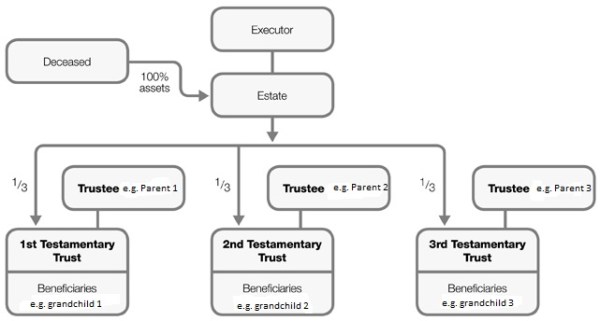
George and Helen have a combined estate worth $1,500,000. They have three young grandchildren whom they wish to make their beneficiaries as they had already helped their children to set themselves up as financially secure.

George and Helen are concerned that, in the event of their deaths, their grandchildren will not be sufficiently mature to use their inheritance responsibly. They wish to establish an education fund to ensure that the grandchildren are encouraged to further their education, but are also adequately provided for during their developing years.

As a result, George and Helen’s Wills provide that 50 per cent of the inheritance received by a child ($250,000 each) will be held in testamentary trust funds on the following terms:

  • Until the beneficiary turns 25, their access to the income and capital of the trust is limited to specified purposes, such as:
    • education expenses, including HECS liabilities
    • hospital and medical expenses
    • rent or accommodation charges
    • electricity, gas and other utility payments
    • maintenance and income support at the discretion of the trustee.
  • If a specified level of tertiary education has been completed by the age of 25, the beneficiary will be given full control of the trust at the time of attaining that educational level, with the ability to either continue the trust for tax planning purposes (as a tax-effective vehicle for supporting the education of their own children) or terminate it.
  • If the beneficiary does not attain the required level of education by the age of 25, the remaining balance of the education fund will be distributed amongst charities specified in the Wills.

beneficiaries-flow-chart

The education funds will ensure that each child is adequately supported, but also given an incentive to further their education. If all children were from the one family you could use just one Trust.

Additional issues to discuss with your legal expert

Common areas which require further thought are:-

  • Whether to have one or several Trusts established under the Will
  • The selection of the appropriate trustee or trustees
  • The method of appointing replacement trustees
  • Whether some classes of beneficiaries are restricted to income and some to capital

Back-up Strategy

There is a second chance for your family to establish a testamentary trust after you die but this second chance must be taken advantage of within three years of your death. This enables a trust to be established from your assets and for the income to enjoy the same tax advantages as income derived through a testamentary trust. However, the assets used to establish the trust cannot exceed the amount which the beneficiary would have received under the law, if you died without a Will.

I hope this guidance has been helpful and please take the time to comment. Feedback always appreciated. Please reblog, retweet, like on Facebook etc to make sure we get the news out there. As always please contact me if you want to look at your own options or get a referral do a recommended Estate Planning solicitor. We have offices in Castle Hill and Windsor but can meet clients anywhere in Sydney or via Skype. Just click the Schedule Now button up on the left to find the appointment options.

Liam Shorte B.Bus SSA™ AFP

Financial Planner & SMSF Specialist Advisor™

SMSF Specialist Adviser 

 Follow SMSFCoach on Twitter Liam Shorte on Linkedin NextGen Wealth on Facebook   

Verante Financial Planning

Tel: 02 98941844, Mobile: 0413 936 299

PO Box 6002 BHBC, Baulkham Hills NSW 2153

5/15 Terminus St. Castle Hill NSW 2154

Corporate Authorised Representative of Viridian Select Pty Ltd ABN 41 621 447 345, AFSL 51572

This information has been prepared without taking account of your objectives, financial situation or needs. Because of this you should, before acting on this information, consider its appropriateness, having regard to your objectives, financial situation and needs. This website provides an overview or summary only and it should not be considered a comprehensive statement on any matter or relied upon as such.

Image courtesy of Stuart Miles at FreeDigitalPhotos.net

The Annihilation of Your Assets – Estate Planning


I am always looking for quality articles to help my clients and here is a great guest post today from Bryan Mitchell of  Mitchells Solicitors in Brisbane on how poor drafting of your will or a lack of a regular review of assets mentioned in a will may leave your intended beneficiaries out-of-pocket. While not focusing specifically on SMSF matters, your will is a very important part of overall wealth management.

Annihilation of your Assets

The doctrine of ademption

What happens to assets listed in a will that no longer exist when the will-maker dies? It might sound like an obscure question, but in fact it is becoming more common as the population ages. Often, the biggest asset people own as they age is their family home. And sometimes, they can no longer live in that home and must move into assisted living. It’s common practice to sell the family home to pay for that care. All well and good until the older person eventually passes away, and the will is found. The beneficiaries discover that the deceased has left them the property held at 182 Birkdale Rd, Birkdale. Where is that asset? the lawyer asks. It was sold to pay for the nursing home, the beneficiaries say. It no longer exists. So swings into action the doctrine of ademption, which means that a specific gift fails if its subject matter has ceased to exist as part of the testator’s property at death. The doctrine of ademption operates on the assumption that if the property cannot be found, the gift cannot take effect. What ruffles the feathers more is the case of real property: a specific testamentary gift of real property will fail if it is sold before death, even if the proceeds from the sale can be traced. The beneficiaries are not entitled to the proceeds of its sale. So the children who might have expected to inherit the Birkdale property now stand to inherit nothing. The only exception is where an agent or attorney through fraud or an unauthorised transaction sells or transfers the asset. Sometimes there may be right for a beneficiary who has missed out to make a claim for compensation even where there has been no fraud or unauthorised transactions, but that is another topic.

Bryan Mitchell - Solicitor http://www.mitchellsol.com.au/

Bryan Mitchell – Solicitor
http://www.mitchellsol.com.au
(07) 3373 3633

Ban v The Public Trustee of Queensland [2015] QCA 18 Ms Ban and Mr ADF had been friends for a long time. As Mr ADF aged, he became unwell as his cognitive function declined and he was eventually diagnosed with dementia. Ms Ban held the Power of Attorney for Mr ADF for personal and financial matters. At around the same time that Mr ADF was hospitalised in a confused and disoriented state, he entered into a contract of sale for a property at Park Ridge. The property was sold for $2.25 million and the funds were placed in an account in the names of Ms Ban and Mr ADF. When Mr ADF passed away, his will revealed that the Park Ridge property had been mentioned specifically. In fact, the will stipulated that the Park Ridge property was gifted to the Queensland State Government, and that the property was not to be sold until the fifth anniversary of his death. Ms Ban used the funds for her own benefit, including her wedding, a political campaign, and home renovations.Because she was convicted and fined for misappropriating the funds, the doctrine of ademption will not stand. The beneficiaries of that gift (in this case, the state government of Queensland) could get compensation or make a claim on the estate. Hay v Aynsley [2013\ NSWSC 1689 The willmaker, Mrs Brook, had three adult children, Peter, Louise and David. Her husband, Mr Brook, pre-deceased her by three years. Prior to his death, he was granted a power of attorney for his wife in need. Upon his death, the Power of Attorney was granted to Louise and David jointly. David also pre-deceased his mother, leaving Louise with sole Power of Attorney authority for her mother. Mrs Brook suffered from dementia, lacked legal mental capacity and Louise acted for her mother under the authority of the Power of Attorney. She decided to sell land owned by Mrs Brook at Soldiers Point in 2011, collected net proceeds of the sale of $360,000 and placed the money in a bank account, accruing interest. Mrs Brook died in 2012 and the will was granted probate. However, specific stipulations within the will gave rise to questions of what the willmaker would have wanted. Mrs Brook, in her will, gave a property to her daughter Louise, at Round Corner. She also gave the property at Soldiers Point to her son, David. The remainder of the estate, which was minimal, would be shared in one-third equal shares to Peter, Louise and David. A further stipulation allowed that if any of Mrs Brook’s children should die before she did, that their share of the estate would be held in a trust for her grandchildren. The question we are looking at in this case is whether the sale of the property at Soldiers Point adeemed the gift to David, who himself had passed away, and whether David’s own heirs were due to receive both the value of the property plus the one-third share of the remaining estate. The judge ordered that the Soldiers Point gift was adeemed (ceased to exist) by virtue of the sale of the property and that the residual estate, including the proceeds of the sale and accrued interest, would be broken up in thirds. In this case, the children of the late David Brook miss out on the value of the property of Soldiers Point, receiving only a third of it. This is how the doctrine of ademption can cause heirs to receive much less from a will that perhaps the will-maker intended. How can I avoid the doctrine of ademption? Reassuringly, it’s not difficult to ensure the ademption won’t apply. The use of back-up clauses is especially useful. For example, if the intent is to give the property at Birkdale, have a back-up clause that applies if the gift fails, providing for a sum of money or a share of the estate. The important issue to remember here is that though ademption is an obscure doctrine that very few people have heard of, it still applies.  And it is not a rare occurrence.  Therefore, it is vitally important that people:

  • Do not write-up their own wills
  • See a specialist who understands the doctrine of ademption
  • Have a will that is clear, concise and thorough

For those who prefer to watch and listen then hear more from Bryan on the Doctrine of Ademption. https://youtu.be/5PXWFzcH4No Are you looking for an advisor that will keep you up to date, access to quality professionals and provide guidance and tips like in this blog? Then why now contact me at our Castle Hill or Windsor office in Northwest Sydney to arrange a one on one consultation. Just click the Schedule Now button up on the left to find the appointment options.

Liam Shorte B.Bus SSA™ AFP

Financial Planner & SMSF Specialist Advisor™

SMSF Specialist Adviser 

 Follow SMSFCoach on Twitter Liam Shorte on Linkedin NextGen Wealth on Facebook   

Verante Financial Planning

Tel: 02 98941844, Mobile: 0413 936 299

PO Box 6002 BHBC, Baulkham Hills NSW 2153

5/15 Terminus St. Castle Hill NSW 2154

Corporate Authorised Representative of Viridian Select Pty Ltd ABN 41 621 447 345, AFSL 51572

This information has been prepared without taking account of your objectives, financial situation or needs. Because of this you should, before acting on this information, consider its appropriateness, having regard to your objectives, financial situation and needs. This website provides an overview or summary only and it should not be considered a comprehensive statement on any matter or relied upon as such.

Image courtesy of Mitchells Solicitors – Brisbane Phone for a FREE Consultation  – (07) 3373 3633

Do you want a say in who gets your superannuation if you die? Then put some strategies in place now.


You may have ignored your Super up to now as you feel young , immortal  or just don’t like thinking about death (see I said “if you die” not “when you die”” just so you would continue reading). But in doing so you may not have left your superannuation to the person you intended.

Strict rules govern how your super is distributed when you die – and it’s important to follow those rules to make sure your money goes to whom you want instead of having a faceless Super Fund Trustee or worse an out of date Trust Deed decide.

One of the most important decisions you make when you join a super fund has nothing at all to do with investment. It revolves around the question of whom to nominate as the beneficiaries of your super when you die.

It is a critical decision – because if you don’t get it right your savings could be given to someone other than your preferred beneficiaries or the funds could be held up while disputes are mediated.

Few exceptions

When a fund member dies, subject to the trust deed, his or her superannuation may only be paid to:

  • The member’s spouse (including a de facto spouse, whether same-sex or not)
  • The member’s children
  • A person who was financially dependant on the deceased member at the date of death
  • A person with whom the deceased member had an interdependency relationship at the date of death
  • The member’s legal personal representative (estate)
  • NOTE that none of the above automatically include Mother, Father, Brothers or Sisters.

An interdependency relationship is defined as one between two persons (whether or not related by family) where it is very clear that:

  • They have a close personal relationship; and
  • They live together; and
  • One or each of them provides the other with financial support; and
  • One or each of them provides the other with domestic support and personal care.

For the purposes of that definition, all of the circumstances of the relationship between the persons must be taken into account, including (where relevant):

  • the duration of the relationship; and
  • whether or not a sexual relationship exists; and
  • the ownership, use and acquisition of property; and
  • the degree of mutual commitment to a shared life; and
  • the care and support of children; and
  • the reputation and public aspects of the relationship; and
  • the degree of emotional support; and
  • the extent to which the relationship is one of mere convenience; and
  • any evidence suggesting that the parties intend the relationship to be permanent;

A determination can take into account a statutory declaration signed by one of the persons to the effect that the person is, or (in the case of a statutory declaration made after the end of the relationship) was, in an interdependency relationship with the other person

In the case of a Retail or many Industry fund the beneficiaries you nominate when you join a fund are normally only a guide – the trustees of your fund will have the ultimate discretion as to who will receive your super. They will take into consideration any nomination of beneficiaries that you have made, but are not bound by your request.

The only exception is where your super fund allows you to make a “Binding Death Benefit Nomination” or even better a ” Non-Lapsing Binding Death Benefit Nomination”  . This is a nomination that the trustees are obliged to follow. You may only nominate a spouse, child, someone who you held an interdependency relationship with, or a financial dependant.

If you want your superannuation to pass to someone else, such as a friend or charity, you should consider nominating your estate as the preferred beneficiary of your superannuation entitlements. You superannuation will then be distributed according to the terms of your will – you would need to nominate such people or bodies as beneficiaries of your will.

Regular review

It is important to review death benefit nominations regularly and to include full details of your beneficiaries – including their relationship to you, their full name and their address. This applies even if you have used a Non-Lapsing BDBN as your circusmtances may have changed,

Keeping your super fund trustee informed of any changes to your beneficiaries – or changes to their personal details – will make the task of distributing your super much less complex for all involved.

It’s also worth noting that the basic binding death benefit nominations are only valid for three years – so make sure you update your nomination regularly or ask for a Non-lapsing Binding Death Nomination form.

To be valid, a binding death benefit nomination must be:

  • Made to the trustee in writing, clearly setting out the proportion of benefits to be paid to respective beneficiaries;
  • Be signed by the member in the presence of two witnesses over 18 years of age and who are not themselves named as beneficiaries;
  • Include a signed witness declaration;
  • Received by the trustee; and
  • Renewed every three years, although it is possible and in my opinion preferred to have a non-lapsing binding death benefit nomination.

Who to leave your superannuation to (and how) can be a complex question that can involve tax, social security and other financial considerations. You are well advised to seek professional assistance from a financial planner in this area and if dealing with an SMSF then a SMSF Specialist Advisor™ is the best place to start.

Are you looking for an advisor that will keep you up to date and provide guidance and tips like in this blog? Then why now contact me at our Castle Hill or Windsor office in Northwest Sydney to arrange a one on one consultation. Just click the Schedule Now button up on the left to find the appointment options.

Liam Shorte B.Bus SSA™ AFP

Financial Planner & SMSF Specialist Advisor™

SMSF Specialist Adviser 

 Follow SMSFCoach on Twitter Liam Shorte on Linkedin NextGen Wealth on Facebook   

Verante Financial Planning

Tel: 02 98941844, Mobile: 0413 936 299

PO Box 6002 BHBC, Baulkham Hills NSW 2153

5/15 Terminus St. Castle Hill NSW 2154

Corporate Authorised Representative of Viridian Advisory Pty Ltd (ABN 34 605 438 042) (AFSL 476223)

This information has been prepared without taking account of your objectives, financial situation or needs. Because of this you should, before acting on this information, consider its appropriateness, having regard to your objectives, financial situation and needs. This website provides an overview or summary only and it should not be considered a comprehensive statement on any matter or relied upon as such.