


SMSF Business Real Property: It’s not what type of property that counts, it’s the use that matters.


The decision to purchase property through an SMSF requires careful consideration. This is perhaps why, in September 2024, the Australian Tax Office (ATO) reported that of the total estimated value of non-residential property assets held by the 621,809 SMSFs, only makes up about 13%.

One of the most common queries we get is “can our SMSF acquire a residential property from us personally”

Talk to an accountant or financial adviser about whether you can buy a residential property from a related party or rent one to your family and often the answer is a simple one; “you cannot acquire a residential property from a related party or lease it to a member or related party” But is this true in all cases?

An SMSF Specialist Advisor (SSA) will often dig deeper to explore the proposed strategy in more detail because it is not about the nature of the property, whether it is a residential property or a commercial office or industrial unit, but rather it is about the actual use of that property at the time of acquisition or when entering the lease.

We often see a residential property in suburbs or regional towns where a Doctor, Dentist, Accoutnant or other professional is using a residential property 100% for their business with no one living in the property. In this case the residential property is actually a Business Real Property and can be acquired from your fund.

Who is the property being acquired from and how is that property being used at the time of the purchase?

The exemption in s66 for business real property is tested at acquisition, so if it is currently not 100% Business Real Property as per s66(5) of the SIS Act, it cannot be acquired from a related party. But there is another chink in this rule, in that it does not have to be exactly 100% as in the case of a Farm where the use of the farmhouse for residential is incidental and therefore allowed. Another example would be the managers quarters in a Motel. So you can se that it pays to look deeper in to the exact details of a property’s use.

Tip on Scenario: Can an SMSF acquire a residential property and repurpose it as a business property so it can be let back to related party business?

– If the property will be used WHOLLY AND EXCLUSIVELY for the business at the time of acquisition, then YES. If not, then is the non-business use incidental? If not, then No

What if some portion of property is used for personal storage?

– Then the property is not used WHOLLY AND EXCLUSIVELY for business, so NO.

One solution maybe to change the nature of the residential property before purchase with the cooperation of the vendor and lease the premises properly from them. This might involve fitting out the rooms as offices/treatment rooms etc. Then when you go to acquire/move the property in to the SMSF it meets the Business Real Property definition. Please don’t try to bend rules, the ATO and your auditor will be looking to see that the changes are long term and with a serious intention for the property to remain as a business real property.

To help is is good to refer to the ATO definition of Business Real Property “Business real property generally means land and buildings used wholly and exclusively in a business.”

For more detailed information on what qualifies as Business Real Property see the ATO self-managed superannuation funds ruling SMSFR 2009/1: business real property for more information.

Other Tips and Traps

Minor Personal Use: In terms of using a small part of a property for personal use such as storage then refer specifically to paragraph 215 : “215. It is the Commissioner’s view that the de minimus principle of statutory interpretation will apply to the ‘wholly and exclusively’ threshold in the business real property definition. This principle will accommodate non-business use of the property that is relatively minor or trifling.”

Changing use of property while under an LRBA: you cannot change nature of the property while under an LRBA. It would be a breach of the rules by changing a residential property in to a commercial property while under a LRBA.

Warning before you jump into implementation of any strategy without checking your personal circumstances and the specifics of the property you are considering.

Are you looking for an advisor that will keep you up to date and provide guidance and tips like in this blog? Then, why not contact me at our Castle Hill or Windsor office in Northwest Sydney to arrange a one-on-one consultation (after 1 July 2025 due to our waiting list). Just click the Schedule Now button up on the left to find the appointment options.

Please consider passing on this article to family or friends. Pay it forward!

Liam Shorte B.Bus FSSA™ AFP

Financial Planner & Fellow SMSF Specialist Advisor™


Tel: 02 9899 3693, Mobile: 0413 936 299

  • PO Box 6002 NORWEST NSW 2153
  • Suite 40, 8 Victoria Ave, Castle Hill NSW 2154
  • Suite 4, 1 Dight St., Windsor NSW 2756


Corporate Authorised Representative of Viridian Advisory Pty Ltd ABN 34 605 438 042, AFSL 476223

This information has been prepared without taking into account your objectives, financial situation, or needs. Because of this, you should, before acting on this information, consider its appropriateness, having regard to your objectives, financial situation, and needs. This website provides an overview or summary only and it should not be considered a comprehensive statement on any matter or relied upon as such.

How to check your Superannuation data via myGov online


The ATO online services site, accessible through myGov, has now become a very useful tool for individuals in managing their superannuation and accessing superannuation information. Unfortunately, their financial planners cannot still access this information so they will often ask you to access this information for them.

You can look up your superannuation information such as contributions for the year to date, carry forward unused concessional contributions, total superannuation balance or transfer balance cap transactions, saving valuable time and minimising the risk of missing important information and making the wrong contributions.

NAVIGATING THE MYGOV WEBSITE

It is relatively easy to find the superannuation data on myGov, and access has improved over time.

If you do not have a myGov account, you need to create one at my.gov.au

Here is the ATO video on how to set it up How to create a myGov account and link to ATO service

Once logged in they need to scroll down to “Link a Service” and follow the steps to link to the ATO.


Those who already have a myGov account which is linked to the ATO, need to click on Australian Taxation Office (ATO) under Your Linked Services.

Information you need to link your myGov account to ATO online services

You will need at least 2 of the following:

  • Your Bank Account Details where a tax refund paid to or has earned interest in last 2 years
  • PAYG Payment Summary within last 2 years
  • Centrelink Payment Summary from last 2 years
  • Notice of Assessment within last 5 years
  • Dividend Statement within last 2 years
  • Superannuation account statement from last 5 years

More detailed information on each option is available here

INFORMATION

Once you have accessed your online ATO account, go to the Super tab, select Information and follow the links:

The information that appears here comes via the ATO from various reporting that superannuation funds and employers are obliged to do as well as from the individual’s income tax return.


It is important to remember that whilst myGov is a useful resource, it may not always be up to date, especially early in a financial year when super funds and individuals have not yet lodged income tax returns for the previous year.


In addition, those who use self-managed super funds (SMSFs) may find their information is not up to date as SMSFs do not have the same reporting frequency as retail and industry funds.

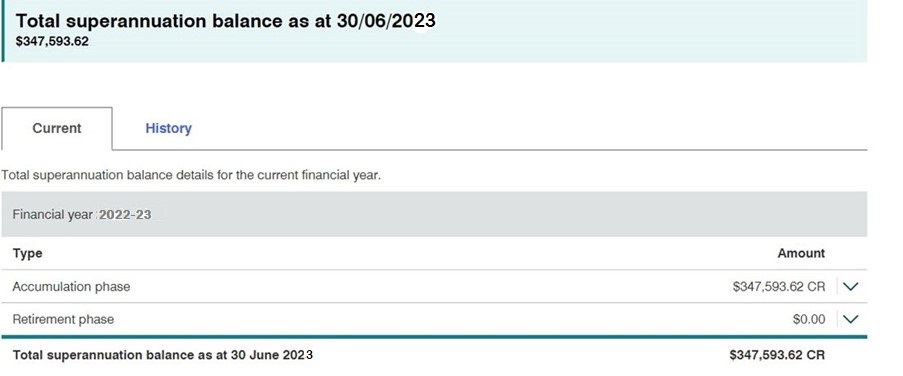
TOTAL SUPERANNUATION BALANCE (TSB)

This tab indicates an individual’s TSB on the most recent 30 June as well as historic TSBs going back to the 2016/17 financial year.


TSB is used to determine if an individual qualifies for several super-related measures the following financial year including the ability to make non-concessional contributions or use carry forward concessional contributions.


TSB is not always as simple as the member’s account balance on 30 June, so being able to look it up on myGov is invaluable.  

BRING FORWARD ARRANGEMENT

This section advises you whether or not you are in a bring-forward arrangement.

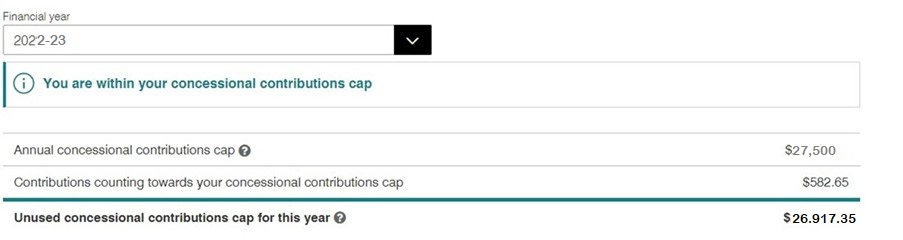
CONCESSIONAL CONTRIBUTIONS

Here you can find out the total concessional contributions you made each year and how you compare with your own concessional contributions cap. Remember that current year contributions may not all be showing up, so should be cross checked. For example, contributions to SMSFs such as personal contributions and related employer contributions, or personal contributions where a tax deduction hasn’t been successfully claimed.

CARRY-FORWARD CONCESSIONAL CONTRIBUTIONS

The carry-forward concessional contribution tab shows the total unused concessional contributions available to carry forward from previous years. It also links the you directly through to the TSB tab to check your eligibility to use the carry-forward amounts available (ie to check that TSB on the previous 30 June was under $500,000).

TRANSFER BALANCE CAP

If you already had a retirement phase income stream at 1 July 2017, or you commenced a retirement phase income stream since 1 July 2017, you can check the balance of your Transfer Balance Account, your personal transfer balance cap and any available cap space.

EMPLOYER CONTRIBUTIONS

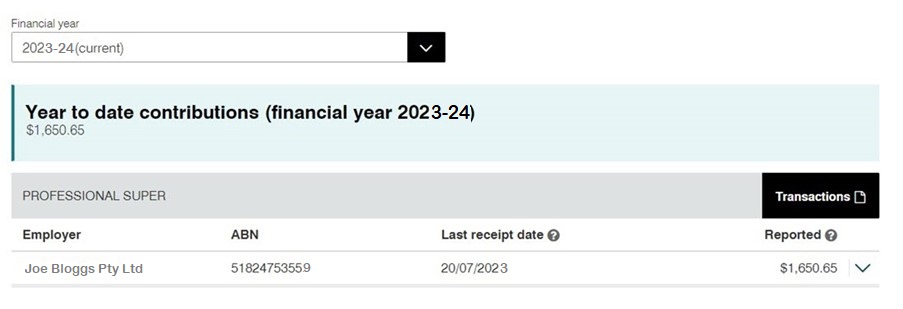
This section is handy if you are looking to make personal deductible contributions and aren’t sure how much your employer has already contributed on your behalf as well as to check that an employer has been making Super Guarantee or salary sacrifice contributions.

MANAGE

Under the “Manage” tab, the following functions are available:

  • request a transfer of super between funds
  • withdraw any ATO-held super
  • make an excess non-concessional contribution election (ie release the excess or retain in the fund)
  • make a Division 293 election
  • apply for a release of super on compassionate grounds
  • apply for a First Home Super Saver Determination

NB: It appears that the Transfer Super, Withdraw ATO-held super and the Non-concessional election tabs only appear if these options are available to you. That is, if you have at least two super funds (for the Transfer super tab), or amounts held by the ATO (for Withdraw ATO–held super) or an excess non-concessional determination (Non-concessional election).

Warning before you jump into implementation of any strategy without checking your personal circumstances.

Are you looking for an advisor that will keep you up to date and provide guidance and tips like in this blog? Then, why not contact me at our Castle Hill or Windsor office in Northwest Sydney to arrange a one-on-one consultation (after 1 February 2023 due to our waiting list). Just click the Schedule Now button up on the left to find the appointment options.
Thank you to the industry tech experts who prepare much of this useful information for advisers but let me amend it to meet the needs of SMSF trustees. They do the heavy lifting for which I am eternally grateful.

Please consider passing on this article to family or friends. Pay it forward!

Liam Shorte B.Bus FSSA™ AFP

Financial Planner & Fellow SMSF Specialist Advisor™


Tel: 02 9899 3693, Mobile: 0413 936 299

  • PO Box 6002 NORWEST NSW 2153
  • Suite 40, 8 Victoria Ave, Castle Hill NSW 2154
  • Suite 4, 1 Dight St., Windsor NSW 2756


Corporate Authorised Representative of Viridian Advisory Pty Ltd ABN 34 605 438 042, AFSL 476223

This information has been prepared without taking into account your objectives, financial situation, or needs. Because of this, you should, before acting on this information, consider its appropriateness, having regard to your objectives, financial situation, and needs. This website provides an overview or summary only and it should not be considered a comprehensive statement on any matter or relied upon as such.

Super changes will hit saving strategies


Please find a link below to an article on the Macro Business blog website about the expected and unexpected effects of the proposed Super changes.  No More Tax Free

http://www.macrobusiness.com.au/2013/04/super-changes-will-hit-saving-strategies/

Macro Business has an excellent engaged readership and as always the comments tend to be very valuable at exploring the details of any subject just that little bit further.

Are you looking for an advisor that will keep you up to date and provide guidance and tips like in this blog? Then why now contact me at our Castle Hill or Windsor office in Northwest Sydney to arrange a one on one consultation. Just click the Schedule Now button up on the left to find the appointment options.

Liam Shorte B.Bus SSA™ AFP

Financial Planner & SMSF Specialist Advisor™

SMSF Specialist Adviser 

 Follow SMSFCoach on Twitter Liam Shorte on Linkedin NextGen Wealth on Facebook   

Verante Financial Planning

Tel: 02 98941844, Mobile: 0413 936 299

PO Box 6002 BHBC, Baulkham Hills NSW 2153

5/15 Terminus St. Castle Hill NSW 2154

Corporate Authorised Representative of Viridian Select Pty Ltd ABN 41 621 447 345, AFSL 51572

This information has been prepared without taking account of your objectives, financial situation or needs. Because of this you should, before acting on this information, consider its appropriateness, having regard to your objectives, financial situation and needs. This website provides an overview or summary only and it should not be considered a comprehensive statement on any matter or relied upon as such.

Using Beer To Explain How Tax Concessions Work


Let’s put tax concessions for superannuation in terms everyone can understand.

Suppose that every night, ten men go to their favorite bar for a few beers. The tab for all tenBeer Fund
comes to $100. If they paid their bill the way we pay our taxes, it would go something like
this:

  • The first four men (the poorest) would pay nothing.
  • The fifth would pay $1.
  • The sixth would pay $3.
  • The seventh $7.
  • The eighth $12.
  • The ninth $18.
  • The tenth man (the richest) would pay $59.

So, that’s what they decided to do. The ten men drank in the bar every night and seemed quite happy with the
arrangement, until one day, the owner threw them a curve ball.

“Since you are all such good customers,” he said, “I’m going to reduce the cost of your nightly tab by $20.”

So, now drinks for the ten only cost $80. The group still wanted to pay their tab the way we pay our taxes.  So, the first four men were unaffected. They would still drink for free.

But what about the other six, the paying customers?

How could they divvy up the $20 windfall so that everyone would get his ‘fair share’?

The six men realized that $20 divided by six is $3.33. But if they subtracted that from everybody’s share, then the fifth man and the sixth man would each end up being ‘PAID‘ to drink beer!

So, the bar owner suggested that it would be fair to reduce each man’s bill by roughly the same amount, and he proceeded to work out the amounts each should pay.

And so:

  • The fifth man, like the first four, now paid nothing (100% savings).
  • The sixth now paid $2 instead of $3 (33% savings).
  • The seventh now paid $5 instead of $7 (28% savings).
  • The eighth now paid $9 instead of $12 (25% savings).
  • The ninth now paid $14 instead of $18 (22% savings).
  • The tenth now paid $49 instead of $59 (16% savings).

Each of the six was better off than before. And the first four continued to drink for free. But once drunk and outside the bar, the men began to compare their savings.

“I only got a dollar out of the $20,” declared the sixth man. He pointed to the tenth man “but he got $10!”

“Yeah, that’s right,” exclaimed the fifth man. “I only saved a dollar, too. It’s unfair that he got ten times more than me!”

“That’s true!!” shouted the seventh man. “Why should he get $10 back when I got only $2? The wealthy get all the breaks!”

“Wait a minute,” yelled the first four men in unison. “We didn’t get anything at all. The system exploits the poor!”

The nine men surrounded the tenth and beat him up.

The next night the tenth man didn’t show up at the bar, so the nine sat down and drank without him. But when it came time to pay the tab, they discovered something important. They didn’t have enough money  between all of them for even half of the tab!

And that, ladies and gentlemen, journalists and Mr Freydenberg, Mr Shorten and Mr Morrison and his shadow Mr Bowen, is how our tax system works. The people who pay the highest taxes get the most benefit from a tax reduction or concession like the Superannuation contribution tax rate. Tax them too much, attack them for being wealthy, and they just may not show up to pick up the tab anymore.

In fact, they might start drinking overseas, where the atmosphere is somewhat friendlier.

“everyone will worry about the poor people in the wagon and not about the people pulling the wagon, until there are no more people to pull the wagon!”

For those who understand, no explanation is needed.
For those who do not understand, no explanation is possible

This article has been adapted to Australian circumstances and is based on what is believed to have originally been a letter to the Chicago Tribune by a Mr Don Dodson in March 2001 (Source SNOPES.com )

As always please contact me if you want to look at your own particular situation as we specialise in plain English strategies. We have offices in Castle Hill and Windsor but can meet clients anywhere in Sydney or via Skype.

Liam Shorte B.Bus SSA™ AFP

Financial Planner & SMSF Specialist Advisor™

SMSF Specialist Adviser 

 Follow SMSFCoach on Twitter Liam Shorte on Linkedin NextGen Wealth on Facebook   

Verante Financial Planning

Tel: 02 98941844, Mobile: 0413 936 299

PO Box 6002 BHBC, Baulkham Hills NSW 2153

5/15 Terminus St. Castle Hill NSW 2154

Corporate Authorised Representative of Viridian Select Pty Ltd ABN 41 621 447 345, AFSL 51572

This information has been prepared without taking account of your objectives, financial situation or needs. Because of this you should, before acting on this information, consider its appropriateness, having regard to your objectives, financial situation and needs. This website provides an overview or summary only and it should not be considered a comprehensive statement on any matter or relied upon as such.

Don’t depend on working longer to save for your Retirement Income


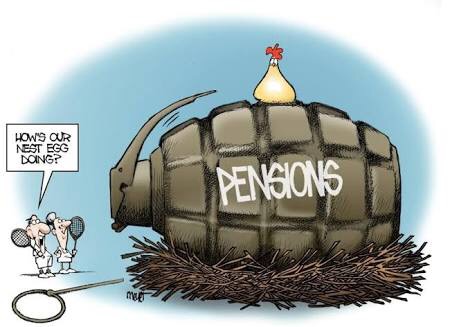
Looking to RetirementMany clients believe delaying their retirement is a solution to inadequate savings, but they often find themselves out of the workforce sooner than they’d planned. None of us has that crystal ball!

It is likely that the shortfall in retirement savings here in Australia stems in part from our “she’ll be right” attitude towards life, which leads us to believe that we do not need to start saving early and that somehow it will all work out ok.

Delaying retirement can be a powerful boost to your superannuation nest-egg. But relying on the ability to work for a few extra years to stretch retirement savings out a little longer is fraught with risk and does not reflect personal and family health or other issues that may arise. As an example I have had some clients forced to retire to look after their grandchildren due to the illness of the parent.

If you played with any retirement planning calculator or have spoken to an adviser, the “work a little longer” solution would have been investigated and many put it forward as the solution to the GFC “dip” (read plunge) in savings.

The concept is easy to grasp: By working longer then you originally planned, you get more years of concessionally taxed growth in your superannuation accounts especially if you used a Transition to Retirement Pension from 55 or 60. You can also continue to salary sacrifice and make non-concessional contributions while getting the benefit of the Senior And Pensioners Tax Offset (SAPTO) that I mentioned a few weeks ago here.

The idea is the longer you work and save and more you get into a superannuation income stream then your capital will last longer and you may also benefit from more Age Pension when required.

Back to reality with a jolt!

But there is a huge disconnect between workers’ expectations and retirement reality. Over half of the retirees surveyed in a US study last year said they left the workforce earlier than planned, and just 8% of them said that positive factors — such as the ability to afford early retirement — prompted the move. For the vast majority of early retirees, negative circumstances, such as personal or spouse health problems or company downsizing played a role.

40% of Australians will suffer a critical illness before age 65 (Cologne Life Re study). They will most likely survive but their retirement funding will be devastated.

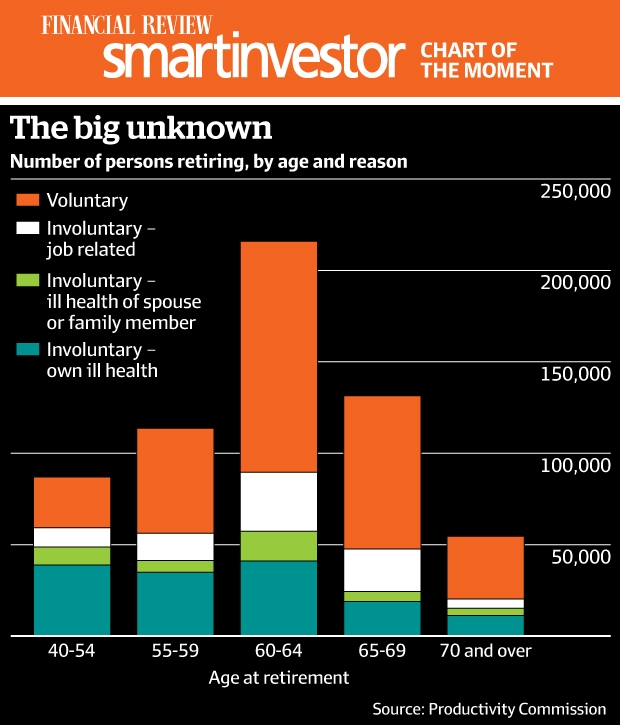
The 2015 Productivity Commission report on post-retirement shows that about 40 per cent of Australians who retire between the age of 60 and 64 do so involuntarily, either because of their own or a family member’s ill health, or redundancy.

For those aged between 65 and 69 who retire involuntarily is not that different, while for younger age groups most people who retire do so involuntarily.

Retirement ages

Clearly, workers relying on delayed retirement are rolling the dice. Yet, most people discount the future so much that they’re willing to take that gamble. May hope that an inheritance will save the day but do not realise that age care costs and parents living longer may eat heavily into any expected inheritance.

Strangely the people most likely to plan on working a few more years to boost their retirement security may actually have the least ability to postpone their retirement. People who suffer an illness or injury  are more likely than those in good health to have pushed back their expected retirement date in recent years, according to  a report from consulting firm Towers Watson. Yet health problems or disabilities were cited by more than half of retirees forced to retire earlier than planned.

Don’t put you head in the sand – start now

As psychologists are quick to point out, we all have that inner voice that loves to procrastinate who loves to put off till tomorrow what we should do today – beause its “all too hard to get your head around”. Saving more today is a sure thing, and extra years in the workforce are anything but. If you know you don’t have enough, you should start saving more today, because that’s by far the less risky alternative.

Let’s look at an example using the Retirement Planner on the MoneySmart.gov.au site for a 55-year-old pre-retiree with just $30K in superannuation. If she earns $80,000, makes $17,500 annual salary sacrifice contributions (in addition to Employers SGC contributions of 9.5%)  and earns a 7.5% return pre retirement and 6.5% after, she could be looking at an Income in retirement of $32,143 by age 67 including the Age Pension. If she’s forced to retire at that point, she’s still in better shape than most Australian’s. And if she can continue working, she  counld improve on this lifestyle with a better retirement income.

Retirement Income

A final don’t is cancelling TPD or Income Protection insurances to save money while in your most productive earning years (read here for more on that subject). The loss of 5-10 years of earnings potential is one guaranteed way to destroy your lifestyle in retirement. Your ability to earn is your biggest asset

Are you looking for an advisor that will keep you up to date and provide guidance and tips like in this blog? Then why now contact me at our Castle Hill or Windsor office in Northwest Sydney to arrange a one on one consultation. Just click the Schedule Now button up on the left to find the appointment options.

Liam Shorte B.Bus SSA™ AFP

Financial Planner & SMSF Specialist Advisor™

SMSF Specialist Adviser 

 Follow SMSFCoach on Twitter Liam Shorte on Linkedin NextGen Wealth on Facebook   

Verante Financial Planning

Tel: 02 98941844, Mobile: 0413 936 299

PO Box 6002 BHBC, Baulkham Hills NSW 2153

5/15 Terminus St. Castle Hill NSW 2154

Corporate Authorised Representative of Viridian Select Pty Ltd ABN 41 621 447 345, AFSL 51572

This information has been prepared without taking account of your objectives, financial situation or needs. Because of this you should, before acting on this information, consider its appropriateness, having regard to your objectives, financial situation and needs. This website provides an overview or summary only and it should not be considered a comprehensive statement on any matter or relied upon as such.
Think twice before cancelling insurances as you get older.


Do you know that the average person cancels their personal insurance about 1-2 years before an claimable illness strikes! The average age a person discontinues one or more of three types of living insurance policies – cover for disability, critical illness/trauma and income protection – is 45 years yet the average age for a claim is 46.5 years. (source TAL)

As mentioned in a previous blog the SMSF regulations now require Self Managed Superannuation Fund Trustees to consider Insurance as part of the SMSF Investment Strategy . TheRisk Management following applies to everyone regardless of the type of investor you are or the structure you use to save for retirement.

I see many clients in our Castle Hill and Windsor offices in their late 50’s who have cancelled their life and income protection insurances before they have come to see me. Usually they say it is because they have paid off their mortgage and are debt free so they didn’t feel they needed cover any longer.

Their focus now was on expense reduction and saving via salary sacrifice to superannuation and even some after tax contributions from savings.

While it is great to see them focus on saving for retirement and budgeting, what they don’t realise is that in cancelling insurances it is their retirement lifestyle or that of their spouse they are no longer insuring and not just their current needs.

With 5-15 years of focused savings towards a retirement nest egg they can substantially improve their lifestyle after retirement. However those dreams of a happy retirement can all be taken away with a diagnosis of cancer or a stroke that inhibits them working for a prolonged period.

You don’t just find yourself financing time off work and medical expenses but also lose out on the employer super contributions and salary sacrifice as well or worse for a small business owner, you face the expense of a getting someone to cover for you to keep the business afloat.

To realistically assess if you need to maintain your Life, Trauma or Income Protection insurance, you need to think through the worst-case scenario. If you were unable to work for 3 years due to an illness today, how would you and your loved ones cope financially?

  • Would you be able to meet ongoing living expenses like food, clothing, changing the car, pay for private health insurance premiums, etc? (this assumes mortgage paid off)
  • Would you have the liquid funds to cover additional expenses or loss in income (e.g., gap in your medical fees, time off work for your spouse to take care of you,
  • What would happen to your retirement plans and would you be able to save enough money to see the kids through the final college years or fund your retirement comfortably?
  • What if you were actually permanently disabled and they had all the costs of rearranging the home, medical care and transport options for you.

In all honesty, it is always a struggle when you lose your earning capacity. The last thing you need compounding the situation are financial concerns. Insurance helps make sure that you and the people you care about will be provided for financially, even if you’re not around to care for them yourself.

So whether you’re in retail, industry or a Self Managed Super Fund, take a moment to consider how insurance might fit into your retirement plans. We can look at ways to reduce the cover and costs to keep them affordable and provide that protection for you and your family.

If you think you may need to review your Insurances then you can contact us to offer you advice on your options. As well as offering advice on Insurances, Superannuation and SMSF’s our advisers can also offer you help in many other area’s you may be experiencing problems such as:

  • Financial Planning,
  • Tax Planning,
  • Debt Consolidation,
  • Investment Portfolios,
  • Estate Planning,
  • SMSF Trustee queries.

Have you found this blog helpful? Pass it on. Social media buttons beneath the article.

Are you looking for an advisor that will keep you up to date and provide guidance and tips like in this blog? Then why now contact me at our Castle Hill or Windsor office in Northwest Sydney to arrange a one on one consultation. Just click the Schedule Now button up on the left to find the appointment options.

Liam Shorte B.Bus SSA™ AFP

Financial Planner & SMSF Specialist Advisor™

SMSF Specialist Adviser 

 Follow SMSFCoach on Twitter Liam Shorte on Linkedin NextGen Wealth on Facebook   

Verante Financial Planning

Tel: 02 98941844, Mobile: 0413 936 299

PO Box 6002 BHBC, Baulkham Hills NSW 2153

5/15 Terminus St. Castle Hill NSW 2154

Corporate Authorised Representative of Viridian Select Pty Ltd ABN 41 621 447 345, AFSL 51572

This information has been prepared without taking account of your objectives, financial situation or needs. Because of this you should, before acting on this information, consider its appropriateness, having regard to your objectives, financial situation and needs. This website provides an overview or summary only and it should not be considered a comprehensive statement on any matter or relied upon as such.
Funding the transfer of the business to the next generation | MYOB Blog


Funding the transfer of the business to the next generation | MYOB Blog.

Trading Company as SMSF Trustee or Sole Purpose SMSF Trustee Company?


 Traditionally the majority of SMSFs steered away from using a company trustee due to the costs associated with it. This has been changing in the last decade as Trustees see the difficulty of adding or removing members or trustees from a fund. The process of replacing a director on the other hand is relatively simple.

The cost to establish a company to act as Trustee for a fund varies from $660 – $1600, depending on who you engage to organise it for you. A SMSF with a corporate trustee can usually be set up within a few days with the ABN and TFN taking up to a month to organise with the ATO and get listed on the Super fund Lookup site http://superfundlookup.gov.au/

The Company is required to prepare and lodge an Annual Review with ASIC each year  and pay an ASIC lodgement fee of $276. (The lodgement fee is reduced from $290 to $59 for companies who are used solely as SMSF Trustee companies commonly now known as a Sole Purpose SMSF Trustee Company).

The problem is people still look to save on costs so occasionally clients ask if they can utilise an existing trading company to act as the SMSF Trustee, to save on “cost”.

The strict answer is yes but just because you can do something, doesn’t mean you should. Using a company for multiple purposes is fraught with risk. You would have to be meticulous about keeping transactions and record keeping of the 2 functions absolutely accurate.

I really recommend against this for a number of reasons:

  • the accounts and bookkeeping for the trustee company inevitably become much more complex, having to account for its trading activities separately from its activities as a trustee. This in turn results in higher accounting fees and risk of mistakes;
  •  SMSF auditors are very delicate individuals who follow rules to the nth degree. There can’t be any overlap between SMSF funds and other company funds. We often get clients calling and advising us that they accidentally used the wrong cheque book or transferred funds by Bpay to or from the wrong account. (This is also a reason I suggest clients use a different bank for the SMSF )Yes it was accident, but the SIS Act and Regulations say this is totally illegal. You can never guarantee that you will never make mistakes. Avoid this hassle and set up a separate sole purpose corporate trustee;
  •  if the company gets into financial difficulty and a receiver or liquidator is appointed – the SMSF fund assets could be at risk. This is because using a trading company may result in you losing control over your SMSF if the company entered some form of administration due to trading difficulties. Even if you have kept clear records the liquidator or receiver may look to freeze those assets while you prove the true ownership which could take months or years if record keeping not perfect;
  • there are potential issues associated with identifying the true owner of the assets. If all of the company/SMSF assets are held in the same company name, how does one distinguish between assets held in capacity of trustee compared with those held beneficially for the company? For example in most States the Land Titles Office will only record the Trustee name not the “ATF XYZ Super Fund”;
  • Introduce some Business Real Property, say a warehouse, leased back to the business and it gets even messier. The company as trustee for the SMSF leases the business premises back to itself in its capacity as the trading company. Now if the trading company gets in difficulty and can’t make lease payments then the same company has an obligation in its capacity as Trustee of the SMSF to chase itself for recovery of the lease payments!;
  • then to the subject of liability. Trustees of funds are generally prohibited from borrowing but nevertheless, liabilities can still arise.  For example, a plumbing contractor engaged to repair a residential investment property might suffer an injury and can sue the trustee for damages.  This could mean that if the SMSF does not have the funds to meet any damages, the assets of the business may now become a target for the lawyers of the victim. Again in time this could be sorted and true ownership proved but could you or your business afford the time arguing the case or funding the defence.
  • The ATO ruling SMSFR 2008/2 further highlights the critical importance of the sole-purpose test for SMSFs, clarifying that SMSF trustees must focus solely on providing retirement benefits to members.

    This ruling is particularly pertinent for SMSFs with a trading company as a trustee, as it raises questions about the company’s ability to maintain the fund’s exclusive retirement focus.

For those who do have a Trading Company as Trustee, then if the company or business is in trading difficulty your first step is go to the ASIC advice for small company directors at http://www.asic.gov.au/asic/ASIC.NSF/byHeadline/Directors%20and%20insolvency

NEW UPDATE 2022

In early 2021, the Federal Government amended insolvency legislation to include a new debt restructuring process and a simplified liquidation process. It is available to small companies, and requires the appointment of a restructuring practitioner.

In December 2021, amendments were made to the Superannuation Industry (Supervision) Act (SIS Act) to reflect these changes, introducing a new category of disqualified persons.

This new category applies when a restructuring practitioner is appointed to a corporate trustee, and triggers the disqualification of the corporate trustee from managing a SMSF.

If your SMSF has a corporate trustee, and a “restructuring practitioner” is appointed to that trustee, the company will no longer be able to act as the corporate trustee, as it is disqualified. This is so even though the stated goal of the Corporations Amendments is to assist financially distressed businesses to remain viable and continue trading.

I would also suggest a quick visit to your Adviser to put in place a new Trustee Company in charge of your fund or if you really feel you are going to be in trouble you might opt to become a Small APRA regulated fund where you hand over the running of the fund to an Approved Trustee but you may struggle to find one willing to take over in such circumstances.

What are your thoughts? I would be interested in feedback from lawyers, accountants and advisers and of course auditors on this issue!

Liam Shorte B.Bus SSA™ AFP

Financial Planner & SMSF Specialist Advisor™

SMSF Specialist Adviser 

 Follow SMSFCoach on Twitter Liam Shorte on Linkedin NextGen Wealth on Facebook   

Color logo with background smaller

Tel: 02 9899 3693, Mobile: 0413 936 299

  • PO Box 6002 NORWEST NSW 2153
  • Suite 40, 8 Victoria Ave, Castle Hill NSW 2154
  • Suite 4, 1 Dight St., Windsor NSW 2756

Corporate Authorised Representative of Viridian Advisory Pty Ltd ABN 34 605 438 042, AFSL 476223

This information has been prepared without taking into account your objectives, financial situation, or needs. Because of this, you should, before acting on this information, consider its appropriateness, having regard to your objectives, financial situation, and needs. This website provides an overview or summary only and it should not be considered a comprehensive statement on any matter or relied upon as such.